Short answer: A brain scan in New Zealand needs a referral, and most headaches don’t need one at all. Your GP can get you a free CT head when your symptoms meet Health NZ’s national criteria, but those criteria don’t include MRI yet. Paying yourself, River Radiology lists a brain MRI at $1,582.50 and a CT head at $690; Auckland X-Ray Services lists a CT brain or head at $679. After an accident, ACC can pay for a brain MRI, but ACC’s GP referral route doesn’t cover the brain, so ask about a specialist’s referral.
Don’t wait for a booking. Call 111 or go to the emergency department for a sudden, very severe (“worst ever”) headache; a headache with blurred vision, confusion, fever or a stiff neck; a headache after a head injury, or with vomiting or weakness; or one that gets worse with coughing or exertion.
On this page
CT or MRI: which brain scan?
Start with the reassuring part. For most headaches, a scan isn’t needed: CT or MRI is only needed if something serious is suspected. When a scan is needed, your doctor chooses between two quite different machines.
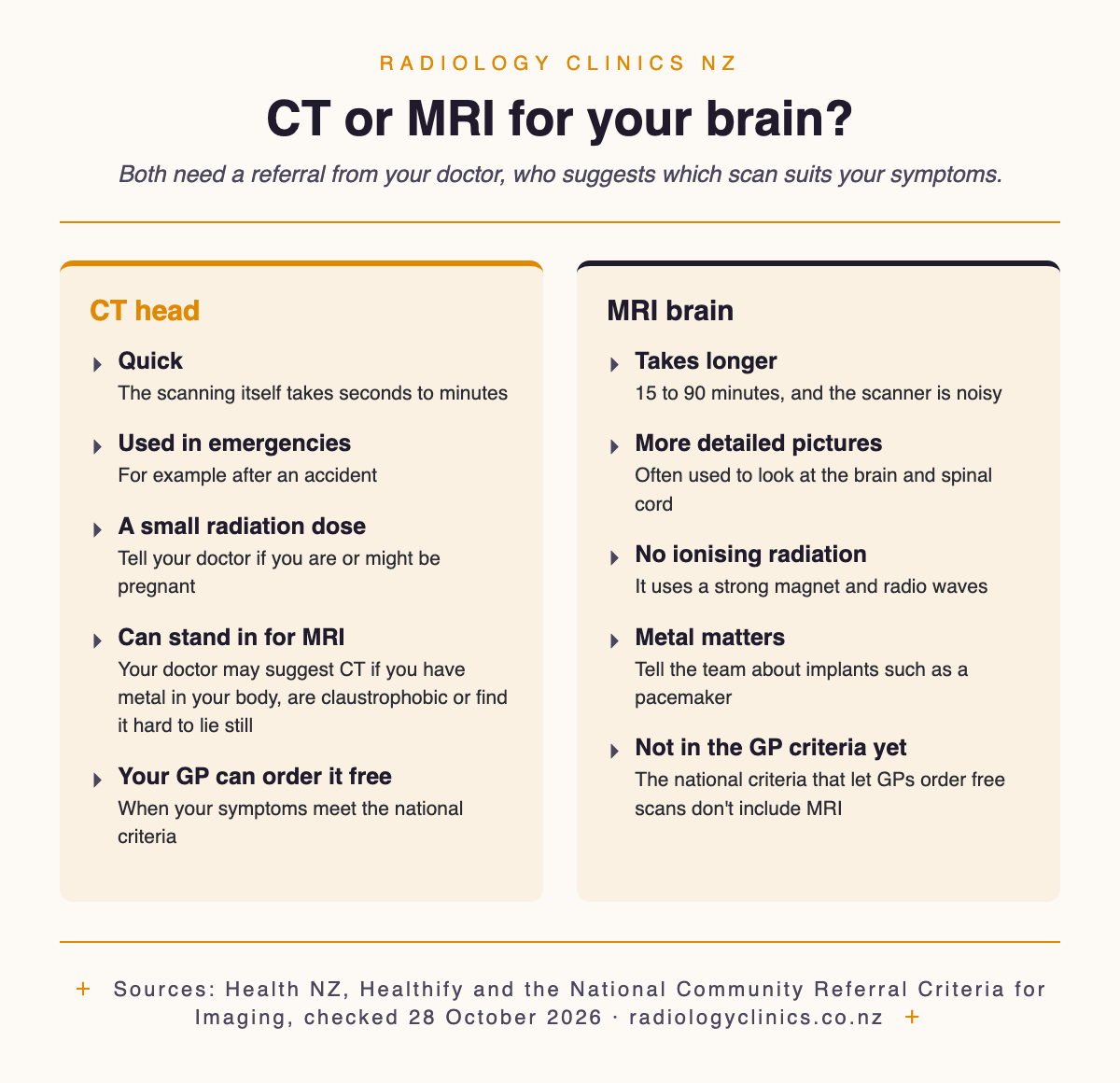
In my work as a radiologist, CT is the scan for the urgent question. It shows bleeding, a fracture or a large mass quickly. MRI is the detailed look, for problems that are subtle or have been building slowly. Neither is simply “better”. If you have metal in your body, are claustrophobic or find it hard to lie still, your doctor may suggest a CT instead. Our guide to having an MRI when you’re claustrophobic covers the other options.
My advice from the reporting side: the question on the referral shapes your scan, including whether the radiologist decides you need contrast. A referral that says “headaches changing over two months, on a blood thinner” gets a better-planned scan than one that says “headache ?cause”. If your symptoms have changed since you saw your doctor, tell your doctor before the scan.
Can your GP get you a free brain scan?
Yes, for a CT head, if your symptoms meet the national criteria. Since the National Community Referral Criteria for Imaging came in, GPs, urgent care doctors and nurse practitioners can refer you directly, without a specialist or the emergency department. Imaging that meets the criteria is free. For the brain, these are the main situations the CT head criteria fund.
The criteria also list situations that aren’t routinely funded, such as established dementia of more than two years with no unexpected change. They add that imaging may still be appropriate and you may choose to pay privately.
MRI is the gap. The current criteria cover X-ray, ultrasound and CT; MRI criteria are due in a later phase. So the national criteria don’t give your GP a free brain MRI to order. They are a minimum level of access, and local HealthPathways set how imaging works in each area, so ask your GP whether a funded MRI is possible where you live or whether a hospital specialist referral is the route. If you’d rather not wait, you can ask about a private referral.
For children aged 15 and under, the criteria use a separate children’s section. Our guide to children’s brain MRI covers that.
What a private brain scan costs
Two of the clinic websites listed here published brain-scan prices on 28 October 2026.
At River, the brain MRI costs about 2.3 times the CT head. My reading is that much of the gap is scanner time: CT scanning is over in minutes, while an MRI takes 15 to 90 minutes, depending on the part scanned. Contrast adds to the bill when it’s needed, and the radiologist decides whether you need it, so ask for the total both ways.
Other groups don’t publish these prices. I-MED asks you to phone or email, and Pacific Radiology, Allevia, Trinity MRI, Beyond and Canopy did not publish a brain-scan price on 28 October 2026. If you aren’t eligible for public healthcare, a public hospital charges too: Christchurch Hospital lists $2,349.39 for an MRI of the head and brain for non-eligible patients (fees valid from 1 February 2025, GST included). Our MRI cost guide and CT cost guide cover other body parts.
Where to get a brain MRI or CT
Our MRI clinic list groups clinics by region, with city pages for Auckland, Hamilton, Wellington and Christchurch. For a CT head, use the CT clinic list.
These are examples from our directory, each checked against the clinic’s own website.
You’ll still need a referral, because you can’t self-refer for an MRI. For a self-paid scan, a GP’s referral is enough at clinics such as Trinity MRI (“any doctor can refer you”) and River (“we accept all referrals”).
Ask when you book
✓ “Do you do brain MRI at this branch, and will you take my GP’s referral if I’m paying myself?”
✓ “What will the total be, including contrast if the radiologist decides I need it?”
Does ACC or insurance pay?
ACC. If the scan is needed because of an accident, ACC will usually pay, though you may have to pay for some of it. ACC pays for MRI and CT scans through its high-tech imaging contract, and most of these scans need ACC’s approval first. ACC lets some authorised GPs refer for MRI directly, but only for knee, lower back and neck injuries. The brain isn’t one of them, so an ACC brain MRI comes through another route, such as a specialist’s referral.
When ACC funds a scan under its high-tech imaging contract, the contract allows no extra charge to you unless you ask for, and agree to pay for, an appointment outside weekday business hours. River’s price list shows its brain MRI and CT head as fully funded, $0, under ACC’s high-tech contract. Our ACC imaging guide explains claims.
Health insurance. Check your policy before you book. Southern Cross’s Wellbeing policy, for example, covers an MRI only when a specialist in private practice refers you, and its imaging cover has other conditions too. Trinity MRI tells patients: “Any doctor can refer you for a scan, but insurance companies will only cover scans referred by a specialist.” A GP referral can still get you the scan. It may not get your insurer to pay.
After a knock to the head
Concussion doesn’t show on a scan. It causes no bleeding, bruising or swelling, so scanning your brain is not helpful to diagnose concussion. A normal scan doesn’t mean you’re unhurt, and you don’t need one to be diagnosed. You do need to be seen, by your GP, an urgent care clinic or the emergency department.
Go to the emergency department or call 111 if, after a head injury, someone is very sleepy or hard to wake, or has a warning sign such as a worsening headache, confusion, a seizure, slurred speech, vision problems, vomiting or passing out. Healthify lists the full set of warning signs. If you need a scan there, you don’t usually pay for a scan done at a public hospital.
Last updated October 2026
Sources
- riverradiology.co.nz: River Radiology Pricing | River Radiology Hamilton and Waikato | River Radiology
- aucklandxray.co.nz: Transparent Pricing: 89 Clear Scan Prices, No Surprises
- Healthify: Headache | Healthify
- Healthify: CT scan | Healthify
- Health New Zealand: MRI (magnetic resonance imaging)
- Health New Zealand: CT (computed tomography) scan
- Healthify: MRI scan | Healthify
- static.info.content.health.nz: National Community Referral Criteria for Imaging v2.0
- Health New Zealand: Community referred radiology service
- Health New Zealand: Scans and x-rays
- i-med.co.nz: Payment and fees | I-MED Radiology Network
- Health New Zealand: Paying for your care — Canterbury
- trinitymri.co.nz: Trinity MRI is now a Southern Cross Affiliated Provider · Defining excellence in brain, spine and vascular imaging · The only dedicated neuroimaging group in NZ.
- trinitymri.co.nz: Trinity MRI Patients Services | Auckland NZ
- riverradiology.co.nz: MRI Scans in Hamilton | Expert Radiology Services in Waikato | River Radiology
- absoluteradiology.co.nz: Frequently Asked Questions (FAQs) — Absolute Radiology
- pacificradiology.com: Our Clinics | Pacific Radiology Locations Across NZ
- ACC: High Tech Imaging Services — Operational Guidelines
- ACC: GP-referred MRI guidelines
- ACC: High Tech Imaging Services — Service Schedule
- southerncross.co.nz: Wellbeing policy document
- Healthify: Concussion | Healthify
- i-med.co.nz: MRI | I-MED Radiology Network
This article is general information, not personal medical advice. Ask your referrer which service is available, and ask the clinic whether public funding or ACC cover applies and what you will need to pay.

Author: Dr. Mark Bekhit
Dr Mark Bekhit (MBChB, FRANZCR) is a musculoskeletal radiologist practising in Brisbane and an AHPRA-registered specialist in diagnostic radiology (MED0002920947). He spends as much time building software as reading scans: he founded Imaging Finder (Australia) and Radiology Clinics NZ to make imaging easier to find, and builds radiology dictation and pain-tracking tools with one aim — better patient outcomes and a smoother reporting workflow. Outside the reading room he's usually training, bringing the same performance mindset to imaging.
Leave a Reply