If you have been hurt in an accident, someone has probably already told you “don’t worry, ACC covers everything.” Then a friend mentions the bill they got, and you stop being sure. Both can be true. ACC almost always pays for the imaging you need after an injury — but ACC-funded is not the same as free, and the type of scan quietly changes who can send you and how fast it happens.
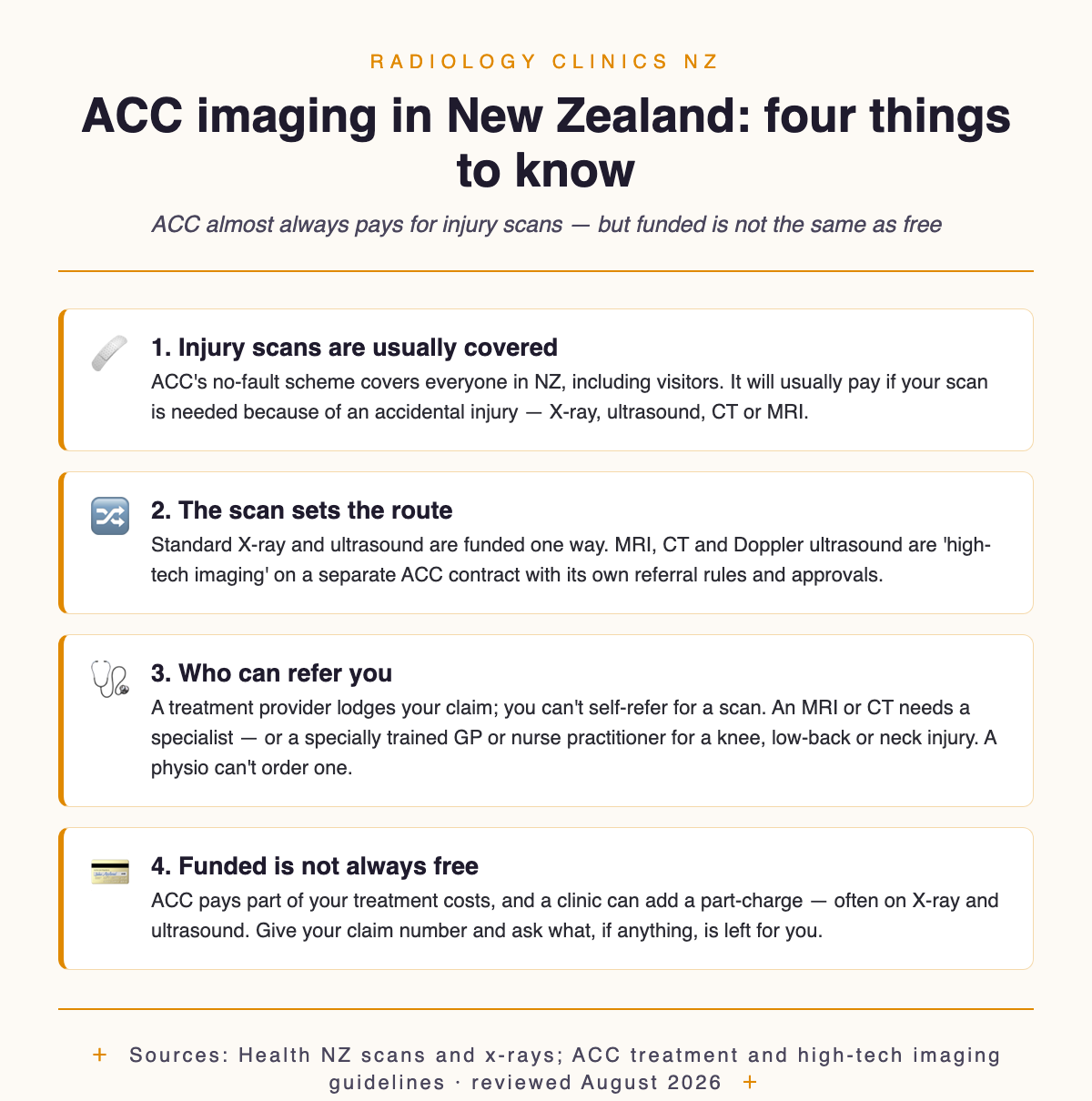
The short answer Yes — ACC will usually pay if your scan is needed because of an accidental injury, and its no-fault cover applies to everyone in New Zealand, including visitors. It can cover an X-ray, ultrasound, CT or MRI. But ACC pays part of your treatment costs, so a clinic can still add a part-charge, and you cannot refer yourself — a treatment provider does. Give the clinic your claim number and ask two things: do you bill ACC directly, and what, if anything, will I pay?
Does ACC pay for my scan?
For an injury, yes, in almost every case. ACC runs a no-fault scheme that covers everyone in New Zealand, including visitors, for injuries caused by an accident. If a scan is part of sorting out that injury, ACC will usually pay. In most cases, you won’t have to pay for care after an accident, and ACC can contribute to a wide range of costs beyond the scan — doctor’s visits, treatment from other health professionals, surgery and prescriptions.
The honest catch is in one word ACC uses about itself: it pays part of your treatment costs. Most of the time that still leaves you paying nothing at the clinic. But “covered” and “free” are not quite the same promise, and the gap between them is where the surprise bills live. The rest of this guide is about closing that gap before you book.
Which scans ACC covers — and its two routes
ACC funds all four common scans for an injury, but not through one door. Behind the scenes it uses two different routes, and knowing which one your scan is on explains a lot about how quickly it happens.
You do not need to memorise any of this — your provider handles the paperwork — but it is why an ACC X-ray can happen this afternoon while an ACC MRI takes a bit of organising. If your injury is not covered by ACC, the same scan runs on the ordinary funding routes instead: our guides to who qualifies for free imaging and public versus private radiology cover those, and how a referral is routed explains who sends you where.
Find a clinic and confirm ACC billing
No directory can tell you your exact part-charge — that is set clinic by clinic — so the useful move is to find a clinic that does your scan and ask it directly. Injury imaging usually starts with an X-ray or an ultrasound; if your injury needs more detail, you may go on to a CT or MRI. Each of those pages lists clinics across New Zealand, so you can open any listing for its location and contact details and call ahead.
As at 23 August 2026, current listings include Allevia Radiology in Auckland CBD (formerly Mercy), Pacific Radiology in Wellington, and Beyond Radiology in Christchurch. These are examples to show the geographic range, not a ranking or a full list — confirm each clinic does the scan your referral asks for, and check its ACC billing when you call.
Ask the clinic when you book
✓ “I have an ACC claim — do you bill ACC directly for this scan?”
✓ “Is there a part-charge or surcharge, and how much is it?”
✓ “Do you have my claim number and referral, or do you need them from me?”
✓ “Does this scan need ACC approval first, and if so, how long does that take?”
Who can refer you (and the physio myth)
You cannot refer yourself for a scan — a healthcare provider requests it. After an accident, the first step is simply to see a treatment provider: your doctor, a physiotherapist, an after-hours medical centre or the hospital emergency department. Whoever you see fills in the forms and lodges the ACC claim for you. That claim, and its number, is what turns a scan from a private bill into an ACC-funded one.
Here is where a common belief trips people up. For an ACC MRI, not just anyone can send you. It needs either a specialist, or a GP or nurse practitioner who has been specifically trained and authorised under ACC’s GP-referred MRI programme — and that direct route only applies to knee, lower-back and neck injuries that meet set clinical criteria. A physiotherapist, though, is not one of ACC’s referral pathways for high-tech imaging, so a physio cannot order an MRI for you. They are still a great first stop for assessment and for lodging your claim — they just cannot make the MRI referral itself. If your injury looks like it needs one, ask your physio or GP who will send you.
Why “ACC-funded” isn’t always free
This is the part worth slowing down on. ACC pays part of your treatment costs, and after that, you may need to pay the rest. For scans, that gap shows up as a part-charge or surcharge the clinic sets itself — in my experience most often on X-ray and ultrasound, which is exactly where clinics tend to list an ACC surcharge (as the examples below show). It is not a sign anything has gone wrong with your claim — it is simply how ACC funding works.
Good to know: Clinics say this openly. Beyond Radiology in Christchurch, for example, notes there “may be part charges on ACC covered X-ray and ultrasound scans” and asks you to check the surcharge with the practice; Allevia Radiology in Auckland lists a “minimal surcharge on X-rays funded by ACC.” The amount differs from clinic to clinic, which is exactly why the question — not the assumption — is what saves you money.
A public hospital is the place a scan is usually free, with no part-charge to you; for an injury, ACC funding can also cover a scan at a private or community clinic instead of the general public queue, though a part-charge may apply there. If ACC does not accept your claim, the scan becomes a private one you pay for — another reason to sort the claim out early. Private health insurance can sometimes help, but policies differ on what they cover, so check yours before booking rather than after.
When ACC has to approve the scan first
For everyday X-rays and ultrasounds, there is usually nothing extra to wait for. For higher-cost, high-tech imaging it can be different: under ACC’s high-tech imaging rules, most listed procedures need written prior approval before they go ahead, and ACC’s processing timeframes can vary. Your provider or the clinic handles that request — you do not lodge it yourself — but it is worth knowing about, because it is the usual reason an ACC MRI or a specialised procedure is not booked the moment you ask.
ACC also only funds treatment that is a generally accepted option for your condition and is provided by a registered, licensed New Zealand provider — which every clinic in the directory is. So the practical takeaway is simple: if a scan seems slow to arrange, ask whether it is waiting on ACC approval, and roughly how long that tends to take.
Common questions
Does ACC pay for an MRI or CT scan?
Yes, when the scan is needed for an injury ACC covers. MRI and CT are funded as high-tech imaging, which has its own referral rules and can need approval first, so it usually takes a little longer to arrange than an X-ray. If your scan is not injury-related, see our guides to MRI scan costs , CT scan costs and ultrasound costs on the other routes.
Do I need my ACC claim number to get a scan?
Yes — give it to the clinic when you book. Without it, a clinic may not be able to bill ACC and could treat the scan as private. The provider who lodged your claim can give you the number if you do not have it.
Can I use private health insurance instead of ACC?
For an accident injury, ACC is normally the first funder. Insurance may help with a part-charge or with care ACC does not cover, but policies differ, so confirm with your insurer before you book.
Is ACC imaging completely free?
Often, but not guaranteed. ACC pays part of your costs, and a clinic can add a part-charge, especially on X-ray and ultrasound. A public-hospital scan is the route that is usually free with no part-charge.
Sources
Health New Zealand — Scans and x-rays ·
ACC — What we cover ·
ACC — Treatment we pay for ·
ACC — What to do after an injury ·
ACC — High Tech Imaging Services Operational Guidelines ·
ACC — GP Referred MRI Operational Guidelines ·
Healthify — New Zealand health system.
Reviewed August 2026.
This article is general information, not personal medical advice. Ask your referrer which service is available, and ask the clinic whether public funding or ACC cover applies and what you will need to pay.

Author: Dr. Mark Bekhit
Dr Mark Bekhit (MBChB, FRANZCR) is a musculoskeletal radiologist practising in Brisbane and an AHPRA-registered specialist in diagnostic radiology (MED0002920947). He spends as much time building software as reading scans: he founded Imaging Finder (Australia) and Radiology Clinics NZ to make imaging easier to find, and builds radiology dictation and pain-tracking tools with one aim — better patient outcomes and a smoother reporting workflow. Outside the reading room he's usually training, bringing the same performance mindset to imaging.
Sources, method, and medical context
This article is published by Radiology Clinics NZ and reviewed for medical-adjacent accuracy by Dr. Mark Bekhit, radiologist. It is general information only and does not replace advice from your own doctor, referrer, clinic, insurer, ACC, or Health New Zealand service.
Official references
- Health New Zealand: scans and X-rays
- Health New Zealand: community-referred radiology service
- ACC: high-tech imaging services operational guidelines
- Radiology Clinics NZ: how the directory is built
Related directory pages
Radiology clinics directoryBrowse by scan typeBrowse by cityHow this directory is built
Last editorial review: 2026-06-30.
Leave a Reply