Short answer: Claustrophobia does not have to stop an MRI. Tell the clinic when you book, or your doctor when the scan is suggested. That call opens the real options: calming techniques, a sedative with someone to drive you home, and at some branches a scanner with a wider 70 cm opening. New Zealand clinics handle sedation differently. Some ask you to bring a tablet from your GP, and others give it themselves. If MRI is still not possible, your doctor may suggest a CT scan instead. Checked 27 September 2026.
On this page
What actually helps?
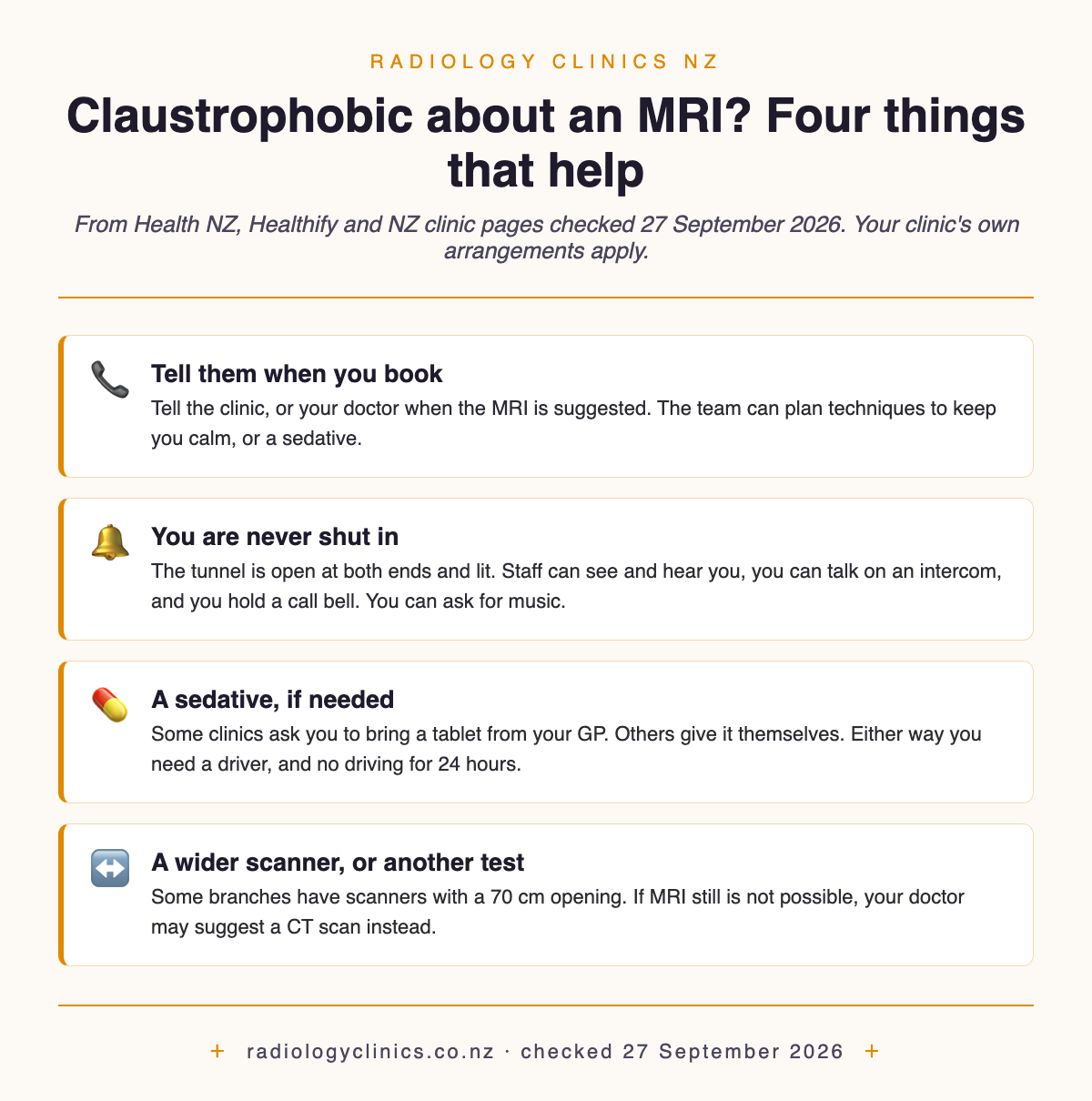
Start with the call. If you dread enclosed spaces, tell your doctor when the MRI is suggested, or the radiology service when the appointment letter arrives. You are not being difficult. MRI technologists are trained to help you through the scan, and a warning lets them plan the appointment around you instead of meeting your panic at the door.
It also helps to know what you are walking into. You lie on a table that slides into an open-ended tunnel with lights and sometimes a mirror. It is noisy, so you get earplugs and headphones, and the option of music. The person doing the scan can see and hear you the whole time, you can talk to them on an intercom, and you hold a call bell for when the machine is too loud to talk over.
In other words, you are never locked in.
Two details are worth asking about when you book:
- How long, and which way in. An MRI takes 15 to 90 minutes, depending on the body part. Auckland Radiology Group’s page notes that you go in head first or feet first depending on the area being scanned. Knowing both beforehand takes some of the dread out of it.
- A look first. You can ask to see the scanner before your scan. Absolute Radiology in New Plymouth offers a look at its machine, and the Centre for Advanced MRI (CAMRI) in Auckland has a mock scanner, an empty MRI shell, for a practice run.
How does sedation work for an MRI in NZ?
If techniques are not enough, you may be offered medicine to help you relax. It is arranged when you book, you arrive earlier, and you need a support person to drive you home.
What the national pages do not say is that clinics do this in different ways. We read the MRI pages of the clinics in the table below side by side. Where a page says who provides the sedative, there are two approaches. In one, you get a tablet from your own GP and bring it with you, not yet taken. In the other, the clinic gives the sedative itself. Neither is wrong. They just need different preparation, and the wrong assumption can derail the day.
So the useful question is not “can I have a sedative?” It is “how do you do sedation?” If the answer is a GP tablet, see your GP well before the scan, not the morning of it.
After a sedative, plan on losing the next 24 hours. A sedative can make you forgetful and impair your judgement and reflexes, even if you feel alert. For 24 hours you must not drive, operate machinery, drink alcohol, sign legal documents or ride public transport alone.
Plan the lift home, and who stays with you, when you book.
Where can I find a wide-bore MRI scanner?
The bore is the opening you lie in. Where a New Zealand clinic page we read gives a size, the wide-bore scanner has a 70 cm opening, and Beyond Radiology says that large bore helps reduce claustrophobia. My view as a radiologist: the extra room helps, but it is still a tunnel. Treat it as one tool alongside the call, the music and, if needed, a sedative.
And if you were hoping for a fully open or upright MRI: none of the New Zealand clinic pages we read on 27 September 2026 describes one at a named branch. Several use “open” to mean a tunnel that is open at both ends.
These are examples from our directory where the clinic’s own current page describes a wide-bore scanner. They are not a ranking or a complete list, and a group can have more than one kind of scanner.
For everywhere else, start from our MRI clinics page, which lists clinics by region. Two Auckland examples that describe their own sedation arrangements are Trinity MRI and SRG Greenlane. You still need a referral for an MRI, public or private (our referral guide explains who can write one), and if you are paying yourself, our MRI cost guide covers the funded routes and what a private scan costs.
Ask the clinic when you book
✓ “I’m claustrophobic. Which scanner will I be on, and is it the wide-bore one?”
✓ “How do you do sedation: do I bring a tablet from my GP, or do you give it?”
✓ “About how long will my scan take, and do I go in head first or feet first?”
✓ “Can I see the scanner before the day?”
What if I still can’t have the MRI?
Sometimes the answer is a different test. Your doctor may suggest a CT scan instead if you are claustrophobic. A CT scan is much quicker.
But it is not a like-for-like swap. MRI uses no ionising radiation (the kind of radiation X-rays use), and CT does. MRI is often used for the brain and spinal cord, and it is good at showing soft-tissue injuries in joints. Whether a CT answers your question is a clinical call for the doctor who referred you, not a comfort choice to make at the front desk. If CT is the plan, our CT cost guide covers the free and paid routes.
For people who cannot manage even with sedation, one Auckland clinic describes a further option. CAMRI describes itself as one of the few private MRI facilities in New Zealand equipped for general anaesthesia. That is a bigger undertaking, and one to discuss with your referrer.
Children are a different conversation, with their own sedation and anaesthetic routes. Our guide to a child’s MRI covers them.
So make the call early. It is the one step that shapes everything else on the day.
Sources and review
Reviewed 27 September 2026 by Dr Mark Bekhit, radiologist, against the Health NZ MRI page, Healthify’s MRI page and the current MRI pages of Astra Radiology, Beyond Radiology, CAMRI (and its Healthpoint profile), Absolute Radiology, Auckland Radiology Group, Pacific Radiology, Bay Radiology, Trinity MRI and SRG MRI. A clinic’s page describes that clinic on the review date, not the country. The directory listings were checked live the same day.
This article is general information, not personal medical advice. Ask your referrer which service is available, and ask the clinic whether public funding or ACC cover applies and what you will need to pay.
Last updated September 2026

Author: Dr. Mark Bekhit
Dr Mark Bekhit (MBChB, FRANZCR) is a musculoskeletal radiologist practising in Brisbane and an AHPRA-registered specialist in diagnostic radiology (MED0002920947). He spends as much time building software as reading scans: he founded Imaging Finder (Australia) and Radiology Clinics NZ to make imaging easier to find, and builds radiology dictation and pain-tracking tools with one aim — better patient outcomes and a smoother reporting workflow. Outside the reading room he's usually training, bringing the same performance mindset to imaging.
Sources, method, and medical context
This article is published by Radiology Clinics NZ and reviewed for medical-adjacent accuracy by Dr. Mark Bekhit, radiologist. It is general information only and does not replace advice from your own doctor, referrer, clinic, insurer, or Health New Zealand service.
Official references
- Health New Zealand: scans and X-rays
- Health New Zealand: community-referred radiology service
- Radiology Clinics NZ: how the directory is built
Related directory pages
Radiology clinics directoryMRI clinicsBrowse by cityHow this directory is built
Last editorial review: 2026-06-30.
Leave a Reply