Short answer: An OPG is a single panoramic X-ray of all your teeth and both jaws. A cone-beam CT is a 3D scan of the jaws with a much bigger radiation dose, so it is kept for questions a flat picture cannot answer. Your dentist or specialist decides which you need and refers you. Adults usually pay: on 21 October 2026 the practices we checked listed $80 to $170 for a panoramic X-ray and $165 to $450 for a cone-beam CT. Under-18s get basic dental care free, including X-rays to find decay, but not orthodontic work.
On this page
OPG or cone-beam CT: what is the difference?
An OPG (orthopantomogram, also called a panoramic or Panorex X-ray) is one wide picture of your upper and lower jaws, from ear to ear. It shows how many teeth you have and where they are, including teeth that have not come through yet. It is not the small bitewing X-ray your dentist takes of your back teeth to look for decay. In fact an OPG is less accurate for decay.
You stand in the machine with your chin on a rest and bite on a sterile mouthpiece. The arm swings around your head. Pacific Radiology puts the actual scanning time at 15 to 20 seconds.
A cone-beam CT (often shortened to CBCT) is a 3D X-ray of the teeth, bones and soft tissues. Your dentist can then look at the jaw in three dimensions rather than as one flattened picture. The classic reasons are planning a dental implant and checking whether a wisdom tooth’s roots are near the nerve before it comes out.
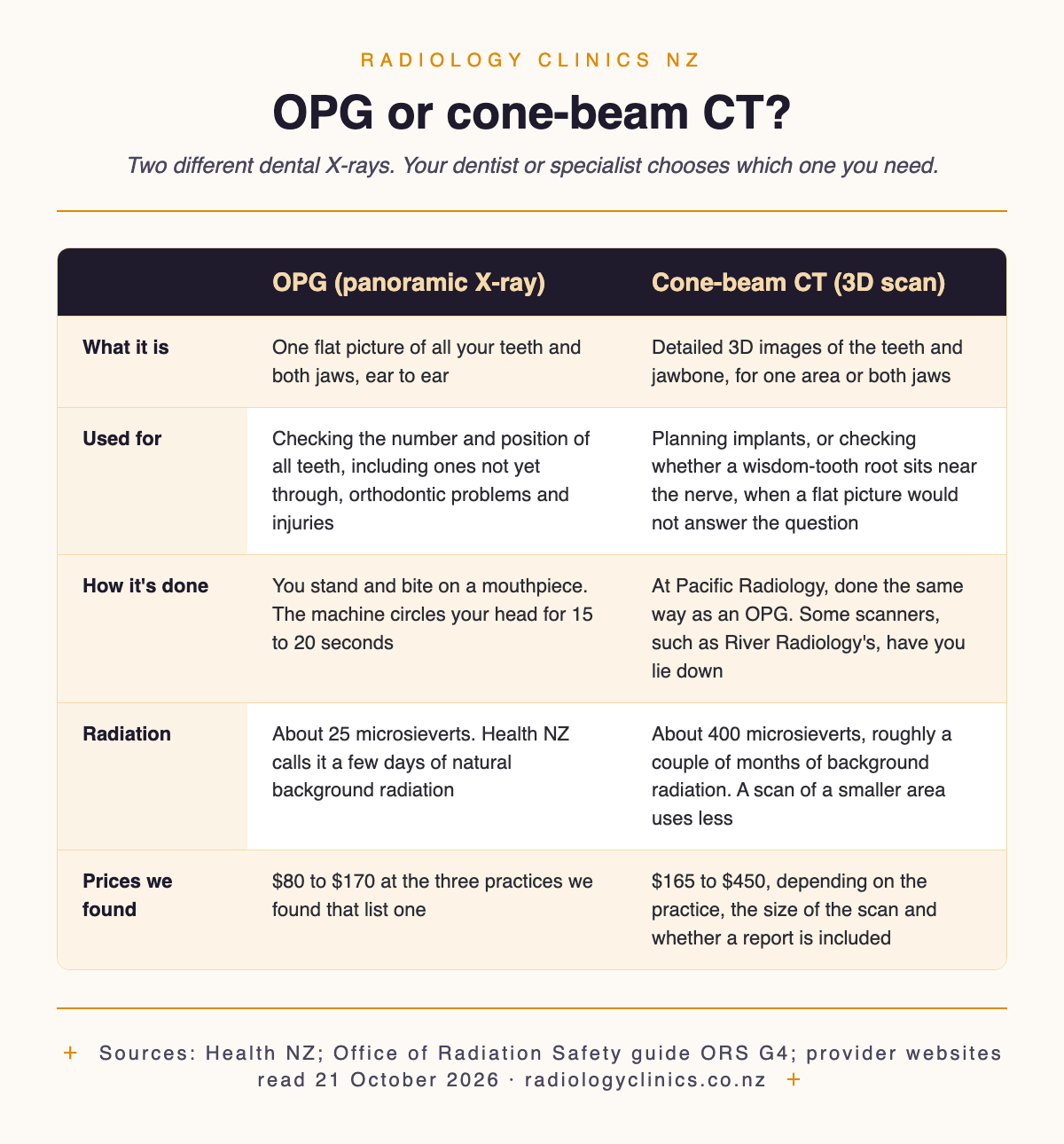
The difference that matters most is radiation. New Zealand’s radiation-safety guidance puts a panoramic X-ray at about 25 microsieverts and a dental cone-beam CT at about 400. A microsievert is a tiny unit of radiation dose. For scale, everyone gets about 2,000 a year from natural background radiation. An OPG is a few days’ worth. A cone-beam CT is roughly a couple of months’ worth, so on these figures about 16 times an OPG. The exact dose depends on how much of the jaw is scanned, and scans should cover only the area in question. To my mind both are small doses. The guidance is blunt: if the 3D scan would not change your treatment, the extra dose is not justified.
As a radiologist, I would put it this way. A cone-beam CT is not a better OPG. It is a different test for a narrower question. If your dentist asks for an OPG and not the 3D scan, that is usually the right call, not a corner being cut.
Who refers you, and where do you go?
Your dentist, orthodontist or dental specialist requests the X-ray. Under the national code for dental X-rays such as OPGs, an exposure needs a request with the clinical reason, and your dentist or specialist must judge it justified. You also have to be told the expected benefits and the risks. Cone-beam CT comes under a separate radiation code, and the same test of justification applies. You cannot simply book one for yourself at a radiology clinic.
Some dental services take an OPG in their own rooms. Health NZ’s Bee Healthy service does for children, and specialist practices such as Henderson Periodontics list one on their fees. So you may never leave the building. A cone-beam CT is a different matter. It is not a drop-in replacement for a panoramic machine and usually needs its own shielded room. Plenty of dentists send you elsewhere for one. That usually means one of three places:
- A radiology clinic. Pacific Radiology does OPGs, cephalometric X-rays (a side-on X-ray of the head), dental cone-beam CT and Dentascan (a dental scan on a full-size CT scanner, about 10 minutes lying down) in Christchurch. Its radiologists interpret the images and send the report to your dentist. In Hamilton, River Radiology has a cone-beam scanner that images the face, sinuses and teeth. You lie down on a table for it.
- An oral and maxillofacial surgery practice that takes scan-only referrals. Examples are OMS Specialists in Auckland, Anglesea OMS in Hamilton and Tauranga OMS. Tauranga OMS sends the scan back to your dentist with a written report from one of its surgeons.
- A specialist or dental practice with its own scanner. In Nelson, for example, dentists and specialists send patients to Nelson Orthodontics for a cone-beam CT.
Dental imaging clinics in our directory
Our dental imaging page maps the radiology clinics in our directory that list dental imaging. Most of them are in Christchurch, so start with our Christchurch dental imaging page if you live there. Dental and oral surgery practices are not in the directory. Your dentist will know where they send patients.
We checked these listings against each clinic’s own website on 21 October 2026:
- Pacific Radiology Forte, Peterborough Street, Christchurch Central, and Pacific Radiology St George’s, Leinster Road. Pacific’s own clinic finder lists both dental imaging and cone-beam CT at each.
- Pacific Radiology Metro, Addington, and Pacific Radiology After Hours, Madras Street. Both have cone-beam CT, but Pacific’s clinic finder does not list them for dental imaging; Metro’s scanner is described as ideal for sports and injury imaging. Pacific’s four cone-beam sites each offer slightly different scans, and its booking team chooses the right one.
- River Radiology Hood Street, Hamilton, the River branch our directory lists for CT. River does not say on its website which branch has the cone-beam scanner. See all four River branches on its group page.
What does a dental X-ray or cone-beam CT cost?
Few of the places we checked publish a price. These are the ones that do, read from each provider’s own page on 21 October 2026. They are examples, not a full list, and prices change. *Henderson’s list says its prices were current at 21 July 2025.
Three things move the price. The first is size: one area costs less than both jaws, which is why Fendalton’s range runs from $195 to $300. The second is where you go. An oral surgery practice may only do the scan as part of a consultation. The third, and the one patients rarely ask about, is whether anyone writes a report.
At River, that is the gap between $197 and $300. At Anglesea, your dentist has to read the scan themselves. OMS Specialists says plainly that it does not interpret or report its scans. That is not necessarily wrong. Your dentist may be well placed to answer the question they asked. But a cone-beam scan usually shows more than the tooth in question. Depending on the size of the scan, it can include the sinuses and the jaw joints. The whole field of view needs to be reported on, and some areas may need a radiologist. With a cheaper unreported scan, the person looking at the whole thing is your dentist.
Does anyone else pay?
For most adults, no. Once you are over 18, you pay for most of your dental care privately, and there is no set fee for private dentists. These are the exceptions:
- Children and teenagers. Basic dental care is publicly funded until the 18th birthday. That includes X-rays used to find tooth decay. Orthodontic treatment, including braces, is not included. X-rays taken by a private orthodontist to plan braces are part of a treatment you pay for. Teenagers get free care through contracted dentists. If your family dentist is not one of them, the care may not be free.
- An accident. If your teeth are damaged in an accident, ACC usually pays a contribution, and you pay the rest. Wear and tear, decay and gum disease are not covered. The dentist registers the injury with ACC for you. Henderson Periodontics, for example, lists an ACC shortfall of $60 for an OPG. Our ACC imaging guide explains how part-charges work.
- Health insurance. Pacific Radiology in Canterbury is a Southern Cross affiliated provider. NSOMS lists cone-beam CT and panoramic X-ray among its Southern Cross affiliated items. Whether your plan includes dental X-rays is set by your policy, not by the provider’s affiliation.
- Low income. Work and Income can pay up to $1,000 a year towards immediate and essential dental treatment, such as extractions or treating an infection. You do not need to be on a benefit, but income and asset limits apply. Its list of treatments does not mention X-rays.
Public dental services rarely help with these X-rays. Hospital dental care is mainly for people referred because of a disability or a medical condition such as mouth cancer. Community Services Card holders may be able to get emergency dental care, such as pain relief or extractions, but Auckland’s hospital service, for example, does not provide routine X-rays. And don’t expect your GP to get you a free OPG through the community radiology scheme: dental X-rays are not among its national referral criteria.
Radiation, children and pregnancy
Radiation-safety rules give children extra protection. Justifying each X-ray is particularly important for children, and panoramic machines must have a child-imaging mode. For a cone-beam CT, Pacific Radiology asks children to stay completely still and not swallow for at least 25 seconds, and suggests practising at home first. A parent or guardian is welcome to stay in the room, wearing a lead apron.
If you are or might be pregnant, tell the radiographer or the dental team before the X-ray. The dose that reaches a baby from small dental X-rays is tiny: for a pair of bitewings, it is equivalent to several hours of background radiation. A cone-beam CT is a bigger dose, and the case for it should be weighed with particular care in pregnancy. Palmerston North Endodontics, for example, says it generally avoids cone-beam scans in the first trimester.
Good to know: do not be surprised if no one puts a lead apron on you for an OPG. Aprons and thyroid collars are not recommended for panoramic X-rays, because they can block the picture.
Before you book
Ask when you book
✓ “My dentist has asked for an OPG [or a cone-beam CT of …]. Which branch does that scan?”
✓ “Does the cone-beam CT cover one area, one jaw or both?”
✓ “Does the price include a report, and who writes it?”
✓ “How will the images get to my dentist?”
Bring the referral. Take off earrings, piercings, hair clips and any denture or plate, as metal can interfere with the images. For prices on other scans, see our X-ray cost guide and which NZ radiology clinics publish price lists.
Sources and review
Reviewed 21 October 2026. Funding and safety: Health NZ (dentists, OPG X-ray, children’s and teenagers’ dental care, Auckland hospital dentistry, X-rays, National Community Referral Criteria for Imaging v2.0); Office of Radiation Safety Code of Practice for Dental Radiology ORS C4 and compliance guide ORS G4; Healthify (dental trauma, wisdom teeth); Work and Income. Services and prices: the websites of Pacific Radiology, River Radiology, Anglesea OMS, NSOMS (Healthpoint), Fendalton Dental, Henderson Periodontics, OMS Specialists, Tauranga OMS, Nelson Orthodontics and Palmerston North Endodontics. The 16-times figure is our arithmetic from the guide’s dose figures (400 divided by 25). Prices are each provider’s own figures and can change.
This article is general information, not personal medical advice. Ask your referrer which service is available, and ask the clinic whether public funding or ACC cover applies and what you will need to pay.
Last updated October 2026

Author: Dr. Mark Bekhit
Dr Mark Bekhit (MBChB, FRANZCR) is a musculoskeletal radiologist practising in Brisbane and an AHPRA-registered specialist in diagnostic radiology (MED0002920947). He spends as much time building software as reading scans: he founded Imaging Finder (Australia) and Radiology Clinics NZ to make imaging easier to find, and builds radiology dictation and pain-tracking tools with one aim — better patient outcomes and a smoother reporting workflow. Outside the reading room he's usually training, bringing the same performance mindset to imaging.
Sources, method, and medical context
This article is published by Radiology Clinics NZ and reviewed for medical-adjacent accuracy by Dr. Mark Bekhit, radiologist. It is general information only and does not replace advice from your own doctor, referrer, clinic, insurer, or Health New Zealand service.
Official references
- Health New Zealand: scans and X-rays
- Health New Zealand: community-referred radiology service
- Radiology Clinics NZ: how the directory is built
Related directory pages
Radiology clinics directoryCT Scan clinicsX-ray clinicsBrowse by cityHow this directory is built
Last editorial review: 2026-06-30.
Leave a Reply