
Short answer: On 25 October 2026, the four New Zealand clinics listed here that publish a price charged $370 to $500 for an ultrasound-guided cortisone injection if you have no injury claim, and listed $40 to $120 once ACC has accepted your claim. At a clinic that bills ACC’s high-tech imaging contract, a specialist’s referral for a covered injury can mean you pay nothing. You need a referral. Your GP’s free community referral doesn’t include guided injections, but a public hospital specialist may be able to arrange one.
On this page
What a guided cortisone injection costs
A guided cortisone injection is a steroid and a local anaesthetic placed by a radiologist while they watch the needle on ultrasound or X-ray. The four clinics below publish what they charge for the ultrasound version.
The figures are not on quite the same footing. Only Auckland X-Ray Services says its prices include GST and gives a date (September 2026). The ACC column assumes ACC has already accepted your injury claim.
Many clinics that do these injections publish no price. Pacific Radiology, Bay Radiology, Beyond Radiology, Horizon Radiology, SRG, Allevia and MSK Medical Imaging list or describe guided injections on their websites without a fee, and I-MED asks you to phone or email for a quote. At River, a CT-guided injection is listed at $1,495. For scan prices, see what an ultrasound costs in NZ and which clinics publish price lists.
Who pays: you, ACC or the public system
Two questions decide it. Is this an injury ACC has accepted? And who wrote your referral?
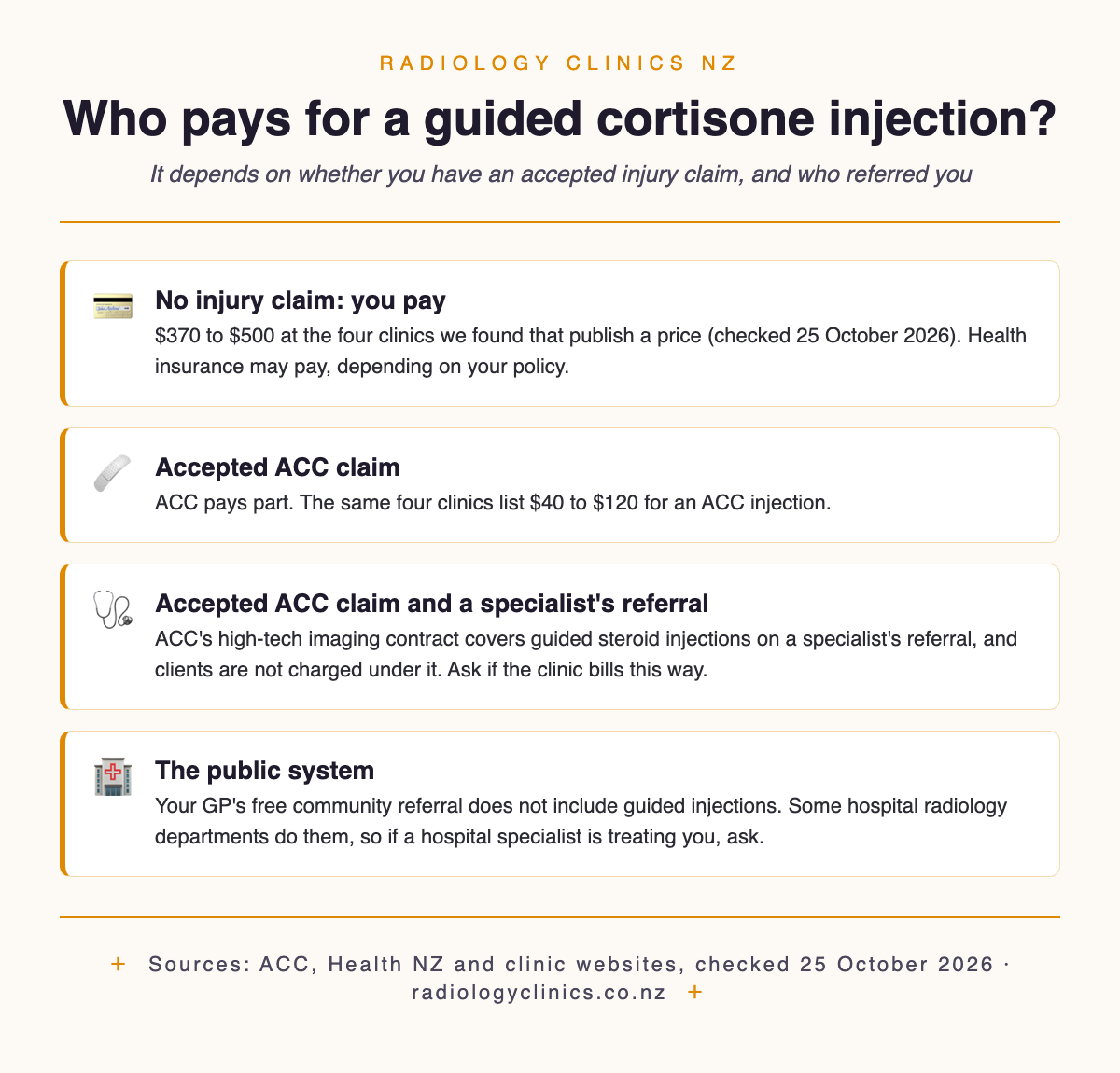
No injury claim. You pay the clinic’s private price. Health insurance may pay, depending on your policy; Auckland X-Ray Services, for example, handles pre-approval with Southern Cross and nib.
An accepted ACC claim. ACC pays part of your treatment costs, and you may pay part too. At the four clinics above, your share is the ACC column. Take your claim number to the appointment. Our guide to ACC and imaging explains claims and part-charges.
An accepted ACC claim and a specialist’s referral. ACC’s high-tech imaging contract covers steroid or local anaesthetic injections into a joint or the area around it under imaging for a covered injury, and these must be specialist referred.
The contract states that no client will be charged for its services, and it allows two procedures before prior approval is required from ACC. River’s price list shows what that looks like for its CT-guided injection: $1,495 privately, $0 under ACC’s high-tech contract. All four price lists above show a charge for an ACC ultrasound injection; the checklist further down has the question to put to the clinic. ACC also does not fund the guided injection when it is part of a treatment ACC does not pay for, such as platelet-rich plasma (PRP) or hydrodilatation.
The public system. Some public hospital radiology departments do these injections too; Health NZ’s Wellington radiology service, for example, publishes patient information for joint injections and CT-guided spinal injections. If a public hospital specialist is treating you, ask whether the hospital can do it. The free community route through your GP does not cover it. Health NZ’s community referral criteria for imaging have no category for guided injections, and say there is “no routine direct access to publicly funded (non-ACC) shoulder or other musculoskeletal ultrasound”. For tendon pain, tennis elbow, plantar fasciitis and pain over the outer hip, the criteria say community imaging is not routinely funded, that imaging may still be appropriate, and that you may wish to consider paying privately.
The same criteria say a scan is not a pre-requisite for a trial of steroid injection when a full clinical assessment has been done and red flags excluded. My reading as a radiologist: the public system expects many cortisone injections to be given in your GP’s or specialist’s rooms, without imaging.
Where to get one
Start with our interventional radiology clinic list, which shows clinics with confirmed and likely interventional services. City pages narrow it down for Auckland, Hamilton, Christchurch and Tauranga.
These directory examples listed steroid or cortisone injections on their own websites on 25 October 2026.
Group pages don’t always say which branch does the injecting.
Ask when you book
✓ “Do you do ultrasound-guided cortisone injections at this branch?”
✓ “My ACC claim is accepted. What will I pay, and does a specialist’s referral change that?”
✓ “If I haven’t had a scan of this area, will you scan it first in the same appointment?”
Do you need a referral, and why the ultrasound?
Yes, you need a referral. You cannot self-refer for an ultrasound, and Advance Ultrasound says a signed referral is legally required. Who can refer you depends on the clinic. Auckland X-Ray Services takes a referral from your GP, specialist or physio. Bay Radiology lists a GP, specialist, physiotherapist, osteopath or chiropractor. At Wellington Imaging, a radiologist reviews your referral, imaging and history before you can book. Our guide to who can refer you for a scan covers the wider rules.
The ultrasound lets the radiologist watch the needle reach its target, so the specialist can be sure they are in exactly the right part of your body. For a joint injection, accuracy matters: the data sheet for Depo-Medrol, a steroid used for joint injections, says treatment failures are most often from failing to enter the joint space.
My view: guidance earns its cost when the target is deep or small, such as the hip joint, a particular bursa or a tendon sheath at the wrist. Plenty of injections don’t need it, which is why GPs, sports doctors and orthopaedic surgeons give them too. The part I value most is the look before the needle goes in, because the scan sometimes shows the problem is not quite what the referral describes. Pacific Radiology’s radiologist may do a preliminary ultrasound if you haven’t had one, and Auckland X-Ray Services can do the scan and injection in one appointment.
What happens on the day, and afterwards?
Keep taking your usual medicines unless your doctor tells you otherwise. If you take a blood thinner such as warfarin, tell the clinic when you book, and don’t stop or change the dose without talking to your doctor and the clinic. Mention diabetes too, tell them if you are pregnant or breastfeeding, and bring earlier scans of the area if you have them.
Clinics give different advice about time, driving and rest, so follow your own clinic’s instructions.
The local anaesthetic works straight away and lasts three to four hours, while the steroid may take a few days to work. A brief flare of pain in the first day is normal, and it usually settles within 24 hours. Unless your clinic says otherwise, rest the joint for about two days and avoid stressing it for about a week.
If you have diabetes, your blood sugar may rise for a few days, so check it closely. Your face may flush for a day or so.
See a doctor straight away if the injected area is severely painful for more than 48 hours, or the joint becomes hotter and more painful, especially if you feel unwell. A joint infection after an injection is very uncommon but serious.
What cortisone can and cannot do
A steroid injection may ease pain for a few months but usually doesn’t cure the problem, and some studies suggest it may even prolong it. I think of it as a window: a stretch of less pain in which the physiotherapy or rehab can do its work. Auckland X-Ray Services puts the aim as settling “inflammation enough for rehab to progress”.
There are limits. Have no more than three or four a year in one joint, at least six weeks apart and ideally three months. Large tendons such as the Achilles are rarely injected, because steroid can weaken a tendon and raise the risk of it rupturing. An injection near the skin can leave a pale, dimpled patch that fades over a year or so.
Last updated October 2026
Sources
- aucklandxray.co.nz: Transparent Pricing: 89 Clear Scan Prices, No Surprises
- wellingtonimaging.co.nz: Ultrasound Guided Injections Wellington | Wellington Imaging
- riverradiology.co.nz: River Radiology Pricing | River Radiology Hamilton and Waikato | River Radiology
- advanceultrasound.co.nz: Cortisone injection
- i-med.co.nz: Image guided injections | I-MED Radiology Network
- aucklandxray.co.nz: Guided Injection Auckland: Effective Relief in 30 Min | AXIS
- ACC: Treatment we pay for
- ACC: High Tech Imaging Services — Operational Guidelines
- ACC: High Tech Imaging Services — Service Schedule
- Health New Zealand: Radiology — Wellington, Hutt and Kāpiti
- static.info.content.health.nz: National Community Referral Criteria for Imaging v2.0
- horizonradiology.co.nz: Radiology Services | Horizon Radiology
- riverradiology.co.nz: Specialist Injections in Hamilton and Waikato | River Radiology
- bayradiology.co.nz: MSK Injections | Joint Pain Relief | Bay Radiology
- pacificradiology.com: MSK Injections | Joint Pain Relief | Pacific Radiology
- beyondradiology.co.nz: Intervention Radiology | Beyond Radiology
- mskmedicalimaging.nz: Ultrasound and X-ray scans — MSK Medical Imaging
- Health New Zealand: Ultrasound
- Advance Ultrasound: Frequently Asked Questions
- bayradiology.co.nz: Bay NZ | Expert Medical Imaging Services
- Medsafe: Depo-Medrol data sheet
- Health New Zealand: Steroid injections
- srgmri.co.nz: Steroid Injections | SRG MRI | Greenlane | Manukau
- Healthify: Cortisone injections | Healthify
- ACC: ACC1521 Radiologists costs v2.pdf
- ACC: ACC8339 Radiology position statement.pdf
- alleviaradiology.co.nz: Ultrasound Scans | Allevia Radiology Auckland
This article is general information, not personal medical advice. Ask your referrer which service is available, and ask the clinic whether public funding or ACC cover applies and what you will need to pay.

Author: Dr. Mark Bekhit
Dr Mark Bekhit (MBChB, FRANZCR) is a musculoskeletal radiologist practising in Brisbane and an AHPRA-registered specialist in diagnostic radiology (MED0002920947). He spends as much time building software as reading scans: he founded Imaging Finder (Australia) and Radiology Clinics NZ to make imaging easier to find, and builds radiology dictation and pain-tracking tools with one aim — better patient outcomes and a smoother reporting workflow. Outside the reading room he's usually training, bringing the same performance mindset to imaging.
Leave a Reply