Short answer: No for a CT, MRI or ultrasound. You cannot self-refer, public or private, and even the most open private clinic we checked asks for a referral. Paying changes nothing; a GP can sign the referral, and often a physio for X-ray or ultrasound. X-ray needs one too, then most clinics we checked let you walk in. You can book two scans yourself: a screening mammogram (free at 45 to 69, or 70 to 74 by birth date; privately from 40) and, at some clinics, a DEXA bone scan. Checked 20 September 2026.
On this page
Can you get a CT, MRI or ultrasound without a referral?
No, and the answer is the same on both sides of the public-private line. The Health NZ pages for CT, MRI and ultrasound each carry the same two sentences: you will need to be referred by your healthcare provider, and you cannot self-refer. The scan can be done publicly or privately, but the request comes first either way.
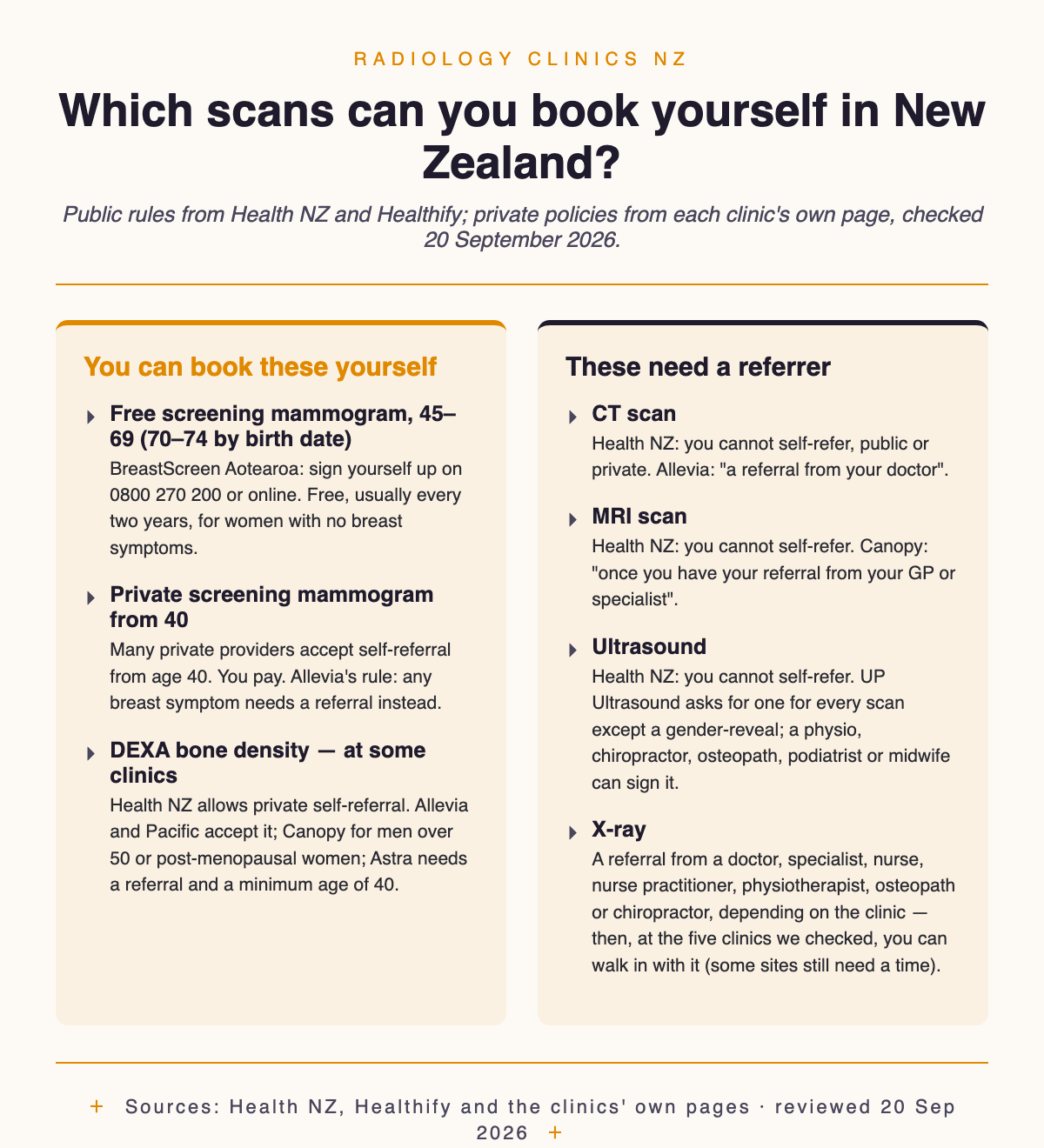
People sometimes read that as a public-system rule that money gets around. It is not. UP Ultrasound in Auckland takes walk-ins and referrals from physios and midwives, and still asks for a referral for every scan except a gender-reveal. The good news inside the “no”: to book and pay privately, a GP referral is enough. Allevia asks for a referral from your doctor for a CT, and Canopy books an MRI once you have your referral from your GP or specialist. ACC is a separate question: Allevia’s ACC CT and ACC MRI are specialist-referred only.
Once the request exists, the CT and MRI cost guides explain which door makes it free and what a private one costs, and the CT clinic list and MRI clinic list show where to take it.
Which scans can you book yourself?
Two, and both are screening tests for people with no symptoms.
A screening mammogram. BreastScreen Aotearoa invites you when you are due once you are signed up. Eligible women aged 45 to 69 get a free mammogram, for most women every two years, and women aged 70 to 74 qualify depending on their birth date. If you are in the age range and have not been invited, you sign yourself up on 0800 270 200 or through the online form. The programme is for women who have no symptoms of breast cancer; the BreastScreen locations page lists where it runs. Under 45, many private providers accept a self-referral for a screening mammogram from age 40, and you pay for it; routine mammograms are not recommended under 40 unless you are high risk. Allevia, for example, usually takes a private screening booking over 40 without a referral, but any symptom needs one. A lump, discharge or skin change is a different pathway, which the breast lump guide walks through.
A DEXA bone density scan, at some clinics. Publicly, you need a referral and cannot self-refer. Privately, you can be referred and pay, or self-refer. Then the clinics diverge, and this is the part Health NZ cannot tell you:
Whether you need the scan at all, and what a T-score changes, is covered in the bone density guide.
One wish that does not make the list: a pregnancy scan. Onsite Ultrasound needs a midwife or GP referral for every pregnancy scan, and a gender-reveal, the one exception in the scan table in the first section, is not a diagnostic scan. Your midwife or GP is the referrer; the pregnancy scan guide sets out which scans and when.
Who can refer you if you don’t want to see a GP?
For an injury X-ray or ultrasound, a physiotherapist can often sign the request. Health NZ says so for X-ray: physiotherapists and some other providers may be able to refer you under ACC cover or if you pay privately, and the scan table in the first section shows which other referrers each clinic takes. If you already see a physio for the injury, that is often the faster door. Whether ACC then pays is a claim question: the ACC imaging guide answers it, and the injury X-ray guide covers where to go today.
For a free scan through the community route, only three signatures count. The national criteria limit eligible referrers to GPs, urgent care doctors and nurse practitioners for CT, ultrasound and X-ray, and the scan is free when the request meets the criteria. A physio referral sits outside that route, and so do ACC-covered injuries and screening programmes; MRI, breast imaging and DEXA are promised in a part 2. Who qualifies for free imaging has the detail.
For an ACC MRI, your GP may be able to refer, on one defined pathway. Authorised GPs and nurse practitioners can refer selected ACC-covered knee, lumbar spine and cervical spine injuries for MRI; this does not apply to every GP or every MRI. That guideline was last read at source on 6 September 2026.
Once you hold a referral, an X-ray at the clinics we checked usually needs no booking. Pacific needs no appointment, most Canopy sites take walk-ins, though some need a time, and three more walk-in clinics are in the examples below. Bring the paper or have your referrer send it ahead: River’s site description says “all referrals accepted”, which still means one.
Why do we ask for a request before a CT, MRI or ultrasound?
This is the part I can add as a radiologist, so treat it as my reasoning rather than a rule you will find on a government page.
A scan is not a product; it is an answer to a question, and the request is where the question is written. “Right knee, twisting injury, locking, three weeks” tells the radiographer which pictures to take and tells me what to look for and what to say. “Scan my knee” does not. The request also names the person who receives the report and acts on it. A report with no one to send it to is a piece of paper that can frighten you and change nothing. For CT and X-ray there is a third reason: they use radiation, and someone has to judge that the question is worth the dose. That judgement is the referrer’s job before it is mine.
So the referral is not the ticket to the scan. It is the first line of your report. The screening exceptions above prove the point rather than break it. A mammogram is an X-ray and a DEXA is a low-dose X-ray test, but each asks one fixed question of a person with no symptoms at a fixed, small dose, which is exactly why a programme, or a clinic, can take the booking without a doctor writing it down.
Where can you book, and what do you ask?
If you can book the scan yourself, start with the bone density clinic list or the mammography clinic list, shown on a map and by city. Each lists clinics that name the scan on their own website; a few are marked “likely also included”, and for those the provider’s page is the place to look. If you need a referrer first, the X-ray list, ultrasound list, CT clinic list and MRI clinic list do the same job. Seven examples from the directory, with each clinic’s policy confirmed on its own page on 20 September 2026. They are examples, not a ranking or a complete list.
Ask the clinic when you book
✓ “Do you accept a self-referral for this exact scan at this branch, and is there an age rule?”
✓ “Which referrers do you accept: a physio, a midwife, a chiropractor?”
✓ “Can I walk in for the X-ray today with this referral, or do I need a time?”
Policies change and branches differ inside one brand, so the first question is the one that matters. If the answer is “you need a referral”, you now know who can write it: for an X-ray or ultrasound often a physio or a midwife, for a CT or MRI your GP.
Sources and review
Reviewed 20 September 2026 against the Health NZ pages for scans and x-rays, CT, MRI, ultrasound, X-ray, DEXA, having your mammogram and BreastScreen eligibility, Healthify’s mammogram page (updated 30 June 2026), Health NZ community referred radiology, the National Community Referral Criteria for Imaging, version 2.0, and the current pages of Allevia, Pacific Radiology, Canopy Imaging, Astra Radiology, UP Ultrasound, The Ultrasound Clinic, Onsite Ultrasound, Auckland X-Ray Services and River Radiology. The ACC high-tech imaging guideline was last read at source on 6 September 2026. A clinic’s policy describes that clinic on the review date, not the country; the directory listings were checked live the same day.
This article is general information, not personal medical advice. Ask your referrer which service is available, and ask the clinic whether public funding or ACC cover applies and what you will need to pay.
Last updated September 2026

Author: Dr. Mark Bekhit
Dr Mark Bekhit (MBChB, FRANZCR) is a musculoskeletal radiologist practising in Brisbane and an AHPRA-registered specialist in diagnostic radiology (MED0002920947). He spends as much time building software as reading scans: he founded Imaging Finder (Australia) and Radiology Clinics NZ to make imaging easier to find, and builds radiology dictation and pain-tracking tools with one aim — better patient outcomes and a smoother reporting workflow. Outside the reading room he's usually training, bringing the same performance mindset to imaging.
Sources, method, and medical context
This article is published by Radiology Clinics NZ and reviewed for medical-adjacent accuracy by Dr. Mark Bekhit, radiologist. It is general information only and does not replace advice from your own doctor, referrer, clinic, insurer, or Health New Zealand service.
Official references
- Health New Zealand: scans and X-rays
- Health New Zealand: community-referred radiology service
- Radiology Clinics NZ: how the directory is built
Related directory pages
Radiology clinics directoryBrowse by scan typeBrowse by cityHow this directory is built
Last editorial review: 2026-06-30.
Leave a Reply