Few appointments in a pregnancy are looked forward to — and quietly worried over — as much as the scans. Patients often arrive unsure how many scans they will have, when, and what each one is actually for, having pieced it together from friends and single-clinic websites. So here is the whole picture in one place: the scans a New Zealand pregnancy usually includes, when they happen, what they look for, who arranges them, and how to find a clinic that does them.
The short answer In an uncomplicated New Zealand pregnancy you are usually offered two ultrasound scans — one at around 12 weeks and one at around 19 to 20 weeks (the anatomy scan). Around 12 weeks you can also choose an optional nuchal translucency screening scan, done with a blood test. Extra or earlier scans happen only if there is a reason, such as pain, bleeding or twins. Your midwife or doctor (your lead maternity carer) arranges the referral — you cannot book a public scan yourself. Ultrasound uses no radiation and is very safe.
The two scans most pregnancies include
If your pregnancy is straightforward, the plan is simpler than most people expect. In Aotearoa New Zealand you are offered two ultrasound scans as part of routine care — one at around 12 weeks and one in the second trimester at around 19 weeks. Health NZ describes the same pair: most women receive two routine scans, one between 12 and 13 weeks and one at around 20 weeks, with any further scans added only if they are clinically needed. Each does a different job, so it helps to know which is which.
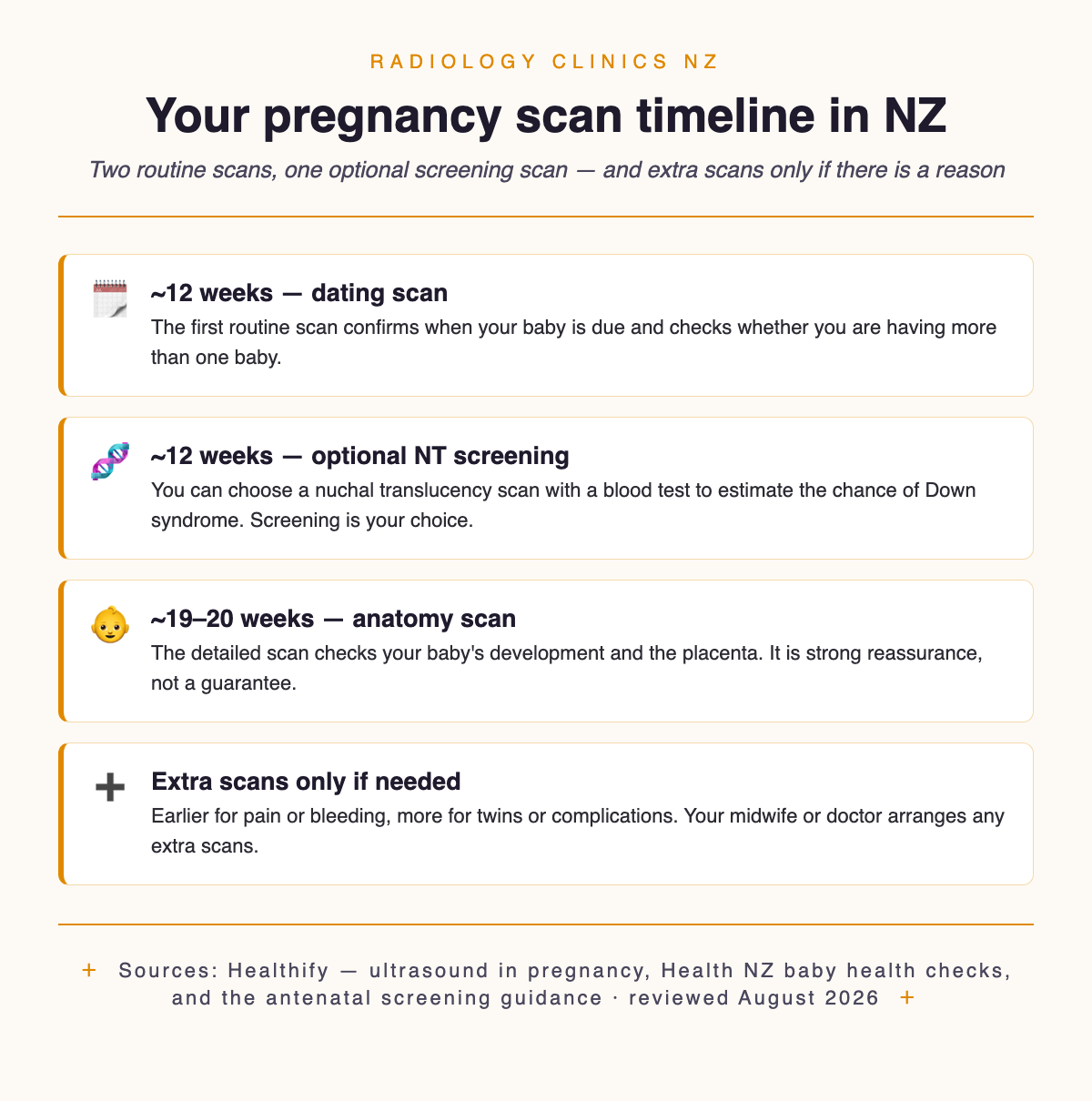
The 12-week scan is often the emotional one — the first real look — but clinically its main jobs are practical: pinning down your due date accurately and confirming how many babies there are. The 20-week anatomy scan is the more detailed examination, a careful check of your baby’s development from head to toe. One honest point I make as a radiologist: a reassuring anatomy scan is exactly that, reassurance, not a cast-iron guarantee. Ultrasound is very good, but some conditions cannot be seen before birth, and that is normal rather than a failure of the scan.
The optional screening scan at 12 weeks
Here is the part that most confuses people: the 12-week dating scan and the “nuchal translucency” scan are not automatically the same appointment. The nuchal translucency (NT) scan is part of screening — a separate, optional offer to estimate the chance of Down syndrome and some other conditions. You are offered an NT scan between 11 and 14 weeks, and the best time is at 12 weeks; it measures the fluid at the back of your baby’s neck and, together with a blood test, helps estimate the chance of a genetic condition such as Down syndrome.
In New Zealand this is delivered as first trimester combined screening: a blood test taken between 9 weeks and 13 weeks 6 days (ideally 9 to 10 weeks), plus the NT ultrasound, ideally at 12 weeks. If you come to maternity care later, there is a second trimester blood screen offered from 14 to 20 weeks instead.
Screening is your choice. The decision to have or not have screening is a personal one, and you can talk it through with your midwife or doctor before you decide. If you do not want the NT screening, you can still have the standard dating scan.
Find a clinic that does pregnancy scans
Most pregnancy scans in New Zealand are done at community ultrasound clinics rather than in hospital, so once you have a referral you often have a choice of where to go. You can browse ultrasound clinics across New Zealand on Radiology Clinics NZ and open any listing for its location, contact details and website, then call to book. As at 30 August 2026, current listings include Auckland Radiology Group at Remuera in Auckland, Pacific Radiology at Lambton Quay in Wellington, and Pacific Radiology at St George’s in Christchurch. These are examples to show the range, not a ranking or a full list — services vary by branch, so confirm the exact scan you need.
Ask the clinic when you book
✓ “Do you do the scan my referral asks for — the dating scan, the 12-week NT screening scan, or the 20-week anatomy scan — at this branch?”
✓ “Do you need my midwife’s or doctor’s referral form first?”
✓ “What co-payment applies, and is it lower with a Community Services Card?”
✓ “Do I need a full bladder, and how early should I arrive?”
When you might need an early or extra scan
The two-scan plan is for a pregnancy that is progressing normally. If your pregnancy is uncomplicated, you don’t generally need any other ultrasound scans. Sometimes, though, there is a good reason to scan earlier or more often, and that is a reason to look more closely rather than automatically a sign that something is wrong.
- You may need a scan in early pregnancy, before 12 weeks, if you have complications such as pain or bleeding.
- You will need extra scans if you are carrying twins (or more), or if you have had complications in this pregnancy or a previous one.
- If there is a specific concern — for example about the heart — your team may arrange a more focused study such as a fetal echocardiogram, a special ultrasound of your baby’s heart usually done around 20 weeks.
These extra scans are arranged by your maternity team based on your situation. If you are ever unsure why a scan has been ordered, ask — the answer is usually reassuring and specific.
Who arranges your scan
You cannot refer yourself for a pregnancy scan in the public system: your healthcare provider requests the test. In practice that provider is your lead maternity carer (LMC) — usually a midwife, or sometimes a GP or obstetrician — who looks after your pregnancy and organises your scans and screening. If you want a scan sooner or more conveniently and are paying or insured, you can talk to your provider about referral to a private provider.
After the scan, you usually will not get the full result on the spot. The sonographer takes the images, and a report of the findings is sent to your doctor or lead maternity carer, who will discuss the results with you. If you have not registered with an LMC yet, that is the first step — and our guide to how imaging referrals work in New Zealand explains the wider pathway.
What a pregnancy scan is actually like
A pregnancy scan is one of the gentlest tests in medicine. Ultrasound is very safe and uses no radiation, and there are no known risks to you or your baby from having an ultrasound scan. That safety is exactly why it is the tool used to watch a pregnancy, sometimes several times.
On the day, the scan usually takes about 20 to 30 minutes. A sonographer applies gel to your stomach and moves a small hand-held probe over your skin. For an early scan you may be asked to arrive with a full bladder — drink plenty of water and do not go to the toilet beforehand, because it gives a clearer picture. The clinic will tell you what to do when they book you; following it exactly saves a repeat visit. For the practical side of preparing, our how to prepare for an ultrasound guide has more.
What it costs
Cost is the one part that surprises people, because a community pregnancy scan is not always free. Routine pregnancy ultrasounds may be free for New Zealand residents, but there is likely to be some cost involved, and it varies by region and provider. A $12.9 million temporary Health NZ scheme now caps what a participating community provider can charge you: up to $30 per scan with a Community Services Card, or up to $90 without — and some providers charge less, or nothing (caps as at August 2026). Scans done in a public hospital remain fully funded with no cost. Because that scheme is temporary while the funding is reviewed, always confirm the co-payment when you book. Our ultrasound cost guide walks through the full funding picture, including the caps and the free routes.
Common questions
How many scans do you get in a NZ pregnancy?
Usually two. In an uncomplicated pregnancy you are offered two routine scans — one at around 12 weeks and one at around 19 weeks, and you don’t generally need any others. You may be offered an optional first-trimester screening (NT) scan around 12 weeks as well, and your team will arrange extra scans if there is a clinical reason such as bleeding, twins or a specific concern.
Do I need a referral for a pregnancy scan, or can I book it myself?
You need a referral. Your healthcare provider requests the test — in pregnancy that is your lead maternity carer (usually a midwife, or a GP or obstetrician). Once you have the referral you can often choose which community clinic to book with. You cannot self-refer for a publicly funded scan.
What is the difference between the 12-week scan and the nuchal translucency scan?
The 12-week dating scan confirms your due date and checks for more than one baby. The nuchal translucency (NT) scan is part of optional screening: it measures the fluid at the back of your baby’s neck and, with a blood test, estimates the chance of a genetic condition such as Down syndrome. They happen around the same time and can be combined, but the NT scan is a choice you make, not an automatic part of dating.
Does a normal 20-week anatomy scan mean my baby is completely healthy?
It is strong reassurance, but not a guarantee. The anatomy scan checks that your baby is growing and developing as expected and looks for abnormalities that ultrasound can show. Some conditions cannot be seen on a scan before birth, so a normal result lowers the chance of a problem without ruling everything out. Your midwife or doctor will explain what your own result means for you.
Sources
This guide draws on current New Zealand sources: Health New Zealand — Maternity ultrasound scans, Checking the health and development of your pēpi, Antenatal screening for Down syndrome and other conditions, Scans and x-rays and the Temporary funding boost for maternity ultrasound services (8 April 2026); and Healthify — Ultrasound in pregnancy. Directory clinic examples were confirmed on the Radiology Clinics NZ listings and each provider’s website on 30 August 2026. Screening is optional; scan timings are the usual windows and may vary for your pregnancy; the pregnancy co-payment figures are national caps under a temporary scheme and may change.
This article is general information, not personal medical advice. Ask your referrer which service is available, and ask the clinic whether public funding or ACC cover applies and what you will need to pay.
Last updated August 2026

Author: Dr. Mark Bekhit
Dr Mark Bekhit (MBChB, FRANZCR) is a musculoskeletal radiologist practising in Brisbane and an AHPRA-registered specialist in diagnostic radiology (MED0002920947). He spends as much time building software as reading scans: he founded Imaging Finder (Australia) and Radiology Clinics NZ to make imaging easier to find, and builds radiology dictation and pain-tracking tools with one aim — better patient outcomes and a smoother reporting workflow. Outside the reading room he's usually training, bringing the same performance mindset to imaging.
Sources, method, and medical context
This article is published by Radiology Clinics NZ and reviewed for medical-adjacent accuracy by Dr. Mark Bekhit, radiologist. It is general information only and does not replace advice from your own doctor, referrer, clinic, insurer, or Health New Zealand service.
Official references
- Health New Zealand: scans and X-rays
- Health New Zealand: community-referred radiology service
- Radiology Clinics NZ: how the directory is built
Related directory pages
Radiology clinics directoryUltrasound clinicsBrowse by cityHow this directory is built
Last editorial review: 2026-06-30.
Leave a Reply