
Dr. Mark Bekhit, Radiologist · Last updated August 2026
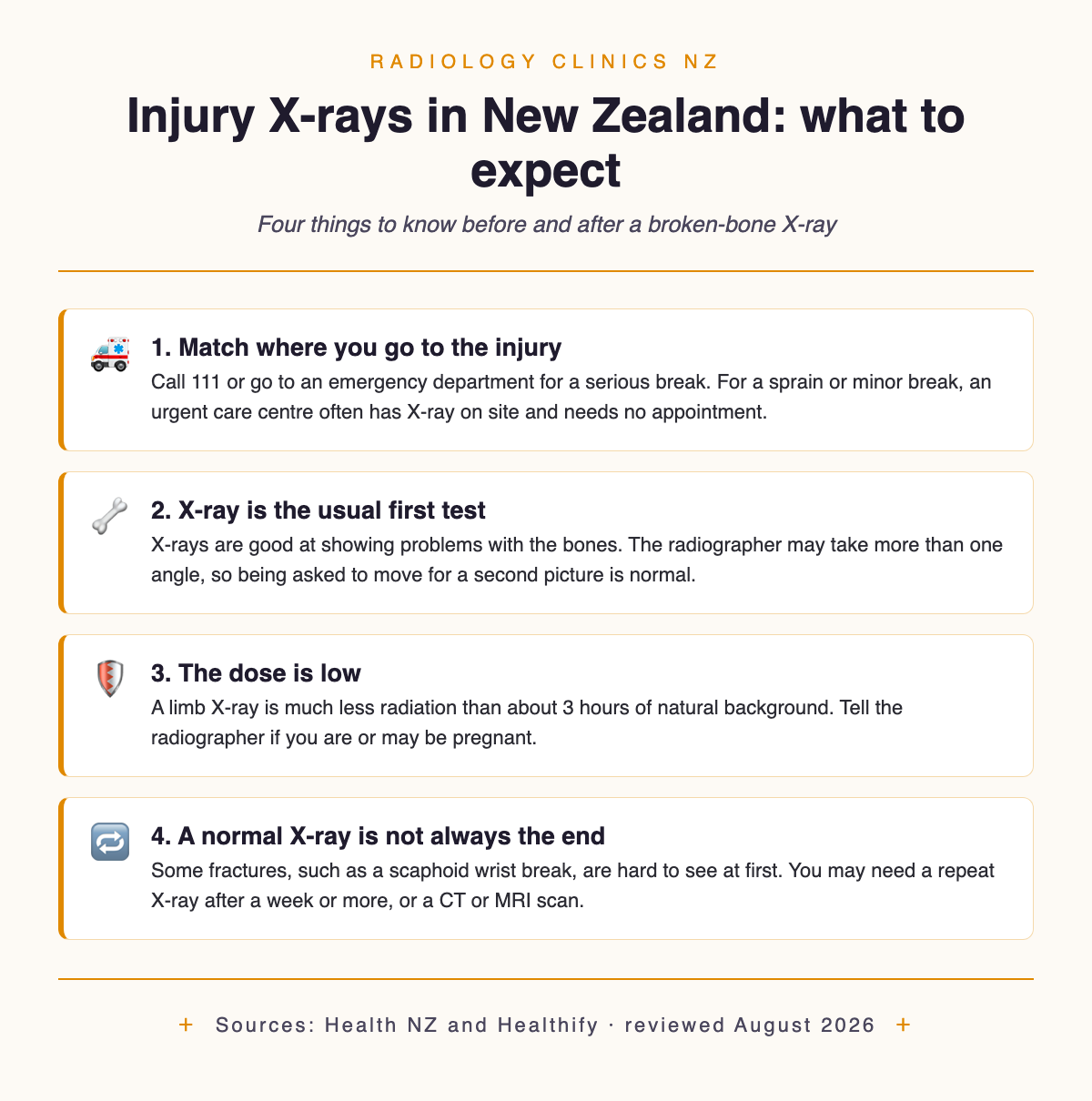
Short answer: An X-ray is usually the first test for a suspected broken bone, because it is good at showing problems with the bones. For a serious injury — a bone through the skin, heavy bleeding or a possible neck or back injury — call 111. For a sprain or minor break, an after-hours or urgent care centre often has X-ray on site. You cannot self-refer in the public system, a public hospital or ACC usually covers most of the cost, and a normal X-ray does not always rule out a fracture.
Where should I go if I’ve hurt a limb?
Match where you go to how serious the injury looks. Call 111 in a critical or life-threatening emergency — for example if a bone has pierced the skin, the person is bleeding heavily, is unconscious, or might have injured their neck, back or head.
For a sprain or a minor break, an after-hours or urgent medical centre can help with accident care, and many have X-ray on site. You do not need an appointment, but you might have to wait. You can also go straight to an emergency department, or start with your usual general practice, where same-day appointments may be available.
While you wait: support the injured limb with a pillow or folded clothing and apply a wrapped ice pack (never ice straight on the skin). If surgery might be needed, do not eat or drink until a clinician has seen you.
Is an X-ray the right test for a broken bone?
For most limb injuries, yes. X-rays pass through the body and are good at showing problems with the bones, so a joint or limb X-ray is a standard step after an injury to look for broken bones or another cause of the pain.
The most common way to diagnose a fracture is by an X-ray, which shows the type of fracture and where it is within the bone. If a break is confirmed, the X-ray tells the team which bones are involved so they can plan treatment.
An X-ray is not the only imaging test, and it is not always the first choice for a soft-tissue problem such as a suspected tendon or ligament tear. If your main question is a muscle or tendon injury, see which imaging test suits which question.
Why do they take more than one picture?
A single flat image can hide a break, because bones overlap and a crack can sit side-on to the beam. To get around that, the radiographer checks the images and may need to take more from a different angle. Joints and areas where several small bones sit close together — the wrist, hand, ankle and foot — usually need more than one angle for this reason.
So being asked to shift position for a second or third picture is normal and expected. It does not mean something has gone wrong; it means the team is making sure a subtle injury is not missed. Having an X-ray is like having a photo taken: you hold still, feel nothing, and most take only about 5 to 10 minutes.
Good to know: the number of images depends on the body part and the question being asked, not on how much radiation you can “have”. Extra angles for a joint are a routine part of getting a clear answer the first time.
Is an X-ray safe? What about pregnancy?
A limb X-ray uses a very small amount of radiation. The radiation you get from having a limb X-rayed is much less than the natural background radiation you are exposed to in about 3 hours, and at the dose levels used in diagnostic X-rays there is little or no evidence of health effects.
Always tell the radiographer if you are pregnant or think you may be pregnant. They can then decide whether to adjust the examination or use shielding. If you want the wider picture on how imaging teams keep doses low, see how radiation dose is kept as low as reasonably possible.
Do I need a referral, or can I just turn up?
It depends on the route. At an emergency department or an urgent care centre you are assessed on arrival and, if you need an X-ray, the clinician there arranges it — you do not need an appointment. For a planned X-ray in the public system, though, you need a referral from your healthcare provider and cannot self-refer.
Injuries have one useful exception. Physiotherapists may be able to refer you for an X-ray under ACC cover or if you pay privately, which can be a quicker path for a sports or work injury. For the full map of who can send you for a scan, see how imaging referrals work in New Zealand.
What will it cost? Does ACC pay?
Most injury X-rays cost you little or nothing, but the exact answer depends on where the scan is done and whether ACC is involved. For clinic-by-clinic prices and the non-injury routes, see what an X-ray costs in NZ.
For injuries, ACC is the usual funder. ACC usually pays some of the medical costs after an accident, though you may have to pay for some of the procedure; the part-charge differs between clinics, so it is a fair question to ask when you book. For the deeper comparison, see public versus private radiology and who qualifies for free imaging in New Zealand.
What if the X-ray looks normal but it still hurts?
A clear X-ray is reassuring, but it is not a cast-iron guarantee that nothing is broken. Some fractures are simply hard to see at first.
The wrist is the classic example. Sometimes a wrist fracture is hard to see on an X-ray; in that case you may need another X-ray after a week or more, or a CT scan or MRI scan. A break in the scaphoid, one of the small carpal bones in the wrist, is a well-known one to hide on the first film. More generally, an MRI or a CT scan may be needed when an X-ray does not fully answer the question.
So if your clinician still suspects a fracture despite a normal X-ray, they may treat it as one and arrange follow-up imaging — that is careful practice, not a mistake. Once a break is confirmed, treatment holds the bone in place while it heals, using a sling, a splint or brace, or a cast.
If the pain does not settle: go back to your clinician rather than assuming the first normal X-ray settled it. Point out exactly where it hurts and whether you can bear weight or use the limb — that steer is what prompts a repeat X-ray, CT or MRI.
What happens on the day, and how do I get my results?
On the day the X-ray itself is quick and painless. It is like having a photo taken — you hold still and feel nothing, and the radiographer and anyone with you step out of the room while each image is taken. You may be asked to move for a second or third angle, as above.
You will not usually get the answer in the room. A specialist doctor (radiologist) views your X-ray images and writes a report about what they show. Your healthcare provider then discusses the results with you at a follow-up appointment, or sometimes over the phone, by email or text message. In an emergency or urgent care setting, the treating clinician often reviews the images and talks to you the same day.
Worth asking before you leave
✓ “Is this being covered by ACC, and will I have anything to pay?”
✓ “Who will give me the result, and when should I expect it?”
✓ “If the pain does not settle, do I come back for a repeat X-ray or a different scan?”
✓ “Should I keep the limb rested, splinted or non-weight-bearing meanwhile?”
If a planned X-ray was arranged for you and no letter or phone call with your appointment details arrives, contact the healthcare provider or hospital doctor who requested it. For a first scan, the questions to ask before imaging and the appointment checklist are worth a look, and the clinic-finding guide or the Radiology Clinics NZ directory helps if the referral can be directed to a private X-ray service.
Frequently asked questions
Can I get an X-ray without seeing a doctor first?
At an emergency department or urgent care centre you are assessed on arrival and do not need an appointment. For a planned X-ray in the public system, you need a referral and cannot self-refer, though a physiotherapist may be able to refer you under ACC cover or privately.
Why did they take several X-rays of the same spot?
Because one angle can hide a break. The radiographer checks the images and may take more from a different angle, and joints such as the wrist, hand, ankle and foot usually need more than one view to see a subtle injury clearly.
Is an X-ray for an injury covered by ACC?
For an accidental injury it usually is. ACC usually pays some of the medical costs after an accident, though you may have to pay for some of the procedure. A scan done at a public hospital usually has no charge. Give the provider your ACC claim number and ask what, if anything, you will pay.
The X-ray was normal but it still hurts — what now?
A normal X-ray does not always rule out a fracture. A wrist fracture can be hard to see, so you may need another X-ray after a week or more, or a CT or MRI scan, and an MRI or CT may be needed for other sites too. Go back to your clinician if the pain does not settle.
Is the radiation from a limb X-ray dangerous?
The dose is very small. The radiation from a limb X-ray is much less than the natural background radiation you get in about 3 hours, and at diagnostic doses there is little or no evidence of health effects. Tell the radiographer if you are or may be pregnant.
Sources and review
This page was written and clinically reviewed by Dr. Mark Bekhit on 9 August 2026. What an X-ray shows, multiple angles, radiation safety, pregnancy, referral and reporting were checked against Health NZ’s X-rays and scans and X-rays pages and Healthify’s X-ray page. Where to go, first aid and 111 advice came from Health NZ’s which health service should I use and broken bones first aid pages. Fracture diagnosis, hard-to-see wrist and scaphoid fractures, repeat imaging and treatment came from Healthify’s fractures and broken wrist pages. This is general information about the imaging pathway, not a diagnosis or a set of positioning instructions for any individual injury.
This article is general information, not personal medical advice. Ask your referrer which service is available, and ask the clinic whether public funding or ACC cover applies and what you will need to pay.

Author: Dr. Mark Bekhit
Dr Mark Bekhit (MBChB, FRANZCR) is a musculoskeletal radiologist practising in Brisbane and an AHPRA-registered specialist in diagnostic radiology (MED0002920947). He spends as much time building software as reading scans: he founded Imaging Finder (Australia) and Radiology Clinics NZ to make imaging easier to find, and builds radiology dictation and pain-tracking tools with one aim — better patient outcomes and a smoother reporting workflow. Outside the reading room he's usually training, bringing the same performance mindset to imaging.
Sources, method, and medical context
This article is published by Radiology Clinics NZ and reviewed for medical-adjacent accuracy by Dr. Mark Bekhit, radiologist. It is general information only and does not replace advice from your own doctor, referrer, clinic, insurer, ACC, or Health New Zealand service.
Official references
- Health New Zealand: scans and X-rays
- Health New Zealand: community-referred radiology service
- ACC: high-tech imaging services operational guidelines
- Radiology Clinics NZ: how the directory is built
Related directory pages
Radiology clinics directoryX-ray clinicsBrowse by cityHow this directory is built
Last editorial review: 2026-06-30.
Leave a Reply