Dr. Mark Bekhit, Radiologist
Last updated August 2026
In brief
Short answer: In New Zealand, a qualified radiologist stays responsible for what your scan means — artificial intelligence is a support tool, with a human kept in the loop. Under RANZCR’s ethical principles, final decisions about your care are made by the health professional with you, not by software. Your health information is protected by law, and Health NZ tells staff not to put patient details into public AI tools. You keep the same rights to be informed and to ask questions.
On this page
- Does AI decide my diagnosis, or does a radiologist?
- Is AI accurate for New Zealand patients like me?
- Is my scan and health data safe when AI is used?
- How is AI checked before it is used in New Zealand radiology?
- Your worry, the New Zealand rule, and what it means
- What you can ask about AI at your appointment
- Frequently asked questions
Does AI decide my diagnosis, or does a radiologist?
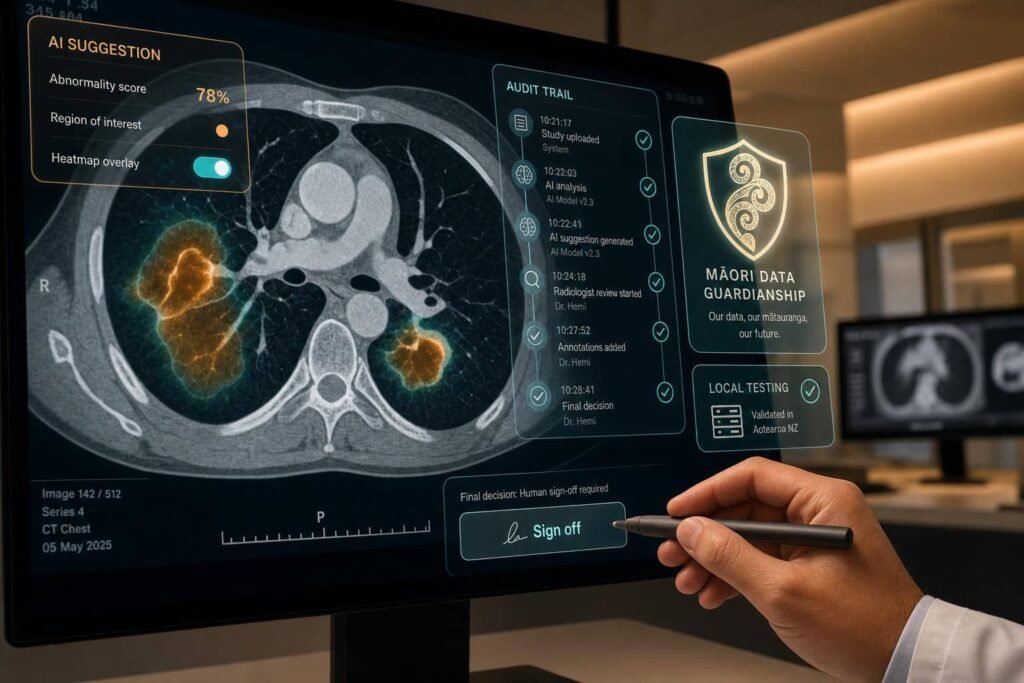
A radiologist decides. Artificial intelligence in medical imaging is a support tool — it can flag a finding or measure something quickly — but a qualified doctor still interprets your scan and owns the result. RANZCR, the college that trains and sets standards for radiologists in New Zealand and Australia, describes AI as something that can support clinical decision-making, and it argues for a “human in the loop” so the technology is used safely.
That is not just a slogan. RANZCR’s Ethical Principles for AI in Medicine state that AI tools must not be used without human oversight where the result could affect the patient. The same document says that while AI can enhance decision-making, the final decisions about your care must be made after a discussion between the health professional and you, taking account of your presentation, history, options and preferences.
Responsibility is spelt out just as plainly. RANZCR’s principles put responsibility for decisions about patient care principally with the health professional, who has to know the limits of any AI tool, explain them, and use their own clinical judgement. The through-line across all of this is that AI should support, not replace, the relationship between you and your doctor.
New Zealand law points the same way. The Health and Disability Commissioner’s Code of Rights gives you the right to have services provided with reasonable care and skill (Right 4). A service cannot hand that duty to software. The Medical Council of New Zealand makes the same point about doctors in general: a doctor’s first concern is the care of patients, delivered with respect, honesty and professionalism.
So if a tool highlights something on your images, a radiologist checks it against your clinical picture before it becomes part of your report. The human sign-off is the safeguard, and in New Zealand it is both a professional standard and a legal expectation.
Is AI accurate for New Zealand patients like me?
This is a fair question, and the honest answer is that an AI tool is only as good as the data it learned from. RANZCR’s ethical principles say plainly that AI tools are prone to bias, and that the data behind a tool should be representative of the patient population it will actually be used on. A tool trained mostly on overseas patients has not necessarily been shown to perform the same way for people here.
Health NZ makes the equity risk concrete. Its guidance warns that AI can reinforce social and health inequities because it may have been trained on data with underlying biases, and that such data can under-represent or misrepresent groups including Māori, women, older people, disabled people and people who are gender diverse. If a tool has seen few patients like you, its performance for you is less certain.
There is a second accuracy problem worth naming. The same Health NZ guidance notes that generative AI can produce convincing text that is nonetheless inaccurate or misleading, and can even invent information and sources — a behaviour sometimes called “hallucination”. That is one reason a person, not a program, signs off the result.
This is exactly why human sign-off matters so much for you specifically. A radiologist reading your images brings your history and the New Zealand clinical context that an imported algorithm does not have. The tool contributes a fast second look; the doctor decides whether it fits your actual situation.
Is my scan and health data safe when AI is used?
Your images and health details are among the most sensitive information a health service holds, and they are protected by law. The Health Information Privacy Code 2020 covers health information about identifiable people that health agencies collect, hold, use and disclose. It sets out 13 privacy rules and is issued and administered by the Privacy Commissioner under the Privacy Act 2020. Those rules apply whether or not an AI tool is involved.
Health NZ has drawn a firm line for its own staff. Its generative-AI guidance tells employees and contractors not to enter any personal, confidential or sensitive patient information into unapproved public AI tools, and not to use those tools for clinical decisions or for personalised advice to patients. The reason is that publicly available tools usually keep whatever is typed into them, and that data could be used to work out who it is about.
There is a specific New Zealand dimension here too. Health NZ notes that public AI models are unlikely to respect Māori Data Sovereignty, and RANZCR’s principles say consideration must be given to Indigenous data sovereignty and governance. Health data carries meaning beyond the clinic, and how it is used is a governance question, not only a technical one.
RANZCR’s principles also set a rule about where your data can go: patient data must not be transferred out of the clinical setting where your care is provided without your consent, approval from an ethics committee, or where the law requires or permits it. In plain terms, a clinic cannot quietly ship your scans off to train someone’s software.
How is AI checked before it is used in New Zealand radiology?
New Zealand does not leave this to individual clinics alone. Health NZ runs a National Artificial Intelligence and Algorithm Expert Advisory Group (NAIAEAG) that guides AI development and provides advice and endorsement for groups developing or implementing healthcare AI for use within Health NZ.
Its job is oversight. The group gives expert advice on the appropriateness, safety, effectiveness, ethics, legality, and the social and cultural licence of AI used within Health NZ, and on how tools improve over time. All AI development or implementation plans have to be registered with the group, which checks that projects line up with ethical, technical, clinical and operational standards and looks at them through a multidisciplinary lens.
The professional standards run alongside that. RANZCR has published nine ethical principles for AI in medicine, covering safety, privacy and data protection, minimising bias, transparency, human values, decision-making, teamwork, responsibility, and governance. Its safety principle requires that AI be used under appropriate conditions and by appropriately trained people — the equipment and the person operating it both matter.
Your worry, the New Zealand rule, and what it means
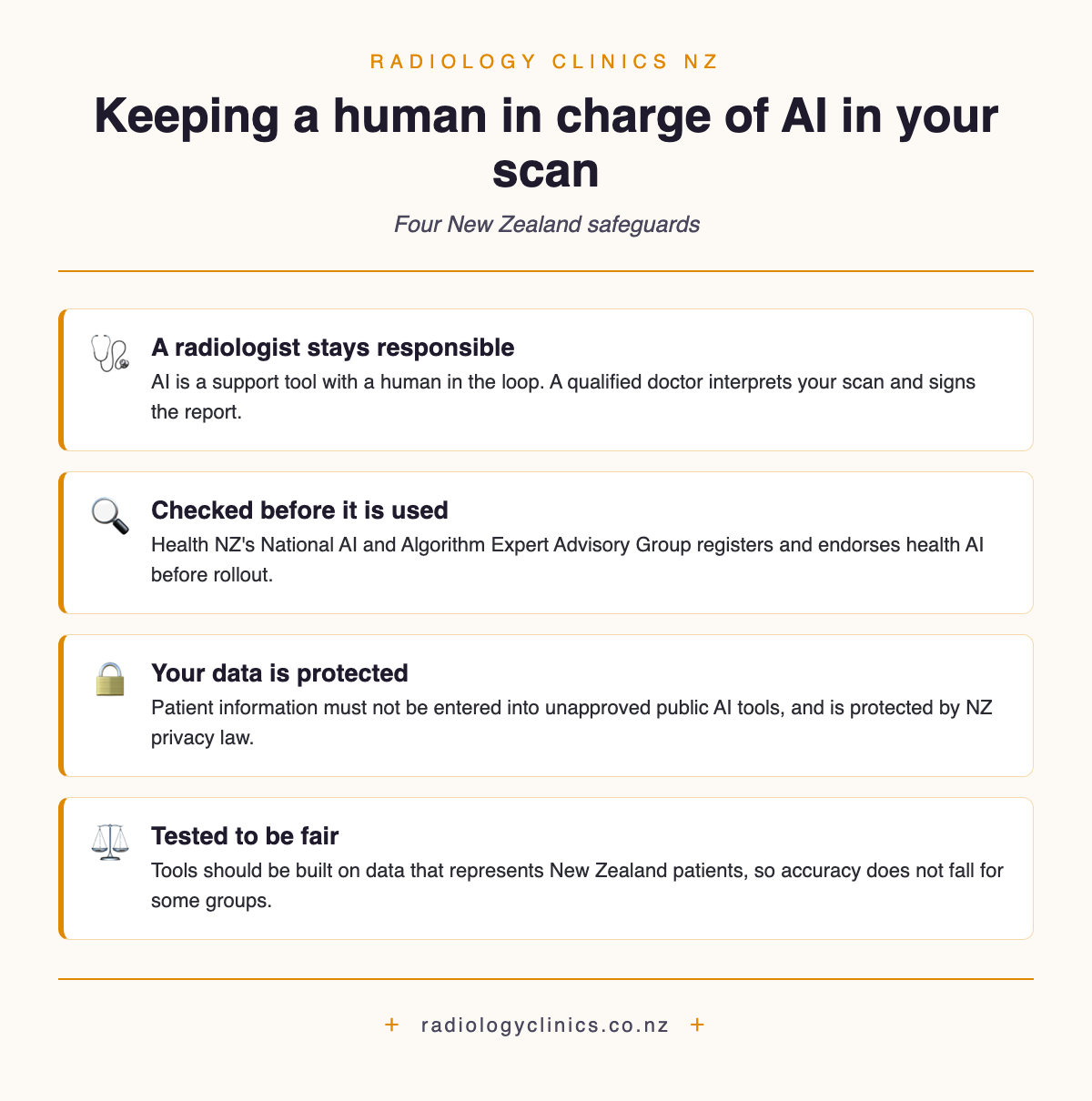
Most of the anxiety about AI in scans comes down to a few specific worries. Here is what each one meets in New Zealand — the rule that applies, and what it means for you on the day.
What you can ask about AI at your appointment
Using AI does not shrink your rights. The Code of Rights still gives you effective communication in a way you understand (Right 5), the information a reasonable person would expect including the results of your tests and honest answers to your questions (Right 6), and the right to make an informed choice and give informed consent (Right 7). Those rights cover how technology is used in your care.
You do not need technical language to use them. A few plain questions get you what you need.
Questions you can ask
✓ Will a radiologist review and sign off my scan?
✓ Is any AI tool used in reading my images, and what does it do?
✓ Who is responsible for my result if a tool is involved?
✓ How is my scan and personal information kept private?
✓ Can I ask questions or say no to something and still be looked after?
If a provider answers these openly, that is a good sign the human oversight described above is real. If you would like to prepare more broadly, the guides to questions to ask before your first scan and the imaging appointment checklist are practical starting points. To understand who performs your scan and who interprets it, see who works at a radiology clinic, and to make sense of the wording afterwards, read the guide to understanding a radiology report.
If something about your care does not sit right, you are entitled to raise it. The guide to radiology feedback and complaints in New Zealand sets out the steps, and what patient-centred radiology looks like describes the wider standard of care you should expect. To find services near you, use the clinic directory.
Frequently asked questions
Will a computer read my scan instead of a radiologist?
No. In New Zealand a radiologist interprets your scan and signs the report. RANZCR’s ethical principles say AI tools must not be used without human oversight where the result could affect the patient, so any AI output is checked by a doctor before it becomes part of your care.
Is AI making the final decision about my diagnosis?
No. RANZCR’s principles put responsibility for decisions about your care principally with the health professional, and require that final decisions be made after a discussion between the professional and you. AI can add a fast second look, but the doctor decides whether it fits your clinical picture.
Could AI be less accurate for me?
It can be, if the tool was trained on data that does not represent patients like you. Health NZ warns that AI can reinforce inequities from biased data, and can also produce inaccurate or invented information. A radiologist reading your images with your history is the check against that.
Is my scan data fed into public AI tools like ChatGPT?
It should not be. Health NZ tells staff not to enter personal or sensitive patient information into unapproved public AI tools. Your health information is also protected by the Health Information Privacy Code 2020 — a set of rules on how health agencies hold, use and share it.
Can I ask whether AI was used, and say no?
Yes. The Code of Rights gives you effective communication, honest answers to your questions, and the right to make an informed choice and give informed consent. You can ask how any tool is used in reading your scan and raise concerns with the provider.
Sources and review
This guide was reviewed on 2 August 2026 against current New Zealand sources: RANZCR’s Ethical Principles for AI in Medicine and its artificial-intelligence guidance; Health NZ’s guidance on generative AI and its National AI and Algorithm Expert Advisory Group; the Privacy Commissioner’s Health Information Privacy Code 2020; the Health and Disability Commissioner’s Code of Rights; and the Medical Council of New Zealand’s professional standards. These sources set professional principles, national oversight, privacy rules and patient rights. They do not describe how any single clinic reads a particular scan, and they do not name a tool used for your examination — that is a question to ask your provider.
- RANZCR: Ethical Principles for AI in Medicine
- RANZCR: Artificial Intelligence in medical imaging and cancer care
- Health NZ: using generative AI and large language models
- Health NZ: National AI and Algorithm Expert Advisory Group
- Privacy Commissioner: Health Information Privacy Code 2020
- Health and Disability Commissioner: Code of Rights
- Medical Council of New Zealand: Good Medical Practice
More practical resources are in the Radiology Clinics NZ blog.
This article is general information, not personal medical advice. Ask your referrer which service is available, and ask the clinic whether public funding or ACC cover applies and what you will need to pay.

Author: Dr. Mark Bekhit
Dr Mark Bekhit (MBChB, FRANZCR) is a musculoskeletal radiologist practising in Brisbane and an AHPRA-registered specialist in diagnostic radiology (MED0002920947). He spends as much time building software as reading scans: he founded Imaging Finder (Australia) and Radiology Clinics NZ to make imaging easier to find, and builds radiology dictation and pain-tracking tools with one aim — better patient outcomes and a smoother reporting workflow. Outside the reading room he's usually training, bringing the same performance mindset to imaging.
Sources, method, and medical context
This article is published by Radiology Clinics NZ and reviewed for medical-adjacent accuracy by Dr. Mark Bekhit, radiologist. It is general information only and does not replace advice from your own doctor, referrer, clinic, insurer, or Health New Zealand service.
Official references
- Health New Zealand: scans and X-rays
- Health New Zealand: community-referred radiology service
- Radiology Clinics NZ: how the directory is built
Related directory pages
Radiology clinics directoryBrowse by scan typeBrowse by cityHow this directory is built
Last editorial review: 2026-06-30.
Leave a Reply