
Dr. Mark Bekhit, Radiologist
Last updated August 2026
In brief
Short answer: Different examinations have different regulated practitioners. Under New Zealand’s regulated scopes, a medical imaging technologist performs X-rays and can practise CT after appropriate training; an MRI technologist performs MRI; and a sonographer performs ultrasound. A clinical radiologist is the specialist doctor whose work includes diagnosis and treatment using imaging. Diagnostic and interventional radiology is one medical vocational scope: an interventional radiologist is a clinical radiologist who also directly performs image-guided procedures.
On this page
- Who performs which imaging examination?
- What is the difference between the scanning practitioner and a radiologist?
- Which regulated imaging role does what?
- What are five signs of professional imaging care?
- What should you ask before or during the appointment?
- What if a trainee or another practitioner is present?
- Frequently asked questions
Who performs which imaging examination?
For an X-ray, the practitioner is a Medical Imaging Technologist, a profession also known internationally as radiographer in MRTB policy. The Medical Radiation Technologists Board makes that practitioner responsible for the diagnostic imaging examination outcome. Their scope covers patient care, positioning, image quality, imaging technology and radiation safety. With appropriate training, the same scope extends to CT, mammography and angiography.
MRI has a separate registered MRI Technologist scope. That practitioner is responsible for the MRI examination outcome, including patient care, positioning, image quality, MRI technology and magnetic-resonance safety. Ultrasound has its own Sonographer scope. A sonographer is responsible for the ultrasound examination outcome and works within general, vascular or cardiac ultrasound; each discipline requires specific education or training.
These professional titles require current MRTB registration. The Board’s competence standards identify Medical Imaging Technologist, MRI Technologist, Nuclear Medicine Technologist, Radiation Therapist and Sonographer as protected titles. If the person’s profession is unclear, the Code of Rights allows you to ask for an honest answer about their identity and qualifications.
For an image-guided procedure, an interventional radiologist has a direct procedural role. This qualified clinical radiologist performs image-guided diagnostic and treatment procedures and takes part in the patient’s clinical management. RANZCR describes this work in its interventional radiology guidance.
What is the difference between the scanning practitioner and a radiologist?
The scanning practitioner is responsible for the examination outcome within their registered scope. For a routine X-ray, that means the radiographer positions you, operates the equipment, checks image quality and manages radiation safety. For MRI, the MRI technologist is responsible for patient care, positioning, image quality and magnetic-resonance safety. These responsibilities are defined in the MRTB scope notice; they are clinical work, not merely button-pushing.
A clinical radiologist is a specialist doctor. The Medical Council of New Zealand recognises diagnostic and interventional radiology as a medical vocational scope. RANZCR describes the radiologist’s specialist-opinion role as combining clinical medicine, disease processes, imaging procedures and radiological expertise for an individual patient’s circumstances.
These are different jobs. A technologist manages the safety responsibilities and image quality defined for that examination scope. A sonographer is responsible for the ultrasound examination outcome and assesses the findings while scanning. When a radiologist is assigned to report the study, that doctor provides the specialist medical opinion. During an image-guided treatment, the radiologist also performs the procedure directly.
You will not necessarily meet a radiologist when that doctor is reporting images. New Zealand’s teleradiology pathway allows appropriately registered doctors to provide radiology services remotely to a New Zealand health facility under approved arrangements. An on-site technologist can acquire the images while the reporting radiologist works elsewhere.
Under the MRTB scope notice, the sonographer assesses the ultrasound findings while scanning and can take images from an additional relevant area when clinical and workplace guidelines support it. Extra images or a longer examination therefore do not establish a diagnosis. The Code of Rights still entitles you to your test or procedure results, but it does not name one universal person who must communicate every ultrasound result.
Which regulated imaging role does what?
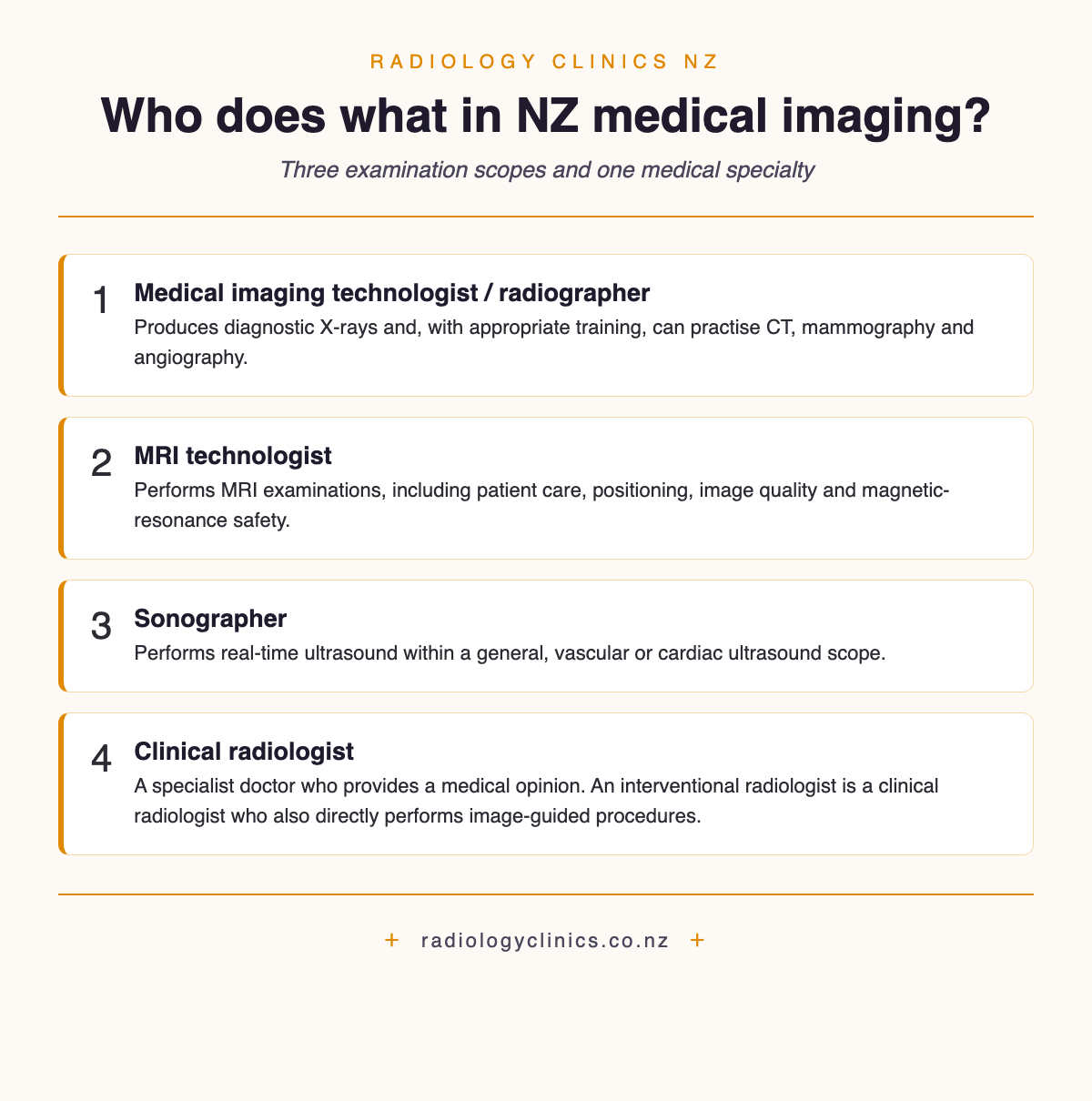
The table separates three MRTB examination scopes from the clinical-radiologist medical scope. Interventional work sits within clinical radiology rather than forming a fifth parallel registration category. This maps regulated responsibilities, not the staffing or reporting allocation of every clinic.
The MRTB allows a practitioner to hold registration in one or more defined scopes. That means the same person can be qualified for more than one kind of imaging work, but each protected title still carries its own competence and safety requirements. The relevant fact on the day is which registered scope covers the examination being performed.
What are five signs of professional imaging care?
A friendly manner helps, but professional care has clearer tests. The MRTB Code of Ethical Conduct and New Zealand’s Code of Rights turn professionalism into behaviours a patient can recognise.
Five signs to look for
1. Your wellbeing comes first. MRTB ethical standards require registered imaging practitioners to make the patient’s health and wellbeing their first priority and to prevent harm.
2. The person’s role matches their responsibility. They identify their role when asked and work within the registered scope that covers the examination.
3. The examination is explained in language you understand. The Code includes a competent interpreter where one is necessary and reasonably practicable.
4. Your dignity, privacy, values and culture are respected. The Code specifically includes the needs, values and beliefs of Māori and other cultural, religious, social and ethnic groups.
5. Consent remains a real choice. The practitioner explains the purpose and nature of the intervention, and respects a refusal or withdrawal of consent.
Professional care can still feel brisk in a busy department. The practical test is whether you understand what is happening, receive respectful care and have enough information to make an informed choice. The Medical Council’s Good Medical Practice makes respect, honesty and professionalism central to a doctor’s care of patients.
What should you ask before or during the appointment?
You do not need to memorise every title. These five questions establish who is doing what, what will happen in the room and how the result will reach you or your referrer.
You can ask
- Who will perform my examination, and what is their role?
- What will happen before, during and immediately after it?
- Who is responsible for reporting it, and how will the result reach my referrer or me?
- May I have a support person, and are there safety or privacy limits?
- What should I do if I need an interpreter or want to pause or withdraw consent?
The Code supports each question. You have the right to honest answers about a provider’s identity and qualifications, effective communication, information needed for an informed choice, test and procedure results, and one or more support people subject to the Code’s stated safety and other-patient limits.
For broader preparation, use the questions to ask before your first scan and the imaging appointment checklist. The guide to understanding a radiology report explains report language, and the clinic directory helps you find New Zealand services.
What if a trainee or another practitioner is present?
The Code gives you the right to be told about proposed participation in teaching or research. It also gives you the right to express a preference about who provides the service and have that preference met where practicable. “Where practicable” is a genuine limit: the provider must consider the preference, but a named practitioner is not guaranteed to be available.
You have a right to one or more support people of your choice. The Code names two exceptions: the provider can limit that right if the person’s presence would compromise safety or unreasonably affect another patient’s rights.
For the narrower issue of procedural training and supervision, see the review of interventional radiology training in New Zealand.
Frequently asked questions
Is a radiographer the same as a radiologist?
No. A radiographer is a Medical Imaging Technologist who performs diagnostic imaging within the MRTB scope, including patient care, positioning, image quality and radiation safety. A radiologist is a specialist doctor in the Medical Council’s diagnostic and interventional radiology scope. The MRTB regulates imaging technologists; the Medical Council regulates doctors.
Does a radiologist perform every scan?
No. Medical Imaging Technologists, MRI Technologists and Sonographers perform examinations within their registered scopes. A clinical radiologist provides specialist medical opinions from imaging and clinical information; an interventional radiologist directly performs image-guided procedures. Some radiology reporting is remote under New Zealand’s regulated teleradiology pathway.
Why can a sonographer acquire extra images?
The MRTB scope makes the sonographer responsible for the ultrasound examination outcome. It permits the sonographer to acquire images from an additional relevant area or sequence when clinical and workplace guidelines support doing so. Extra images or a longer examination do not, by themselves, establish a diagnosis.
Can I ask about a staff member’s qualifications?
Yes. The Code of Rights gives you the right to honest and accurate answers about a provider’s identity and qualifications. Protected imaging titles require current MRTB registration, and diagnostic and interventional radiology is a Medical Council specialist scope for doctors.
What should I do if staff communication or conduct worries me?
Raise the concern with the staff member or person in charge if you feel able. The Health and Disability Commissioner identifies the provider, the free Advocacy Service and a formal complaint as available pathways. The guide to radiology feedback and complaints in New Zealand puts those options in practical order.
Sources and review
This guide was reviewed on 1 August 2026 against the current MRTB scope notice, competence standards and ethical code; the Health and Disability Commissioner’s Code of Rights; Medical Council vocational-scope and professional standards; and RANZCR role guidance. These sources define regulated professions, rights and conduct. They do not allocate every examination to a named reporter or prescribe the staffing model of every clinic.
- MRTB: scopes of practice and prescribed qualifications
- MRTB: competence standards
- MRTB: Code of Ethical Conduct
- Health and Disability Commissioner: Code of Rights
- Medical Council: diagnostic and interventional radiology
- RANZCR: interventional radiology role
For the wider care experience, read what patient-centred radiology looks like. More practical resources are in the Radiology Clinics NZ blog.
This article is general information, not personal medical advice. Ask your referrer which service is available, and ask the clinic whether public funding or ACC cover applies and what you will need to pay.

Author: Dr. Mark Bekhit
Dr Mark Bekhit (MBChB, FRANZCR) is a musculoskeletal radiologist practising in Brisbane and an AHPRA-registered specialist in diagnostic radiology (MED0002920947). He spends as much time building software as reading scans: he founded Imaging Finder (Australia) and Radiology Clinics NZ to make imaging easier to find, and builds radiology dictation and pain-tracking tools with one aim — better patient outcomes and a smoother reporting workflow. Outside the reading room he's usually training, bringing the same performance mindset to imaging.
Sources, method, and medical context
This article is published by Radiology Clinics NZ and reviewed for medical-adjacent accuracy by Dr. Mark Bekhit, radiologist. It is general information only and does not replace advice from your own doctor, referrer, clinic, insurer, or Health New Zealand service.
How this list was selected
List-style articles on this site are based on visible directory signals such as clinic location, brand coverage, listed scan services, and whether the clinic has enough public information to compare. They are not paid rankings, clinical endorsements, or a guarantee that a clinic is the best option for a particular patient.
Official references
- Health New Zealand: scans and X-rays
- Health New Zealand: community-referred radiology service
- Radiology Clinics NZ: how the directory is built
Related directory pages
Radiology clinics directoryBrowse by scan typeBrowse by cityHow this directory is built
Last editorial review: 2026-06-30.
Leave a Reply