
Dr. Mark Bekhit
Last updated July 2026
In brief
Short answer: If something about your scan was not right — a long wait, confusing instructions, a result you never received, or care that felt disrespectful — you have the right to raise it, and the provider must take it seriously. Start by telling the clinic or the person in charge; you can do that in person, by phone or in writing. A free advocate on 0800 555 050 can help. If you are still not satisfied, you can complain free to the Health and Disability Commissioner on 0800 11 22 33.
On this page
Does giving feedback actually change anything?
Yes, and it is backed by law, not goodwill. New Zealand’s Code of Health and Disability Services Consumers’ Rights gives you the right to make a complaint and to have it taken seriously. When you raise a concern, a provider cannot simply file it away; the Code sets out what it must do and by when.
Feedback also feeds a clinic’s own quality checks. A comment about a long phone wait, a prep sheet no one could follow, or a result that never arrived is exactly the kind of signal services use to find and fix a gap. The Health and Disability Commissioner puts it simply: the earlier you raise a concern, the more straightforward it usually is to resolve.
This guide is about the practical steps: your rights, how to raise a concern, the free help available, and how to escalate if you are not satisfied.
Your rights when you use a radiology service
A radiology clinic is a health service, so the same Code of Rights that covers a GP or hospital covers your scan. Several of its rights matter most when something goes wrong:
- Respect and privacy (Right 1). The Code requires services that take into account the needs, values and beliefs of different cultural groups, including Māori, and that respect your privacy.
- Effective communication (Right 5). You are entitled to be told things in a form, language and manner you understand, with a competent interpreter where you need one.
- Being fully informed (Right 6). You should receive the information a reasonable person would expect, including the results of your tests and procedures.
- Care of an appropriate standard (Right 4). Services should be provided with reasonable care and skill and should fit your needs.
- Informed consent (Right 7). A scan or an injection of contrast should go ahead only after you make an informed choice, and you can decline or withdraw consent.
- The right to complain (Right 10). You can complain in a way that suits you, and your complaint must be taken seriously.
You do not have to prove a right was breached before you speak up. Naming the part of your care that fell short is enough to start a conversation the clinic is obliged to have.
Common imaging concerns and the right they touch
Most imaging feedback falls into a handful of patterns. The table links each to the right it touches and a concrete next step.
For help making sense of a written report before you decide whether something is wrong, see the guide to reading a radiology report.
Step 1: raise it with the clinic first
Health New Zealand advises starting with the person you received the service from, or the person in charge. Many concerns — a missed call-back, an unclear instruction, a booking mix-up — are sorted quickly once the right person hears about them. You can raise it in person, by phone or in writing.
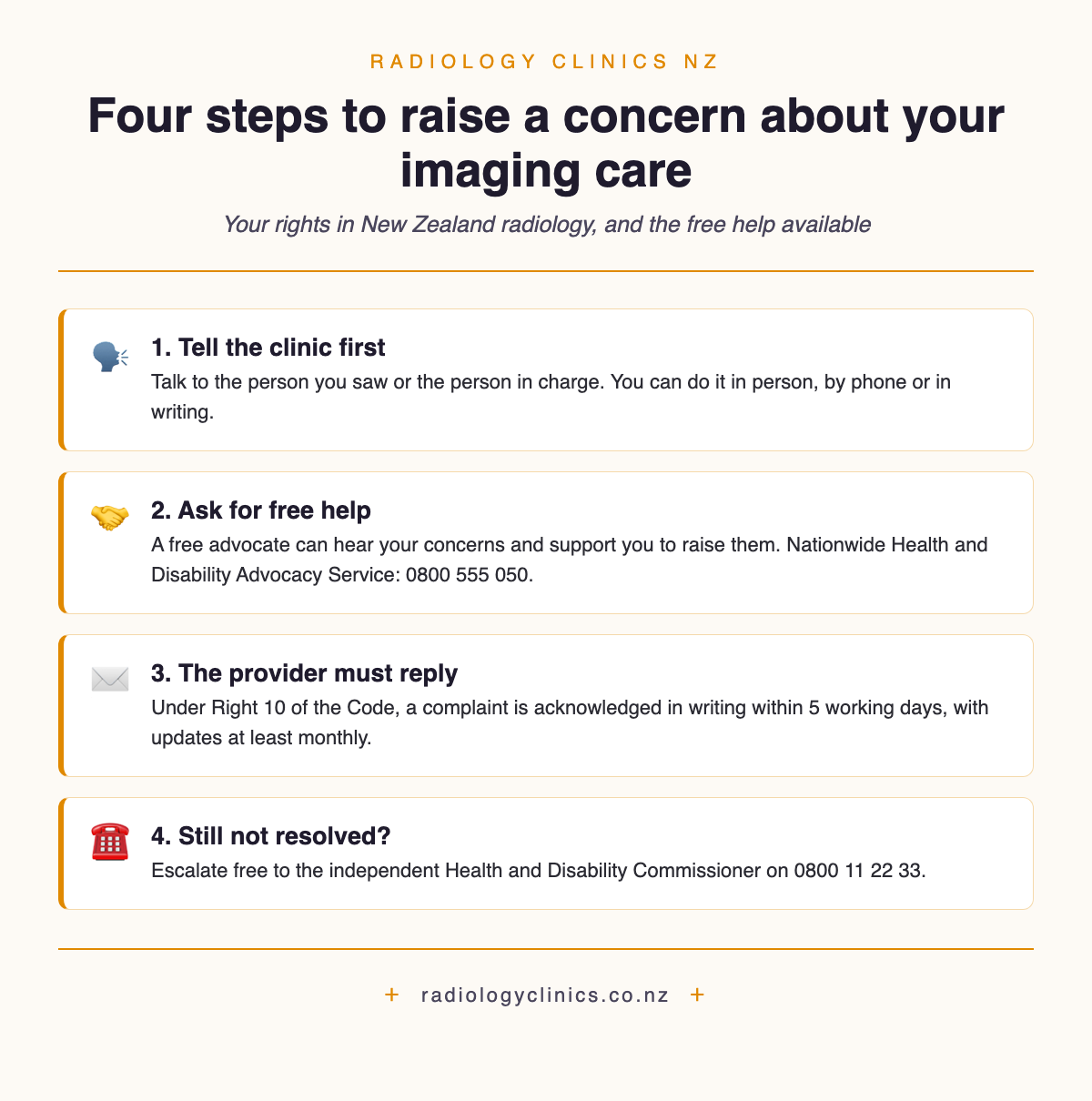
Once you make a formal complaint, the Code’s Right 10 sets a clear timetable the provider must follow:
When you raise a concern, include
✓ The date of your scan and the clinic or hospital where it happened.
✓ What happened, in your own words, and what you were expecting instead.
✓ The names of any staff involved, if you know them.
✓ What outcome you are hoping for — an explanation, an apology, or a change.
Get free help
You do not have to do this alone. Health NZ says it is fine to have a family member or friend help you make a complaint, and that you can get help from a free health and disability advocate. You also have the right to a support person with you at most times.
Good to know: The Nationwide Health and Disability Advocacy Service on 0800 555 050 is a free service. An advocate can hear your concerns, tell you the steps you could take, and support you to raise a concern or make a complaint.
An advocate can guide you through your options at no charge. They are a practical option if you are unsure how to start, if English is not your first language, or if earlier attempts to be heard went nowhere.
Step 2: escalate to the Health and Disability Commissioner
If you have raised your concern with the clinic and you are still not satisfied, Health NZ says you can complain to the Health and Disability Commissioner, free, on 0800 11 22 33. The Commissioner sits outside the clinic and handles complaints across all health and disability services.
The Commissioner offers more than one route: raising the concern with the provider, talking to the Advocacy Service, or making a formal complaint that can lead to an investigation. You can approach the Commissioner yourself, or an advocate can help you do it.
Special situations
You never received your result. This is a common and reasonable worry, and the responsibility does not sit with you. Under the RANZCR result-notification standard, making sure a critical result is communicated and received is a shared responsibility between your referrer and the radiologist, and the balance shifts with the situation. If that communication is delegated to someone else or to an automated system, the radiologist is still responsible for making sure it happens in time and is documented. If a result has not reached you or your referrer, contact the clinic or referrer first; if it is still unresolved, raise a concern. For how results are meant to travel between clinic and referrer, see the handover guide.
You want a copy of your images or report. Health NZ says you have the right to request access to the information it holds about you. Ask the clinic how to make that request; many keep a simple form for it.
You were charged for something you did not agree to. Health NZ says a complaint about costs — for example, being charged for a service you did not agree to — can be taken to legal advice or the Disputes Tribunal, which is a separate path from a complaint about your clinical care.
Frequently asked questions
Can I complain about a radiology clinic in New Zealand?
Yes. A radiology clinic is a health service, so the Code of Rights gives you the right to complain and to have it taken seriously. Health NZ suggests starting with the clinic or the person in charge. If you are not satisfied, you can complain free to the Health and Disability Commissioner on 0800 11 22 33.
Is making a complaint free?
Yes. The Nationwide Health and Disability Advocacy Service on 0800 555 050 is a free service, and the Health and Disability Commissioner is free to contact on 0800 11 22 33. You can also have a family member or friend help you at no cost.
How long does the clinic have to respond to my complaint?
Under Right 10 of the Code, the provider must acknowledge your complaint in writing within 5 working days of receiving it, unless it is resolved to your satisfaction first. Within 10 working days of that acknowledgement it must decide whether it accepts your complaint is justified or needs more time, and it must keep you updated at least once a month.
I never received my scan result — what should I do?
Contact the clinic or your referrer first. Under the RANZCR result-notification standard, communicating a critical result is a shared responsibility of the referrer and radiologist, and the radiologist stays responsible for timely communication even when it is delegated. The Code also gives you the right to your test and procedure results. If it is still unresolved, raise a concern.
Can someone help me make a complaint?
Yes. Health NZ says a family member or friend can help you, and you can get help from a free health and disability advocate. The advocacy service on 0800 555 050 is a free service, and you have the right to a support person with you at most times.
Sources and review
This guide was reviewed against current sources accessed on 31 July 2026: the Health and Disability Commissioner’s Code of Rights and complaint information, Health New Zealand’s rights, privacy and complaints pages, Healthify’s plain-language summary of the Code, and the RANZCR result-notification standard. They set out your rights and the complaint process; they do not decide whether a particular concern is justified — that is what raising it is for.
- Health and Disability Commissioner: Code of Rights
- Health and Disability Commissioner: making a complaint
- Health New Zealand: complaints about a health or disability service
- Health New Zealand: your rights and privacy
- Healthify: Code of Health and Disability Consumers’ Rights
- Nationwide Health and Disability Advocacy Service
- RANZCR: Clinical Test Result Notification position statement
For what to ask before a scan, see questions to ask before your first radiology scan and the imaging appointment checklist. To check a provider is legitimate, see the mobile imaging safety guide. More patient guides are in the Radiology Clinics NZ blog, and you can browse clinics in the directory.
This article is general information, not personal medical advice. Ask your referrer which service is available, and ask the clinic whether public funding or ACC cover applies and what you will need to pay.

Author: Dr. Mark Bekhit
Dr Mark Bekhit (MBChB, FRANZCR) is a musculoskeletal radiologist practising in Brisbane and an AHPRA-registered specialist in diagnostic radiology (MED0002920947). He spends as much time building software as reading scans: he founded Imaging Finder (Australia) and Radiology Clinics NZ to make imaging easier to find, and builds radiology dictation and pain-tracking tools with one aim — better patient outcomes and a smoother reporting workflow. Outside the reading room he's usually training, bringing the same performance mindset to imaging.
Sources, method, and medical context
This article is published by Radiology Clinics NZ and reviewed for medical-adjacent accuracy by Dr. Mark Bekhit, radiologist. It is general information only and does not replace advice from your own doctor, referrer, clinic, insurer, or Health New Zealand service.
Official references
- Health New Zealand: scans and X-rays
- Health New Zealand: community-referred radiology service
- Radiology Clinics NZ: how the directory is built
Related directory pages
Radiology clinics directoryBrowse by scan typeBrowse by cityHow this directory is built
Last editorial review: 2026-06-30.
Leave a Reply