By Dr. Mark Bekhit, Radiologist
Last updated August 2026
Short answer: Ask for an interpreter or communication support when the radiology appointment is booked. Name your preferred language, dialect, written language, NZSL or accessible format. Under Right 5 of the Code of Rights, a competent interpreter must be provided where necessary and reasonably practicable. Delivery may be in person or by phone, and a private arrangement may have a fee.
Can I ask for an interpreter or communication support for radiology?
Yes. New Zealand’s Code of Health and Disability Services Consumers’ Rights says communication must be provided in a form, language and manner that enables you to understand. Where it is necessary and reasonably practicable, that includes a competent interpreter. The qualifier matters: it is a right to effective communication, but not a promise that every interpreter or format will be immediately available at every clinic.
Communication support is broader than spoken-language interpreting. Health New Zealand says language translators can be arranged and NZSL interpreters are available for healthcare appointments on request. You can also ask for accessible written information, bring a support person, or use a tool that records how staff should communicate with you.
A support person and an interpreter have different jobs. A whānau member or friend can listen, take notes and help you ask questions. Healthify cautions that family and friends may not understand health information well enough to interpret it accurately. For clinical explanations, ask for a professional interpreter while keeping your support person involved in the way you want.
Right 8 gives you the right to one or more support people. The stated exceptions are where their presence could compromise safety or unreasonably infringe another person’s rights. The Code also requires respect for privacy and for cultural, religious, social and ethnic needs, values and beliefs, including Māori.
When should I arrange it, and what should I tell the clinic?
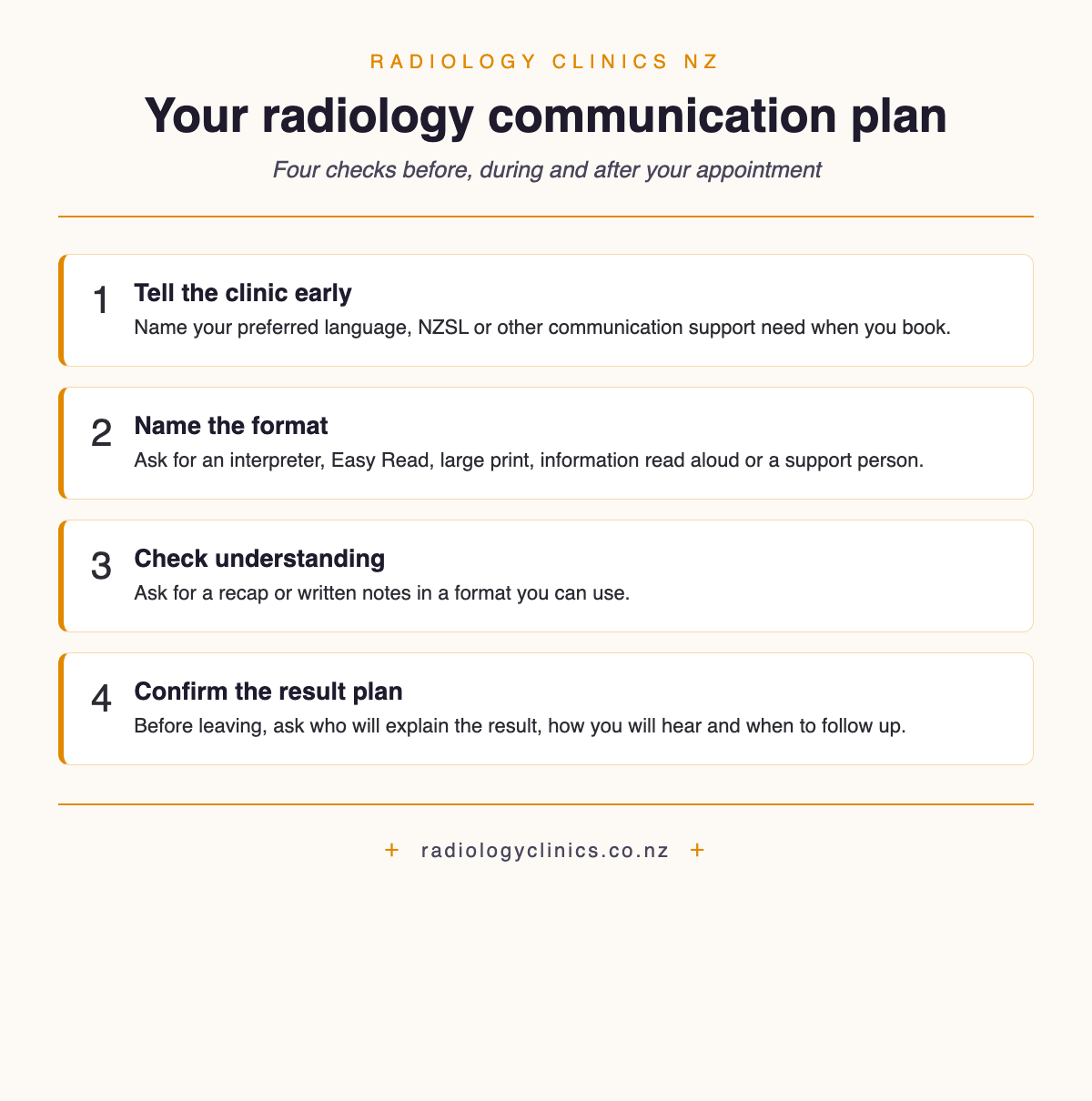
Tell the clinic as early as possible—ideally when the appointment is booked. Health New Zealand advises patients to identify interpreter and communication needs early and to ask for an interpreter before an appointment.
Be specific. Give your preferred spoken language, dialect and preferred written language. If you use NZSL, say that you need an NZSL interpreter and name a preferred interpreter if that is relevant. If you need information in Easy Read, large print or read aloud, state the format rather than using a general phrase such as “accessibility support”. These are the details identified in current Healthify interpreter guidance and Health New Zealand’s disability-support guidance.
Ask how the interpreter will join. Healthify says professional interpreters may attend in person for some languages and may be available only by phone for others. If the clinic cannot provide your preferred method, ask what alternative it can arrange and whether that alternative will still let you communicate during the parts of the appointment that matter.
Booking sentence: “I need a [language, dialect or NZSL] interpreter and information in [written language or accessible format]. Please tell me how the support will be provided and whether I need to pay anything.”
Do not assume that every pathway is free. Healthify says most public health services provide free interpreting for people eligible for publicly funded services. A private interpreter service may need to be paid for directly or through the healthcare provider. Ask the clinic which arrangement applies to this appointment and whether there is a separate charge.
Which communication support fits which need?
There is no single interpreter solution for every communication barrier. Name the task you need help with: understanding spoken information, using NZSL, reading appointment material, recording communication preferences, or making a phone call. Healthify’s interpreter guidance distinguishes preferred spoken language, dialect and written language, as well as in-person and phone delivery.
| Communication need | Concrete request |
|---|---|
| Spoken language or dialect | Ask for a professional interpreter and give your preferred written language. Ask whether support will be in person or by phone. |
| NZSL | Tell staff you use NZSL, request an NZSL interpreter early and name your preferred interpreter if you have one. |
| Blind or low-vision access | Ask for large print, an accessible version or for information to be read aloud. |
| Easy Read or help retaining information | Ask for Easy Read, a recap and written notes. A support person can listen and take notes; My Health Passport records how services should communicate with and support you. |
| Hearing or speech support for phone booking | Use New Zealand Relay, the free government-funded phone service for people with hearing or speech communication difficulties. |
My Health Passport is a booklet where you can record how health and disability services should communicate with and support you. It is available in accessible versions. It does not diagnose a condition and does not replace your medical records; it carries your preferences in a consistent form.
What should be explained before I consent to the scan?
Under the Code of Rights, effective communication supports informed consent. Right 6 includes an explanation of your condition and the available options, including expected risks, side effects, benefits and costs. It also entitles you to honest and accurate answers about a provider’s identity and qualifications when you ask.
Right 7 generally requires informed choice and informed consent. You can refuse a service or withdraw consent. An interpreter or accessible format should help you understand the explanation and express your own decision; it should not turn your support person into the decision-maker.
Before agreeing, check that you understand:
- the condition or question being investigated;
- the available options and expected benefits;
- the relevant risks, side effects and costs;
- who is speaking with you and their role, if you want to know; and
- that you can ask again when something is unclear and make your own choice.
This guide does not replace instructions for a particular examination. Use the questions to ask before a first radiology scan and the imaging appointment checklist for preparation and appointment documents. If the person explaining the examination is unfamiliar to you, the guide to radiology staff roles explains who does what.
What should be clear before I leave?
Ask for a recap at the end of the appointment and request written notes if they will help. Health New Zealand explicitly encourages both. Deaf patients can also ask for a written summary of the main points.
Right 6 includes the results of tests and procedures. Before leaving, ask three specific questions: who is expected to explain the result, how you will be contacted, and when or how you should follow up if you have heard nothing. Health New Zealand advises patients to ask what happens next before leaving.
When a report arrives, the guide to understanding a radiology report can help with common language. If communication or follow-up becomes a concern, see the practical routes in the guide to radiology feedback and complaints.
What can I say when booking?
Use these questions as a script. Replace the brackets with the language, format or support you use.
- Can you book a [language, dialect or NZSL] interpreter for this appointment?
- Will the interpreter attend in person or by phone?
- Can you provide the information in [Easy Read, large print, read aloud, preferred written language or another usable format]?
- May my support person attend, and is there a safety concern or an unreasonable infringement of another person’s rights that limits where they can be?
- Is there a fee for this communication support in my pathway?
If hearing or speech makes phone booking difficult, New Zealand Relay can support the call.
For physical access rather than communication access, use the accessible radiology clinic checklist. You can compare practical details in the Radiology Clinics NZ directory.
Frequently asked questions
Is an interpreter a right at a radiology appointment?
Right 5 of the Code of Rights requires effective communication in a form, language and manner that enables understanding. It includes a competent interpreter where necessary and reasonably practicable.
Is a radiology interpreter free in New Zealand?
Not in every pathway. Healthify says most public health services provide free interpreting to people eligible for publicly funded services. Private interpreter services may need to be paid for directly or through the healthcare provider.
Can my family member interpret for me?
Your whānau member can be a support person, but that is different from professional interpreting. Healthify warns that family and friends may not understand health information well enough to interpret accurately. Ask for a professional interpreter for clinical explanations while involving whānau in the support role you choose.
Can I bring a support person into the scan room?
The Code of Rights gives you the right to one or more support people unless their presence could compromise safety or unreasonably infringe another person’s rights.
What is My Health Passport?
My Health Passport is a booklet for recording how you want health or disability services to communicate with and support you. It is available in accessible versions. Bring it if useful, but remember that it is not a diagnostic tool and does not replace your medical records.
Sources and review
This guide was reviewed on 3 August 2026 against the Health and Disability Commissioner’s Code of Rights and My Health Passport guidance, Health New Zealand’s communication-support and appointment guidance, and Healthify’s interpreter information. They establish patient rights and practical requests; they do not guarantee a particular interpreter, format, delivery method or charge at every clinic.
- HDC: Code of Rights
- HDC: My Health Passport
- Health NZ: services for Deaf and disabled people
- Health NZ: talking with your healthcare provider
- Health NZ: New Zealand Relay
- Healthify: interpreter services
More patient resources are in the Radiology Clinics NZ blog.
This article is general information, not personal medical advice. Ask your referrer which service is available, and ask the clinic whether public funding or ACC cover applies and what you will need to pay.

Author: Dr. Mark Bekhit
Dr Mark Bekhit (MBChB, FRANZCR) is a musculoskeletal radiologist practising in Brisbane and an AHPRA-registered specialist in diagnostic radiology (MED0002920947). He spends as much time building software as reading scans: he founded Imaging Finder (Australia) and Radiology Clinics NZ to make imaging easier to find, and builds radiology dictation and pain-tracking tools with one aim — better patient outcomes and a smoother reporting workflow. Outside the reading room he's usually training, bringing the same performance mindset to imaging.
Sources, method, and medical context
This article is published by Radiology Clinics NZ and reviewed for medical-adjacent accuracy by Dr. Mark Bekhit, radiologist. It is general information only and does not replace advice from your own doctor, referrer, clinic, insurer, or Health New Zealand service.
Official references
- Health New Zealand: scans and X-rays
- Health New Zealand: community-referred radiology service
- Radiology Clinics NZ: how the directory is built
Related directory pages
Radiology clinics directoryBrowse by scan typeBrowse by cityHow this directory is built
Last editorial review: 2026-06-30.
Leave a Reply