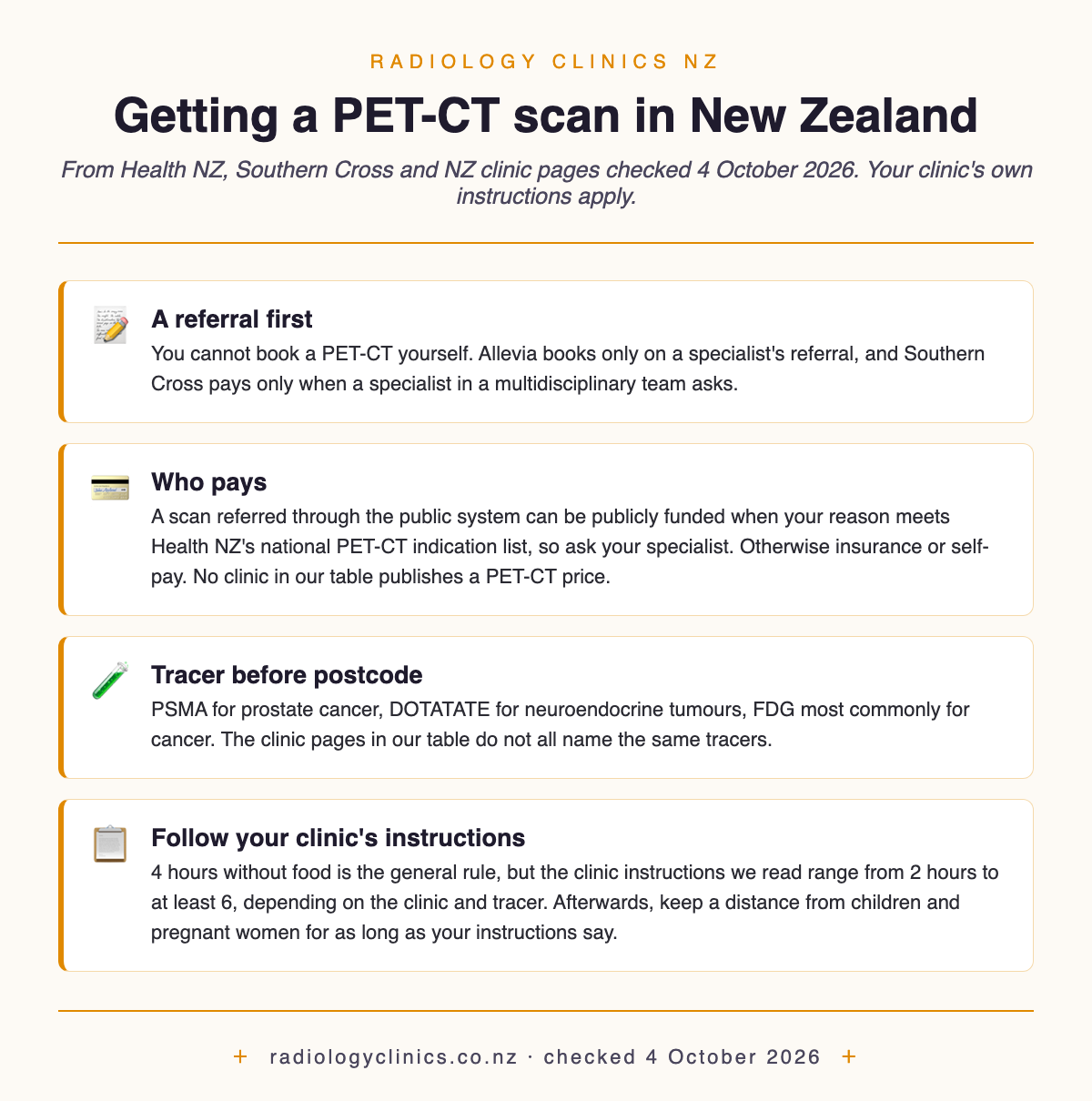
Short answer: You cannot book a PET scan yourself in New Zealand. A healthcare provider has to refer you. If you are referred through the public health system and your reason meets Health NZ’s national PET-CT indication list, the scan can be publicly funded; your specialist can tell you. Otherwise you claim on insurance or pay. None of the clinics in our table publishes a PET-CT price. Our table covers PET-CT clinics in Whangārei, Auckland, Hamilton, Tauranga, Hastings, Palmerston North, Wellington, Christchurch and Dunedin, and they do not all name the same tracers. Checked 4 October 2026.
On this page
Will you have to pay for a PET-CT?
A PET-CT is two scans done together on one machine. First, a small amount of a radioactive tracer goes into a vein, and a special camera picks up where it collects. The tracer gathers where cells are very active, which is why the scan is so useful for finding cancer and for checking whether treatment has worked. The CT part shows where those spots are.
The scan can be done in the public system or privately. Which one you get, and whether you pay, comes down to three main routes, each with one question to ask.
Public funding. The Government announced in February 2024 that Health NZ would fund an updated national list, developed by the Cancer Control Agency, so that access is the same wherever you live. Before that, men in the South Island paid for prostate PET-CT scans that men in most of the North Island did not.
Insurance. Read your insurer’s rules before you assume you are covered. Southern Cross’s criteria (last updated July 2022) say it reimburses a PET-CT only when a vocationally registered specialist who is part of a multidisciplinary team (the group of specialists who plan your treatment together) requests it, and only for the situations its criteria list.
Self-pay. None of the providers in our table below publishes a PET-CT price on its PET-CT page, or on its Healthpoint profile where it has one (checked 4 October 2026). Instead, Allevia asks you to send a copy of your referral for an estimate, I-MED quotes by phone or email and Reform provides cost estimates.
ACC. A separate route: Allevia lists no charge for ACC scans referred by a specialist. Our ACC imaging guide explains how ACC imaging works.
My view, as a radiologist: whether you pay is decided by the route your referrer uses, not by the clinic’s front desk. If you do pay, the amount is that clinic’s estimate. Get the funding question answered before you choose a scanner.
Who can refer you for a PET-CT?
You need a referral from a healthcare provider, and you cannot self-refer. Beyond that, the clinics that state a rule word it differently:
- Allevia needs a referral from your specialist before it will book the scan.
- Astra’s PET-CT page asks for a doctor’s referral, and its payment page, under its Southern Cross affiliated-provider services, says all CT, PET-CT and MRI scans must be referred by a specialist.
- SRG accepts referrals from all medical practitioners.
So SRG may accept a GP’s form. Accepted is not the same as paid for. If your GP suggests a PET-CT, my advice is to ask whether a specialist should make the request instead. That one question can decide whether Southern Cross pays. For the wider rules on who can refer you for which scan, see our referral guide.
Where are the scanners, and which tracers do their pages name?
If you are paying yourself or claiming on insurance, choose by tracer before postcode. For a publicly funded scan, ask your specialist where it will be done. Different tracers are used for different reasons, and a tracer aimed at a particular disease collects where that disease is. These are the tracer names to look for on your referral, as the clinic pages in our table describe them:
- FDG. It behaves like sugar and collects where cells are more active, and it is most commonly used for cancer or infection.
- PSMA, used for prostate cancer.
- DOTATATE, used for neuroendocrine tumours.
- Others: FET for brain tumours, FBB for Alzheimer’s disease, NaF for bone and FAPI for a wide range of cancers.
The table shows what each provider names on its PET-CT page. These are examples in our directory, checked on 4 October 2026 against each provider’s own page. It is not a ranking or an endorsement.
“Group page” (Auckland Radiology Group, Bay Radiology and Pacific Radiology), “service page” and “network page” mean the tracer list covers the whole provider, not one branch. I-MED’s network page places its PSMA service at a site it calls “Midland PET CT” without giving an address, so ask I-MED’s booking team which branch does PSMA.
DOTATATE appears only on the Allevia and Reform pages in this table, so if your referral says DOTATATE, those are the pages to start with.
Every clinic in the table except SRG has a listing on our PET-CT clinic page; the clinic names in the table link straight to them. For the street address, use your booking letter or the clinic’s own page. The mobile PET-CT service stopped running on 3 September 2026. For help with travel costs, see our South Island PET-CT guide.
How do you prepare, and what happens afterwards?
Your clinic sends its own instructions when it books you. The general rule is no food for 4 hours before the scan, with water allowed, and no strenuous exercise for a couple of days beforehand. Clinic sheets differ by clinic and by tracer, from 2 hours without food on Allevia’s PSMA and DOTATATE sheet to at least 6 hours at Astra and SRG. Follow your own sheet, not a friend’s.
Tell the clinic when you book if you have diabetes. Allevia and Astra both give people with diabetes their own instructions. Also tell them if you are or might be pregnant, are breastfeeding, have reacted to CT contrast before, have kidney disease or asthma, or are scared of small spaces. Our guides on contrast allergies and claustrophobia in scanners cover those two.
On the day, the tracer is usually given 45 to 60 minutes before the scan, and you rest quietly while it spreads. The wait depends on the tracer: Pacific’s page gives 60 to 90 minutes after a whole-body FDG injection and 2 hours after a PSMA injection. Then you lie very still on a padded table that slides into a short tunnel; the scan is painless.
The whole process usually takes up to 2 hours, though Allevia’s FDG sheet says to allow up to 3 hours. Arrive on time, and give notice if you cannot come: Astra asks for 24 hours’ notice to cancel because its tracer is produced in Wellington, is very costly and has a very short shelf life.
After the scan: the tracer leaves in your urine within a few hours, and drinking plenty of fluids helps. For those few hours, limit contact with other people. You can eat and go back to normal activities straight away. The rule that lasts longer is distance from children and pregnant women:
- Health NZ says you may be advised to limit contact with tamariki (children) and pregnant women until the next day.
- Clinic sheets give times from 3 hours after Allevia’s PSMA or DOTATATE scan to 6 hours at Astra and SRG.
- If you are breastfeeding, Allevia asks you to collect and discard your milk for 2 hours after the scan.
A radiologist reports the images to the person who referred you, who then talks you through the results.
Ask the clinic when you book
✓ “Do you do the tracer on my referral at this branch?”
✓ “If I am paying or claiming on insurance, what is your written estimate?”
✓ “How long should I fast, and what are your instructions if I have diabetes?”
Our appointment checklist covers what to wear and bring. Bring the referral, the tracer name and the funding answer, and the rest of the day is logistics.
Last updated October 2026
Sources
- Health New Zealand: PET-CT (positron emission tomography and CT) scan
- beehive.govt.nz: 29 February 2024 release on the national PET-CT criteria
- Astra Radiology: PET-CT
- srgmri.co.nz: PET-CT | Cavendish | Manukau
- southerncross.co.nz: Southern Cross’s PET-CT criteria
- healthpoint.co.nz: Allevia Radiology – Epsom PET-CT • Healthpoint
- alleviaradiology.co.nz: PET-CT Scans | Allevia Radiology Auckland
- i-med.co.nz: PET-CT | I-MED Radiology Network
- reformradiology.co.nz: Account Information | Manage Your Radiology Account Today — Reform Radiology
- astraradiology.co.nz: Astra Radiology | Payment
- srgmri.co.nz: PET-CT now available at SRG Radiology
- canopyimaging.co.nz: It behaves like sugar and collects where cells are more active
- reformradiology.co.nz: Molecular Imaging + Therapy Centre — Reform Radiology
- argtetaitokerau.co.nz: Our clinics | ARG Te Tai Tokerau
- alleviaradiology.co.nz: Epsom PET-CT Radiology Specialists | Allevia Radiology
- alleviaradiology.co.nz: Radiology Specialists in Milford, Auckland | Allevia Radiology
- canopyimaging.co.nz: New scanner, now open
- Pacific Radiology: Wellington Crofton Downs Bowen Centre
- Pacific Radiology: Dunedin Great King Street
- Scoop: Major diagnostic imaging expansion brings advanced imaging closer to home for Otago and Southland patients
- pacificradiology.com: PET-CT Scans | Advanced Cancer Imaging | Pacific Radiology
- i-med.co.nz: PSMA PET-CT | I-MED Radiology Network
- Allevia Radiology: PSMA and DOTATATE PET-CT Patient Information
- Allevia Radiology: FDG PET-CT Patient Information
- scoop.co.nz: Access Barriers To PET-CT Scans Removed | Scoop News
- arg.co.nz: Our clinics | Auckland Radiology
- bayradiology.co.nz: Our Clinics | Bay Radiology Locations Across Tauranga
- i-med.co.nz: I-MED Radiology – Anglesea Medical Complex | I-MED Radiology Network
- i-med.co.nz: I-MED Radiology – Turanga | I-MED Radiology Network
- reformradiology.co.nz: Positron Emission Tomography | Pet Scan Christchurch |<br/>PET/CT | Reform Radiology — Reform Radiology
- astraradiology.co.nz: Astra Radiology | X-Ray | Ultrasound | CT Scan | Ascot Central
- canopyimaging.co.nz: Molecular imaging and therapy centre
- Pacific Radiology: Christchurch Southern Cross
This article is general information, not personal medical advice. Ask your referrer which service is available, and ask the clinic whether public funding or ACC cover applies and what you will need to pay.

Author: Dr. Mark Bekhit
Dr Mark Bekhit (MBChB, FRANZCR) is a musculoskeletal radiologist practising in Brisbane and an AHPRA-registered specialist in diagnostic radiology (MED0002920947). He spends as much time building software as reading scans: he founded Imaging Finder (Australia) and Radiology Clinics NZ to make imaging easier to find, and builds radiology dictation and pain-tracking tools with one aim — better patient outcomes and a smoother reporting workflow. Outside the reading room he's usually training, bringing the same performance mindset to imaging.
Leave a Reply