Short answer: Most ultrasounds need no preparation at all. Two main kinds of scan do. For the upper abdomen (liver, gallbladder, pancreas) you fast, for 4 to 6 hours at the clinics listed below. For the pelvis, kidneys, bladder and early pregnancy you arrive with a full bladder: anything from two large glasses to 1 litre of water, drunk in the hour or so before the scan. Those are adult instructions; children’s differ. Clinics disagree on the numbers, so your own clinic’s instruction wins. Clinic instructions as at 23 September 2026.
On this page
Which ultrasounds need preparation?
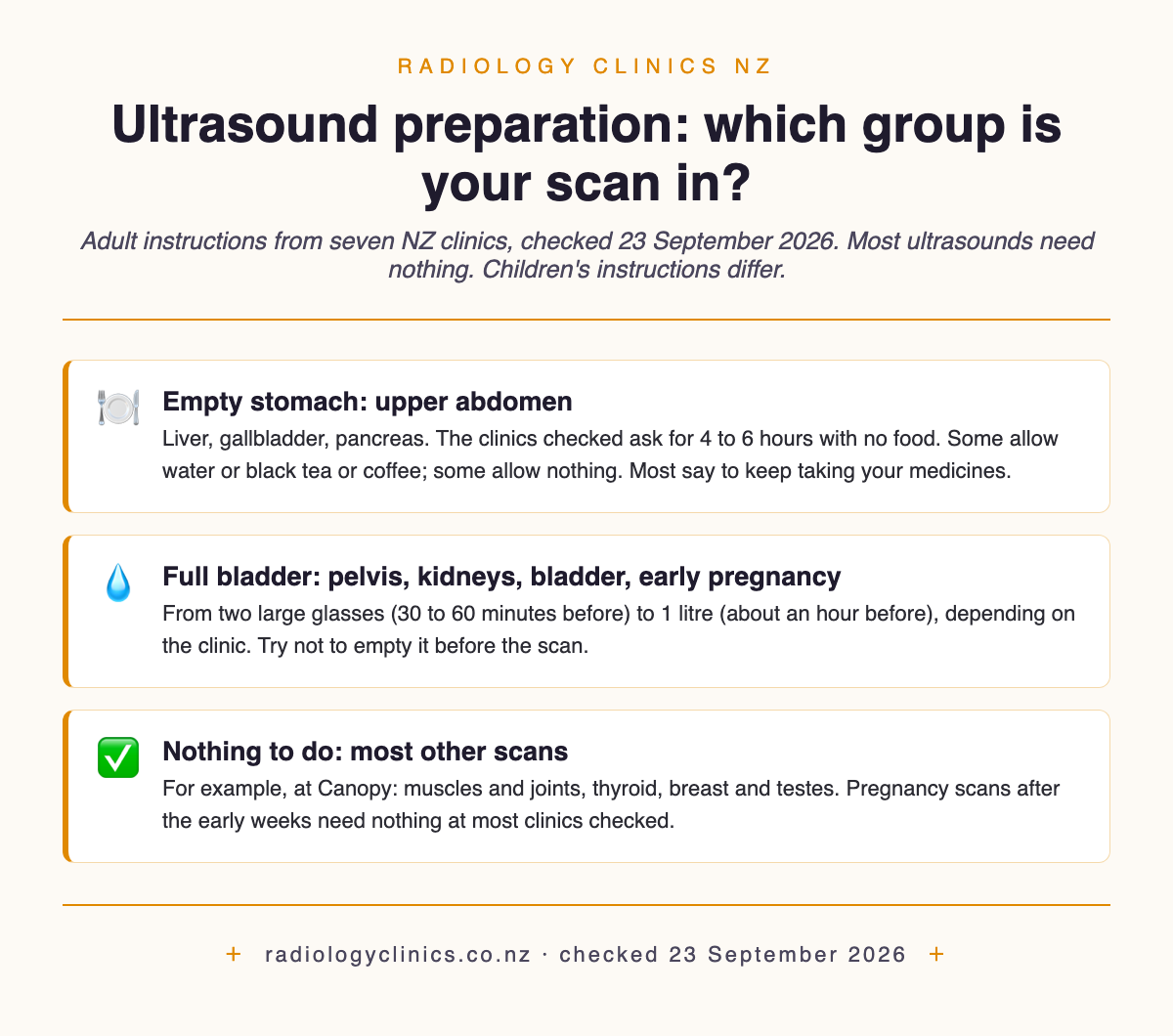
Preparation has one job: to let the sonographer (the person doing the scan) see the organ clearly. For most scans nothing is in the way, which is why most ultrasound scans need no preparation. The exceptions mostly sort by body area.
- Upper abdomen (liver, gallbladder, pancreas): come with an empty stomach.
- Pelvis, kidneys and bladder, including the male pelvis and prostate, and early pregnancy: come with a full bladder.
- Almost everything else: nothing to do. At Canopy Imaging, for example, that covers muscles and joints, the thyroid, the breast and the testes.
A combined abdomen-and-pelvis scan can need both. UP Ultrasound asks for a six-hour fast and a full bladder for that one. Whatever the scan, the exact instructions come with your appointment.
Fasting for an abdominal ultrasound: how long, and what can you drink?
At the seven clinics in the table below, the fast for an upper-abdominal scan runs from 4 to 6 hours. Allevia, Canopy, UP, The Ultrasound Clinic and Coastal Radiology ask for 6. Advance Ultrasound asks for 4, and New Wave in New Plymouth for 4 to 6.
What you may drink during the fast is where the instructions really split. Allevia and Canopy say nothing to eat or drink. Advance and Coastal allow water. The Ultrasound Clinic allows clear fluids, such as water. UP and New Wave allow water, black tea or black coffee (New Wave says sips).
Good to know: a flat white during the fast is allowed at none of the seven clinics. Black coffee is named as allowed at two.
Why fast at all? Fatty food makes the gallbladder squeeze, and a squeezed gallbladder is hard to assess. Fasting keeps it full and keeps food and fluid out of the way, which is the reason Canopy gives for its six-hour rule.
Keep taking your usual medicines: Advance, UP, The Ultrasound Clinic, Coastal and New Wave all say so. If a tablet must go down with food, The Ultrasound Clinic and Coastal allow dry crackers. If you have diabetes, a fast is not something to improvise, and Advance, UP and New Wave ask you to check with your doctor first.
The sum people actually need: at a six-hour clinic, a 2 pm appointment means you finish eating by 8 am. If you have the choice, I would take a morning slot and sleep through most of the fast. Children’s fasts are shorter at UP; the children’s rules are in the next section.
Canopy asks for 8 hours without food or drink before a scan of the kidney arteries, the aorta (the body’s main artery, which runs through the belly) or the leg arteries, so that food, fluid and bowel gas do not hide them. UP lists no preparation for its vascular scans, and Advance puts the aorta inside its 4-hour abdominal fast.
Full bladder: how much water, and when?
You need a full bladder for scans of the pelvis, the kidneys and the bladder, including the male pelvis and prostate, and for early pregnancy. It makes these areas easier to see.
The amount varies more than you would expect. Allevia, Canopy, UP, The Ultrasound Clinic and Coastal ask for about 1 litre. Advance asks for three large glasses, about 750 to 900 ml, an hour before. New Wave asks for at least two large glasses, 30 to 60 minutes before.
Allevia gives the most exact timetable: empty your bladder 90 minutes before, drink 1 litre over the next half hour, and finish an hour before the scan.
Aim for comfortably full, not bursting. If you are not full ten minutes before your appointment, UP, Advance and New Wave ask you to drink more.
The clinics split on what to do if it hurts. UP, Advance and New Wave let you release a little if you must. The Ultrasound Clinic, Coastal, Allevia and Canopy simply say not to empty your bladder, and Health NZ’s advice is not to go even if you feel you need to. Either way, you can go to the toilet as soon as the scan is done.
Early pregnancy has its own disagreement: the cut-off. UP asks for a full bladder (750 ml) only for a dating scan under 10 weeks. The Ultrasound Clinic, Canopy and Coastal ask for one up to 14 weeks. New Wave asks for one for its dating scans and for the nuchal translucency scan, the 11-to-14-week scan that measures the fluid at the back of the baby’s neck. Advance lists no preparation for pregnancy scans at all, and Coastal asks for a half-full bladder, one to two cups of water, at the 20-week anatomy scan. Our pregnancy scan guide explains which scans you are offered and when.
Children are prepared differently. At UP Ultrasound, babies under 12 months need no preparation, and children fast for 4 hours before an abdominal scan, or 3 hours under age three. At Canopy, a full bladder before a kidney scan is desirable but not essential under age six. Those are two clinics’ rules, not a national standard.
How do seven clinics’ instructions compare?
These are the published instructions of seven clinics in our directory, read on each clinic’s own website on 23 September 2026. They are examples, not a ranking or a complete list.
Three other radiology groups, Auckland Radiology Group, Bay Radiology and Pacific Radiology, give no scan-by-scan list on their ultrasound pages. Each says it will give you an overview of any preparation before the appointment.
If you have a referral and still need a clinic, start from our ultrasound clinics page, which groups clinics by region, or search the directory for ultrasound. Where a service is marked “likely also included”, we have not yet confirmed it on the clinic’s own site. For Hawke’s Bay, our Hawke’s Bay ultrasound guide covers the public, Wairoa and private routes.
Ask the clinic when you book
✓ “For my exact scan, do I need to fast, have a full bladder, or nothing?”
✓ “If I fast, for how long, and can I have water or black coffee?”
✓ “If I need a full bladder, how much water, and when do I start drinking?”
✓ “I am booking for my child. What are the children’s instructions?”
✓ “If I have eaten, or forgotten the water, should I still come in?”
Ask that last one before you leave home, not at the front desk. A two-minute call beats a wasted trip.
What happens on the day?
Bring the referral form. Most scans need one, and UP says plainly that it cannot scan you without it; our referral guide explains who can write one. Bring any previous scan reports as well, so the radiologist can compare, and a growth chart for a pregnancy scan if you have one.
Most ultrasound scans take around 30 minutes. Some pelvic scans start on the outside of the tummy and may be followed by an internal (vaginal) scan, which is only done with your consent. You can usually ask for a woman to do a vaginal internal scan.
Afterwards, the radiologist writes a report that goes to whoever referred you, and they go through the result with you. If cost is your next question, our ultrasound cost guide has clinic prices.
Last updated September 2026
Sources
- Health New Zealand: Ultrasound
- canopyimaging.co.nz: Canopy Imaging
- upultrasound.co.nz: Patients | UP Ultrasound
- alleviaradiology.co.nz: Ultrasound Scans | Allevia Radiology Auckland
- theultrasoundclinic.co.nz: Patient Information | The Ultrasound Clinic
- coastalradiology.nz: Patient Information | Coastal Radiology
- advanceultrasound.co.nz: Advance Ultrasound
- nwu.co.nz: General – New Wave Ultrasound
- Healthify: Gallstones | Healthify
- Healthify: Ultrasound | Healthify
- nwu.co.nz: Maternity – New Wave Ultrasound
- Health New Zealand: Checking the health and development of your pēpi
- arg.co.nz: Ultrasound | Auckland Radiology
- bayradiology.co.nz: Ultrasound Services | Expert Diagnostic Scans | Bay Radiology
- pacificradiology.com: Ultrasound Services | Expert Diagnostic Scans | Pacific Radiology
This article is general information, not personal medical advice. Ask your referrer which service is available, and ask the clinic whether public funding or ACC cover applies and what you will need to pay.

Author: Dr. Mark Bekhit
Dr Mark Bekhit (MBChB, FRANZCR) is a musculoskeletal radiologist practising in Brisbane and an AHPRA-registered specialist in diagnostic radiology (MED0002920947). He spends as much time building software as reading scans: he founded Imaging Finder (Australia) and Radiology Clinics NZ to make imaging easier to find, and builds radiology dictation and pain-tracking tools with one aim — better patient outcomes and a smoother reporting workflow. Outside the reading room he's usually training, bringing the same performance mindset to imaging.
Leave a Reply