By Dr. Mark Bekhit, Radiologist
Short answer: A nuclear medicine scan uses a small amount of radioactive tracer to show how part of your body is working, not just how it looks. You need a referral. Depending on why it’s needed, it can be free in the public system. We found no private price. Christchurch Hospital’s fee list, valid from February 2025, shows $2,281.07 for a bone scan and $1,895.96 for a lung scan, for people not eligible for public care. A bone scan usually means two visits two to three hours apart, and it isn’t a bone density (DEXA) scan.
On this page
What is a nuclear medicine scan?
Most scans show you what’s there. Nuclear medicine shows what it’s doing. A tracer goes into your body, collects in the area being studied, and a sensitive camera picks up where it went. That is how it can show how tissue and organs are working, where an X-ray shows only structure.
The tracer is usually injected into a vein. For some scans it’s swallowed, inhaled or injected under the skin. You’ll hear the test called nuclear medicine, scintigraphy, isotope imaging or molecular imaging. When the camera is combined with a CT scan, it’s called SPECT-CT, which gives more detail.
It’s used for injuries and pain, cancers, heart and kidney function, and thyroid, parathyroid and brain disorders, along with problems in the lungs, stomach, liver, gallbladder and bowel. PET is also a nuclear scan, and it has a separate PET-CT guide.
Is a bone scan the same as a bone density scan?
No, although the names invite the mix-up. A bone scan is different to a bone density scan. A bone scan looks for problems such as fractures hard to see on X-ray, infection, arthritis and cancer, including cancer that has spread to bone. A DEXA is a low-dose X-ray test of how dense or strong your bones are.
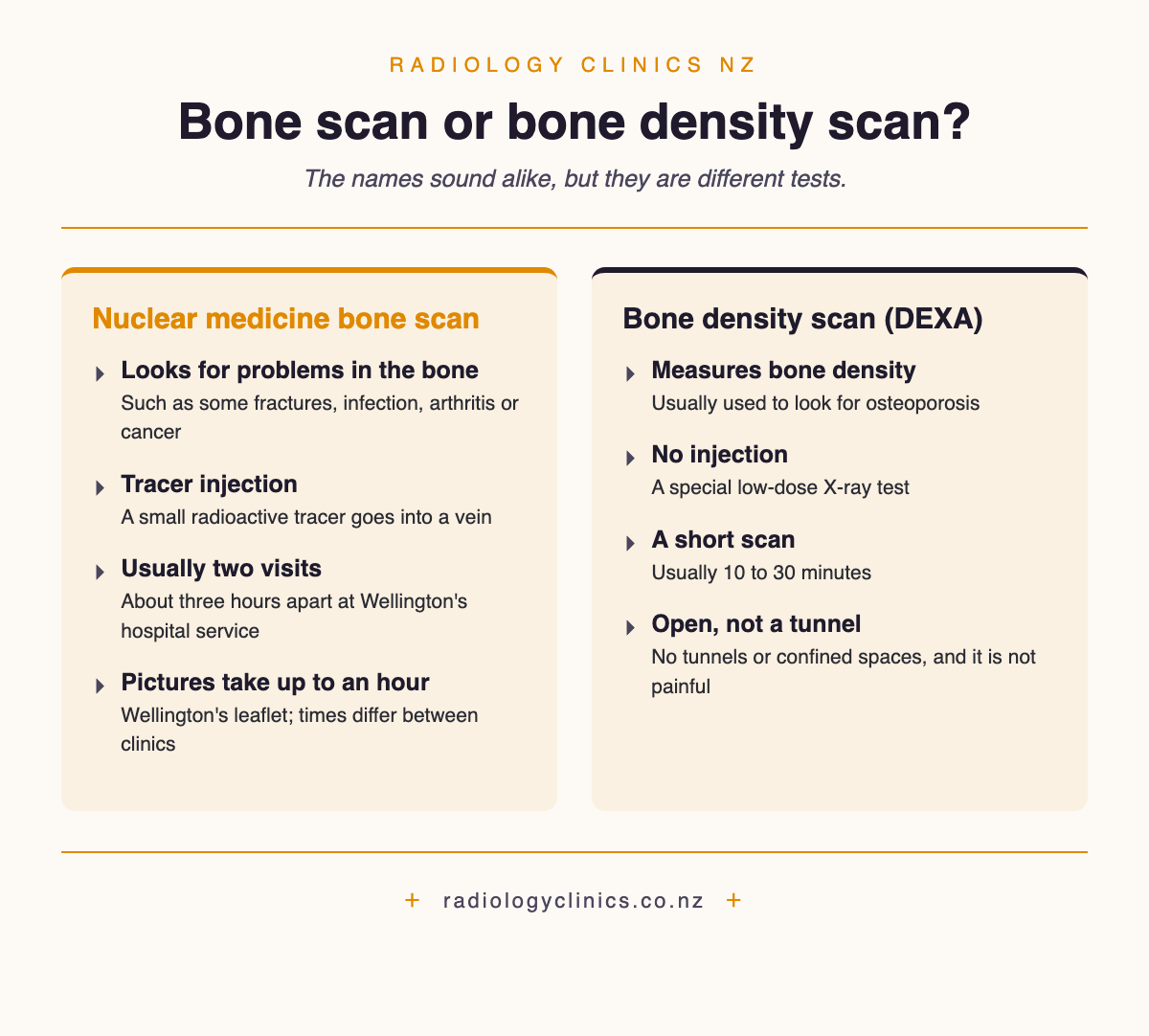
If you’re being checked for osteoporosis, you want our bone density guide instead. If you’re having both tests, tell the DEXA clinic: Allevia says a DEXA shouldn’t be done within 72 hours of a nuclear bone scan.
What a “hot spot” means: areas of bone growth take up more tracer and show up as “hot” spots. These may mean a problem such as cancer, a fracture or an infection. The doctor who ordered your scan should discuss your results with you.
Who refers you, and who pays?
You can’t refer yourself, so this isn’t one of the scans you can book without a referral. Who pays depends on the reason for the scan, and it’s worth settling that before you book.
What does it cost? We found no published price on the clinic pages we read for this guide on 4 November 2026. The NZ figures we did find are Christchurch Hospital’s: $2,281.07 for a nuclear medicine bone scan and $1,895.96 for a lung V/Q scan, valid from 1 February 2025, with GST included and marked as indicative. These are hospital fees for people who aren’t eligible for publicly funded care. They aren’t private clinic prices, and eligible patients don’t pay them.
What happens on the day?
You’ll get a time and preparation instructions with your appointment. Follow those over anything here, because departments differ.
A bone scan is the one most people meet, and Beyond calls it the most commonly performed. At Wellington’s hospital service, there’s no preparation and you have two appointments. You have the injection, then return after about three hours, with pictures taking up to 60 minutes. You’re encouraged to drink extra fluids in between. Other services run close to this: Reform says the first visit takes about 15 minutes, the gap two to three hours and the scan 30 to 45 minutes.
The gap catches people out. You can leave if the wait is more than an hour, so you don’t have to sit there. For the scan, you lie on a bed and keep very still. The tracer won’t make you sleepy or stop you driving.
Other scans have more preparation, and that’s where people get caught out.
Kidney and gallbladder scans have their own rules for fluids or fasting. Wellington’s kidney filtering (GFR) test, for example, has half an hour of pictures, then four blood samples, one an hour, from two to five hours after the injection. If you have diabetes and you’re told to fast, talk to the department first: NZMI asks for this, and Wellington’s heart leaflet has a separate instruction.
If you can’t make it, ring early. At Auckland Radiology Group, your injection is prepared specifically for you and can only be used on the day, and you may be charged for it if you don’t cancel before that day.
Is it safe?
The word “nuclear” does a lot of frightening here. Health NZ calls this a very safe test: allergic reactions are extremely rare, most people feel nothing from the tracer, and it leaves your body over the next 24 hours, mostly in your urine.
Radiation dose varies between scans, and we found no single NZ figure. Healthify says many bone scans are about the same as 2 normal X-rays. Health NZ puts a thyroid scan at about the same as an X-ray or less. Clinic pages talk about nuclear medicine generally, and they don’t agree: SRG calls its doses comparable to X-ray examinations, Allevia says often less than a CT, and I-MED says similar to CT. If the dose worries you, talk to the doctor ordering your scan.
- Pregnant, or might be: tell your provider first. They may advise precautions, a delay or a different test.
- Breastfeeding: tell them too. You may be advised to pause, then discard milk before starting again.
- Young children and pregnant people: you may be advised to limit continuous close contact until the next day. It depends on the scan. Auckland Radiology Group says 12 hours, and Reform says the rest of the day.
- Your partner and pets: it’s safe to share a bed unless you’re told otherwise, and pets are fine.
When do you get the results?
A specialist reports your images and sends the report to whoever referred you, and that person discusses the result with you. Timing differs a lot: within 48 hours at SRG, seven to 10 days at I-MED, and usually two weeks for Wellington’s bone scans.
Where can you have one?
Start with our nuclear medicine clinic list, or the Auckland page if you’re there. Public services are reached by referral, and Health NZ pages name them at Christchurch Hospital, Waikato, Dunedin and Southland and Wellington. We couldn’t find a national list, so that isn’t the full picture. In Christchurch, some scans run only on certain days.
Affinity lists nuclear medicine under all three clinics, so ask which one does your scan. For addresses, use the clinic’s own site.
Ask when you book
✓ “Do you do this exact scan at this branch, and on which days?”
✓ “What will I pay, and do you need ACC or my insurer to approve it first?”
✓ “How soon will my doctor get the report?”
With some of these scans, the instructions start weeks before the appointment. Read your letter the day it arrives, not the night before.
Sources
- Health NZ: SPECT-CT and molecular imaging
- Health NZ: Thyroid scan
- Health NZ: Bone density scan (DEXA)
- Health NZ Wellington leaflets: bone scan, general nuclear medicine, myocardial perfusion scan, GFR scan
- Health NZ Canterbury: Paying for your care
- Health NZ Canterbury: Molecular imaging and therapy
- Canterbury DHB: Molecular imaging, archived copy of the page updated October 2024
- Health NZ: National Community Referral Criteria for Imaging v2.0
- Healthify: Nuclear medicine, Bone scan
- Heart Foundation: Myocardial perfusion scan
- Southern Cross: Wellbeing plan document, effective 1 April 2026, Affiliated Provider-only services, effective 14 October 2026
- Clinic pages: Allevia, SRG, Auckland Radiology Group, Beyond, Affinity, Reform, Canopy referral form, I-MED, NZMI
This article is general information, not personal medical advice. Ask your referrer which service is available, and ask the clinic whether public funding or ACC cover applies and what you will need to pay.
Last updated November 2026

Author: Dr. Mark Bekhit
Dr Mark Bekhit (MBChB, FRANZCR) is a musculoskeletal radiologist practising in Brisbane and an AHPRA-registered specialist in diagnostic radiology (MED0002920947). He spends as much time building software as reading scans: he founded Imaging Finder (Australia) and Radiology Clinics NZ to make imaging easier to find, and builds radiology dictation and pain-tracking tools with one aim — better patient outcomes and a smoother reporting workflow. Outside the reading room he's usually training, bringing the same performance mindset to imaging.
Leave a Reply