Short answer: You can buy a full-body MRI in New Zealand. Every programme we found is in Auckland, usually inside a health-check package: Vitalis lists $4,400 (its imaging page adds GST) and Novator’s start at $5,855 for packages that include one (checked 11 October 2026). Astra Radiology needs a referral from your GP or a wellness provider. Southern Cross’s terms for its First Cover, Sovereign and Super plans exclude health screening, with narrow exceptions. And the radiologists’ college does not recommend it if you are well and have no past cancer or inherited cancer syndrome.
On this page
Where can you get a full-body MRI in NZ?
A full-body MRI still needs a referral. For any MRI, you cannot refer yourself; our guide to scans without a referral explains the rule. That leaves two routes, and every programme we found is in Auckland:
- A preventive-health company that bundles the scan into a health check. Four we checked are in the table below; Astra also names a fifth, Well For Life, which we did not check.
- Your GP, if they agree to refer you. Astra Radiology, a radiology practice, accepts wellness-scan referrals from your GP as well as from those companies. Astra publishes no price, so ask for a quote when you send the referral.
Read 11 October 2026 from each company’s own pages. These are the programmes we found, not a complete list.
“Full-body” is a looser label than it sounds. The radiologists’ college defines a whole-body MRI as the head, neck, chest, abdomen and pelvis. Astra’s own list of regions, quoted above, does not mention the chest, and Astra sells a lung CT as a separate test.
How much does a full-body MRI cost in NZ, and does insurance pay?
Only two of the programmes publish a price on the pages we read, and both are package prices. You are buying a doctor’s assessment, blood tests and other checks along with the scan.
Prices as listed on 11 October 2026. Each company confirms the price when you book.
Vitalis makes the scan’s share easy to see: its home page describes Prestige as everything in Foundation plus the full-body MRI, a difference of $2,500 (both prices from the home page; its imaging page adds GST to the $4,400).
A public hospital scan is usually free, and Health New Zealand | Te Whatu Ora describes MRI as a test to diagnose a condition, plan treatment or check how a treatment worked. In my experience the public system does not offer an MRI to check on a well person, and every programme above is private, so expect to pay for a wellness scan yourself. If you want the general picture of private MRI prices and the public and ACC routes, our MRI cost guide covers it.
Insurance: Southern Cross’s terms for its First Cover, Sovereign and Super plans (effective 1 April 2026) define health screening as tests done “in the absence of any sign or symptom” and exclude it, except where a plan’s imaging benefit specifically provides for mammograms and breast ultrasound, or its surgical benefit for colonoscopy. A full-body MRI on a well person fits that definition. We read only those Southern Cross terms. Ask your own insurer one question: does my policy pay for a scan when I have no symptoms?
Is a full-body MRI worth it? A radiologist’s view
In July 2025 the Royal Australian and New Zealand College of Radiologists (RANZCR) approved version 1.1 of its position statement. It does not recommend whole-body MRI screening in people without symptoms who have not had cancer and do not carry an inherited cancer syndrome. These are the doctors who report the scans.
The reason is not that MRI is dangerous. It uses no ionising radiation (the kind of radiation X-rays and CT use). The problem is what happens after the pictures.
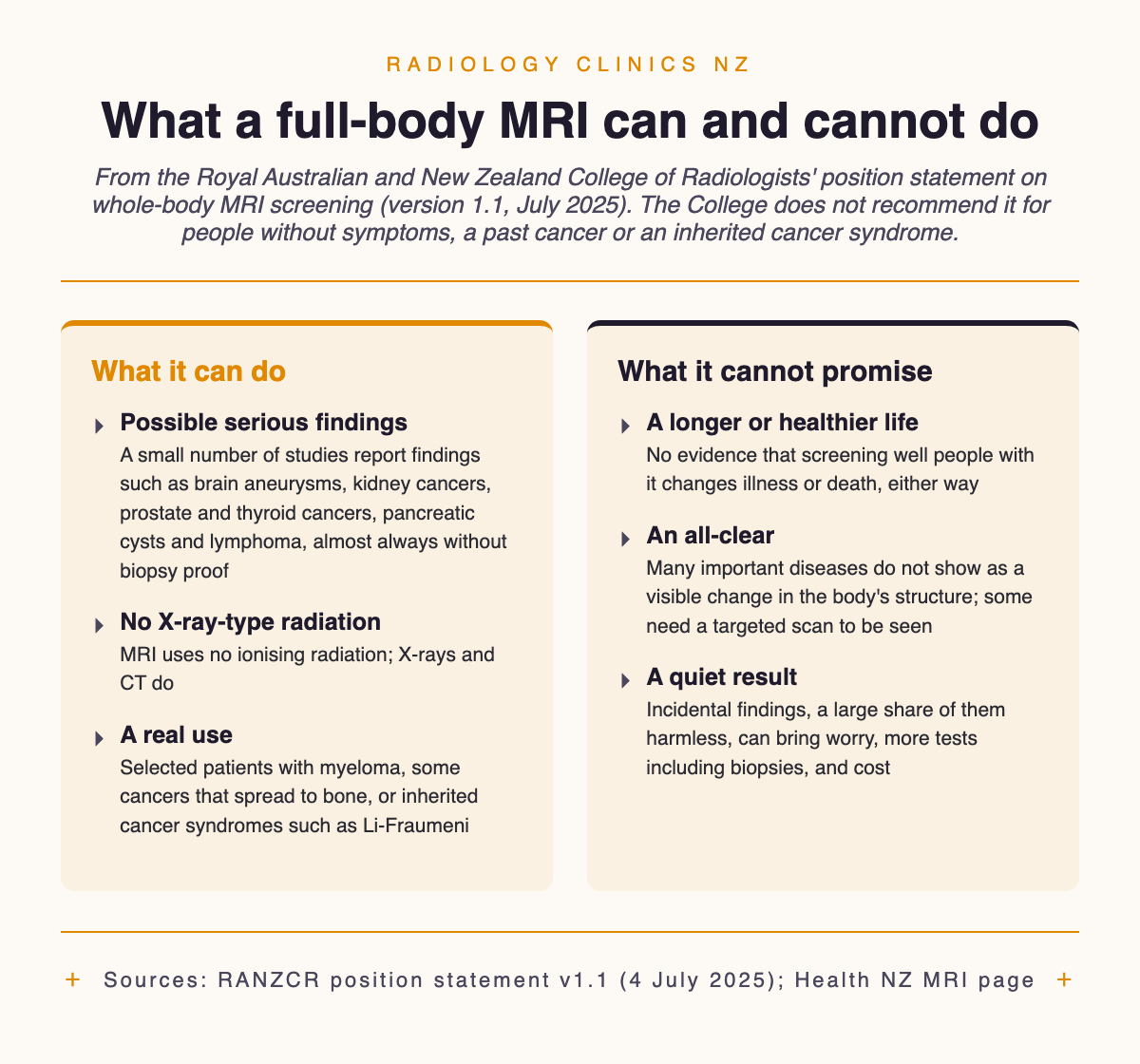
It finds things, and many of them do not matter. A small number of studies of whole-body MRI report findings such as brain aneurysms, kidney cancers, prostate and thyroid cancers, pancreatic cysts and lymphoma, but their importance was almost always judged without biopsy proof. Meanwhile, the college notes, a large share of incidental findings (things the scan picks up by chance, which nobody was looking for) are harmless or unlikely to affect your health, and each can still bring anxiety, further tests including biopsy, and real cost.
From the reporting side, this is the part people underestimate. Once a finding is in a report, someone has to decide what to do with it, and “probably nothing” is a hard sentence to live with. In my view, a well person rarely finishes a whole-body scan with a report that says nothing at all. Go in expecting a finding, and knowing who will deal with it.
A normal scan is not an all-clear. Many important diseases do not show up as a visible change in the body’s structure, so whole-body MRI cannot see them, and some that a targeted scan would pick up can be missed by the general set of pictures (the protocol) a whole-body scan uses. No study has shown that a normal result rules out serious disease five or more years later. False reassurance is its own harm.
No proven benefit. There is no evidence that screening well people this way changes illness or death, for better or worse.
Whole-body MRI does have a proper job. The college lists selected patients with myeloma and other blood cancers, some cancers that spread to bone where no better staging test (a scan that shows how far a cancer has spread) is available, and inherited syndromes such as Li-Fraumeni. If that describes you, the scan should come through the specialist looking after you, with a protocol chosen for your condition, not through a wellness package.
What free cancer screening should you do first?
If what you really want is to catch cancer early, New Zealand already runs three national cancer screening programmes. Bowel and breast screening are free for eligible people; cervical screening is free for some groups. Screening mammography is the kind of targeted screening that large trials have shown reduces the burden of disease.
Health New Zealand | Te Whatu Ora pages, read 11 October 2026.
If you are in the eligible age band and your bowel kit is sitting unopened in a drawer, that kit is a better use of your morning than a full-body scan. If you have symptoms, that is a different conversation altogether: see your GP, because a targeted test aimed at the symptom is what finds the cause.
If you still want one, where do you go and what do you ask?
It is your money and your decision. If you go ahead, Everlab names Allevia Hospital Ascot in Remuera for its whole-body MRI and CT, and Astra Radiology, which takes wellness-scan referrals from these companies and from GPs, has several Remuera listings in our directory. Here are two that name MRI, checked 11 October 2026:
Astra Radiology, Ascot Hospital: our listing names MRI and CT. Astra’s own page places this clinic inside Allevia Hospital Ascot, the hospital Everlab names for its whole-body MRI and CT.
Astra Radiology, Ascot Central: our listing names MRI. Astra’s Ascot Central page lists MRI.
Examples only, with no endorsement implied. The programme or Astra decides which site does your scan when you book.
For the full spread of clinics, our Auckland MRI clinic list and the national MRI clinic list show addresses and phone numbers. A wellness scan is arranged through one of the programmes above, or with a GP referral to Astra Radiology.
Ask before you pay
✓ “Which body regions does the scan cover, and is the chest included?”
✓ “Will a radiologist report it, and who explains the findings to me?”
✓ “If something turns up, who arranges the next test, and is that cost in the package?”
Tell the clinic about any metal or implant in your body, such as a pacemaker or cochlear implant, before the day. A long scan in a tunnel is hard for some people; our guide to claustrophobia and MRI covers what helps. And if a package adds a CT, as Everlab’s does, remember that CT uses ionising radiation and MRI does not.
If you buy a full-body MRI, buy it with a plan for the report. Do the free screening either way.
Sources and review
Reviewed 11 October 2026 against the RANZCR position statement on whole-body MRI screening in low-risk patients (v1.1, 4 July 2025); Health New Zealand | Te Whatu Ora pages on MRI, scans and x-rays, cancer screening, bowel screening eligibility, breast screening and cervical screening eligibility; the Southern Cross terms and conditions (effective 1 April 2026); and the pages of Astra Radiology, Everlab, Novator Health, Vitalis Health and Autonomy Health. Prices are each company’s own listed figure on the review date.
This article is general information, not personal medical advice. Ask your referrer which service is available, and ask the clinic whether public funding or ACC cover applies and what you will need to pay.
Last updated October 2026

Author: Dr. Mark Bekhit
Dr Mark Bekhit (MBChB, FRANZCR) is a musculoskeletal radiologist practising in Brisbane and an AHPRA-registered specialist in diagnostic radiology (MED0002920947). He spends as much time building software as reading scans: he founded Imaging Finder (Australia) and Radiology Clinics NZ to make imaging easier to find, and builds radiology dictation and pain-tracking tools with one aim — better patient outcomes and a smoother reporting workflow. Outside the reading room he's usually training, bringing the same performance mindset to imaging.
Sources, method, and medical context
This article is published by Radiology Clinics NZ and reviewed for medical-adjacent accuracy by Dr. Mark Bekhit, radiologist. It is general information only and does not replace advice from your own doctor, referrer, clinic, insurer, or Health New Zealand service.
Official references
- Health New Zealand: scans and X-rays
- Health New Zealand: community-referred radiology service
- Radiology Clinics NZ: how the directory is built
Related directory pages
Radiology clinics directoryMRI clinicsBrowse by cityHow this directory is built
Last editorial review: 2026-06-30.
Leave a Reply