Dr. Mark Bekhit, Radiologist · Last updated August 2026
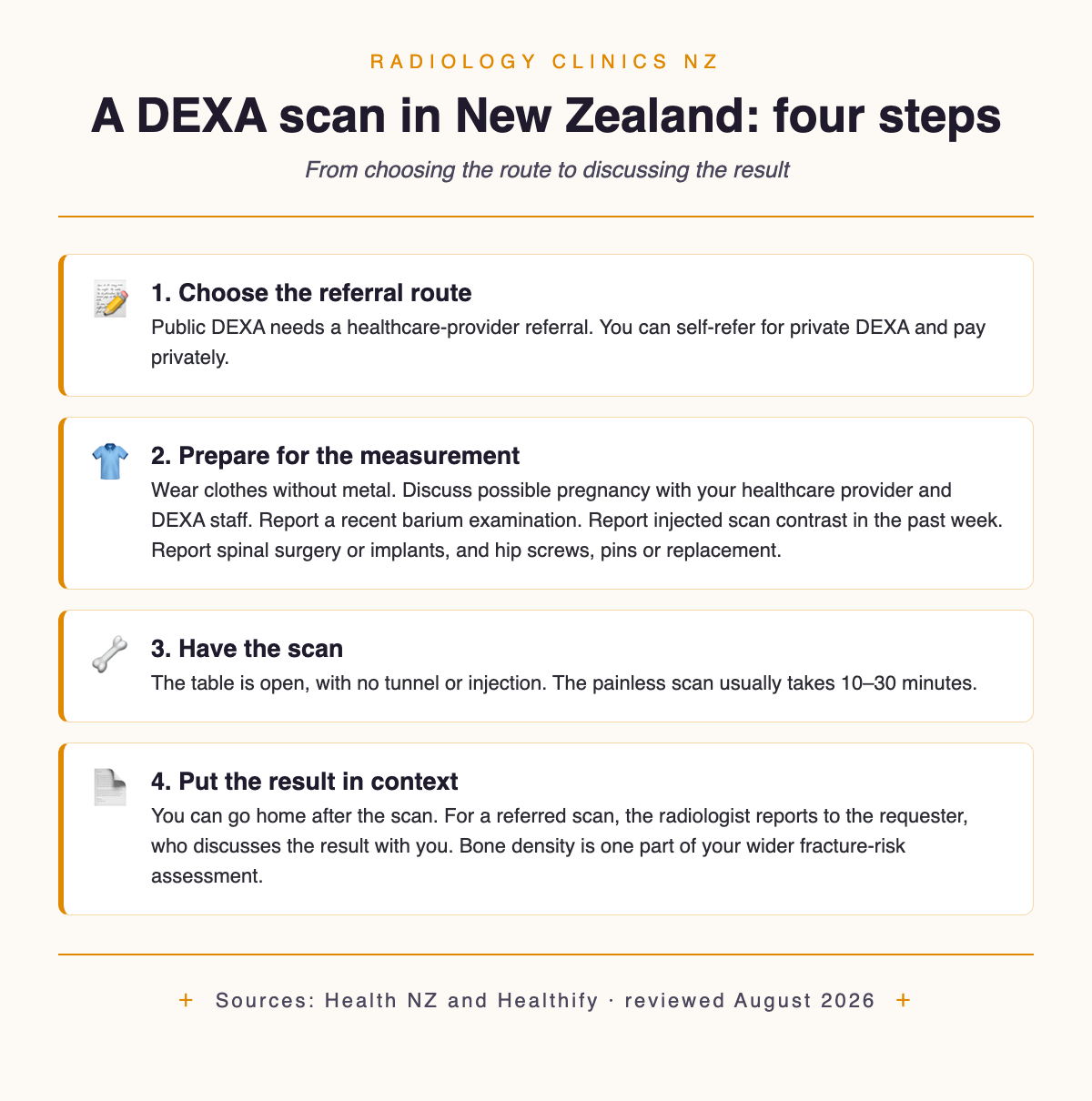
Short answer: A DEXA scan is a low-dose X-ray test of bone density. Public DEXA needs a healthcare-provider referral. You can self-refer privately and pay. Preparation is usually simple, and the painless scan has no tunnel or injection and usually takes 10–30 minutes. The result is not used alone. It becomes part of a wider assessment of your age, fracture history, medicines and other personal risks.
What does a DEXA scan tell you?
A DEXA scan measures how dense or strong your bones are. It can help your healthcare provider assess osteoporosis. Osteoporosis often causes no symptoms in its early stages.
A break caused by osteoporosis is often called a fragility fracture. It can happen after a small fall or an everyday activity because the bone is weak. Fragility fractures commonly affect the wrist, hip, spine or upper arm.
A denser bone generally has fewer air spaces, is stronger and is less likely to fracture. DEXA provides that density measurement. It does not directly record the other reasons why one person may be more likely to fracture than another.
Bone density is one part of that risk. A bone health check estimates your chance of an osteoporosis-related fracture over the next 10 years. A DEXA measurement can make that estimate more precise when it is included.
Ask about a bone health check if you have had a previous fracture, have a parent who fractured a hip, fall often, have poor balance, or use medicines that weaken bones. Older age, menopause before 45, some medical conditions and high-dose prednisone for more than three months are also established risk factors. These factors can prompt a bone health check. A healthcare provider may then suggest DEXA to assess bone health.
Do you need a referral for DEXA in New Zealand?
The route is clear in the public system: a healthcare provider must refer you, and you cannot self-refer.
Private access is different. If public DEXA is unavailable, your healthcare provider can refer you privately and you will need to pay. You can also self-refer privately and pay for the scan.
For more detail, compare public and private radiology in New Zealand or read how imaging referrals work.
Where can you find a clinic that offers DEXA?
As at 11 August 2026, the live bone-density clinic map shows 17 New Zealand branches with current branch-specific evidence for DEXA. Open a map marker to see the clinic location, contact details and website.
A provider’s national service page does not prove that every branch has the same scanner. The map therefore excludes clinics without branch-specific DEXA evidence. It is the current verified set, not a claim that every New Zealand DEXA provider has been captured.
Before you book: ask whether that location still offers DEXA, whether it accepts your referral or private self-referral route, and what you will pay.
How do you prepare for a bone density scan?
A DEXA scan generally needs no special preparation. Wear loose, comfortable clothing without metal zips, belts or buttons. Staff may ask you to change into a gown.
Tell staff before the scan: DEXA is not suitable during pregnancy, so tell your referrer and scan staff if pregnancy is possible. Also report a recent barium examination, or injected CT or other scan contrast within the previous week, because the DEXA may need to wait. Tell staff about spinal surgery, metal spinal implants, hip screws or pins, or a hip replacement.
You may also be asked to remove jewellery, removable dental appliances or eyeglasses if they could interfere with the X-ray images.
The imaging appointment checklist covers other general appointment details.
What happens during a DEXA scan?
You lie on a table while a scanner passes over your body and sends information to a computer. The table is not enclosed. There is no tunnel or injection, and the examination is not painful.
The scan usually takes 10–30 minutes, depending on the body part examined. The technologist stays in the room, guides your position and tells you when to keep still. DEXA uses much less radiation than a standard X-ray. You can go home afterwards.
How should you use the result, and what should you ask?
A radiologist reviews a referred scan and sends the report to the healthcare provider who requested it. That healthcare provider discusses the result with you.
DEXA supplies one measurement for the wider discussion. A bone health check also uses your age, medical history, lifestyle, previous fractures and medicines. Adding the DEXA result can make a fracture-risk estimate more precise. These calculators estimate risk over time, but they use different inputs: FRAX estimates 10-year hip and major-fracture risk, while Garvan estimates 5- and 10-year hip or any-fragility-fracture risk.
If the report wording is unfamiliar, use the guide to reading a radiology report. If the report remains unclear or does not seem to address the clinical question, the radiology second-opinion guide explains clarification and review routes.
Questions about your result
✓ “If I self-refer, who receives the report?”
✓ “Who will discuss the result with me?”
✓ “What follow-up is suitable for me?”
The first-scan questions provide a broader checklist.
Sources
The medical and access facts in this article come from current Health NZ DEXA guidance, its osteoporosis information and scan overview, plus Healthify’s pages on DEXA, bone health checks and fracture-risk calculators. The clinic total and examples use the live Radiology Clinics NZ hub and saved branch evidence checked on 11 August 2026. Clinics without branch-specific DEXA evidence are excluded. No fixed fees, waiting times, treatment thresholds or universal repeat intervals are published here.
This article is general information, not personal medical advice. Ask your referrer which service is available, and ask the clinic whether public funding or ACC cover applies and what you will need to pay.

Author: Dr. Mark Bekhit
Dr Mark Bekhit (MBChB, FRANZCR) is a musculoskeletal radiologist practising in Brisbane and an AHPRA-registered specialist in diagnostic radiology (MED0002920947). He spends as much time building software as reading scans: he founded Imaging Finder (Australia) and Radiology Clinics NZ to make imaging easier to find, and builds radiology dictation and pain-tracking tools with one aim — better patient outcomes and a smoother reporting workflow. Outside the reading room he's usually training, bringing the same performance mindset to imaging.
Sources, method, and medical context
This article is published by Radiology Clinics NZ and reviewed for medical-adjacent accuracy by Dr. Mark Bekhit, radiologist. It is general information only and does not replace advice from your own doctor, referrer, clinic, insurer, or Health New Zealand service.
Official references
- Health New Zealand: scans and X-rays
- Health New Zealand: community-referred radiology service
- Radiology Clinics NZ: how the directory is built
Related directory pages
Radiology clinics directoryBrowse by scan typeBrowse by cityHow this directory is built
Last editorial review: 2026-06-30.
Leave a Reply