
Dr. Mark Bekhit, Radiologist · Last updated August 2026
Short answer: Start with the doctor or healthcare practitioner who requested your scan. Explain the exact concern and ask whether you need an explanation, a re-review by the original radiologist, or another opinion. Your referrer is best placed to request a re-review because the radiologist may need your symptoms, treatment, past history or surgery. You also have a right to your results and an honest answer about how to get another opinion.
If a health concern is not life-threatening but cannot wait for your usual provider, go to an after-hours or urgent medical centre. Call 111 for a critical or life-threatening emergency.
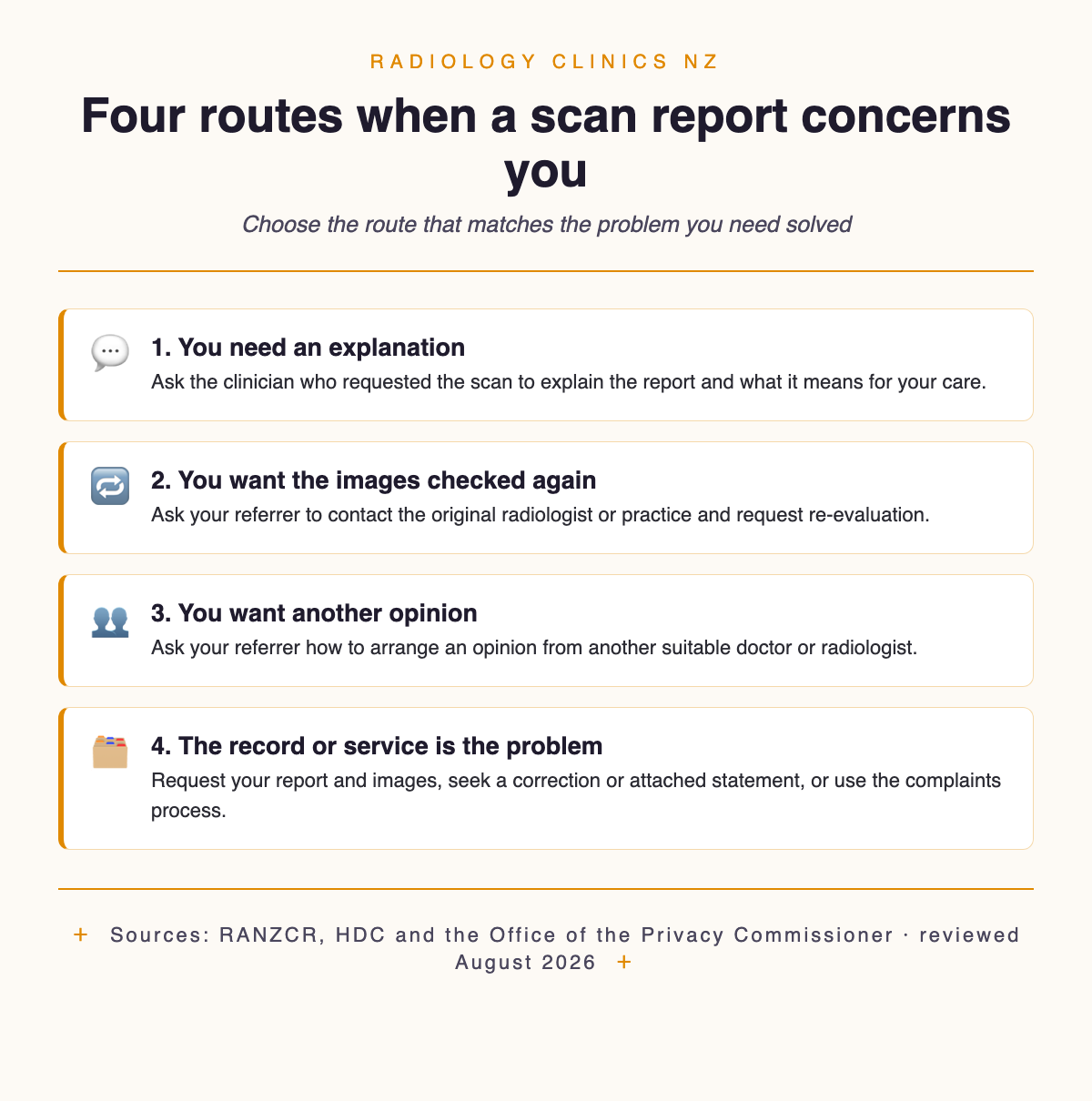
Which route fits your concern?
Begin with the clinical question and the clinician who requested your scan. That clinician receives the radiologist’s report and should discuss the result with you. You may also request a written summary of the information.
If the words themselves are the problem, see how to read a radiology report before your appointment. Bring the sentences you do not understand. You do not need to learn radiology vocabulary before asking a fair question.
How do I ask for the scan to be reviewed?
Name the study, the concern and the decision. A useful request sounds like this:
Try this: “My MRI was done on 4 August. The report does not seem to address the pain in my left leg. Could you explain the finding and ask the radiology practice whether the images should be reviewed with that clinical detail?”
The exact route matters. RANZCR advises patients to contact the referring practitioner first. The practitioner can often explain the report and will usually be able to contact the original radiologist or practice about it.
Your referrer also carries the information that a scan cannot show by itself. A reviewing radiologist may need the clinical problem, treatment, previous surgery and relevant history. New clinical information can lead to a different interpretation when it was absent from the first request.
A re-evaluation may end with a supplementary report or an addition to the original report.
RANZCR sets professional standards but does not arrange second opinions or provide member contact details for this purpose.
What records should I request?
Ask for the written radiology report and the actual images. Name the examination and date. If the review will cover several scans, list each one rather than asking for “everything”.
You have a national right to request personal information held about you. The request can be made by email, letter, phone or in person. The organisation normally must respond within 20 working days. A limited extension is possible, but the organisation must explain it and give you an updated date.
A Health NZ records request needs a written form, enough detail, relevant dates and proof of identity; that service has no charge. In most circumstances, access and correction requests should not carry a fee. Keep a copy of your request and the date you sent it.
The central-region MyVue portal lets patients view and share images and reports. Its page tells patients to contact their local radiology department for access help. If that page does not cover your area, make the information request to the organisation that holds your scan.
A reviewing radiologist may need the clinical problem, treatment, past history, surgery and other medical background. The referrer is best placed to provide those details. For more detail on result delivery, see online portals versus a results appointment.
Is a correction or complaint the same as a second opinion?
No. These routes solve different problems.
A clinical re-review asks what the images show. A correction request asks whether stored information about you is wrong, incomplete or misleading. The organisation must consider your correction request but does not have to make the change you request.
If the organisation declines, it must explain why. You can then ask it to attach a statement of correction. Keep that statement short so it can be read alongside the disputed information.
A complaint concerns the quality of the service or whether your rights were respected. Under Right 10, you may complain in a form that suits you and should be told the provider’s complaint and appeal process. If you need communication support for that conversation, use the radiology communication support guide.
Keep the routes separate: HDC cannot provide a second opinion, change your medical notes or get you an appointment. A complaint may examine the service. It does not replace the clinical route for another interpretation.
What should I confirm before another radiologist reviews it?
Ask before the review starts
✓ “Who needs to request the review: my GP, specialist, ACC, insurer or another clinician?”
✓ “Will the original radiologist re-check it, or will another radiologist give an independent opinion?”
✓ “Do you need the original images, report, earlier scans and referral information?”
✓ “What clinical question should the request state?”
✓ “What will it cost, and has ACC or my insurer approved that specific service?”
✓ “When should I expect the report, who will receive it, and who will discuss it with me?”
These are not fussy administrative questions. Right 6 includes information about your available options, expected costs and an estimate of service timing. Ask for the answers in writing if you will pay privately.
Do not assume that funding for the first scan automatically pays for a separate report. Public hospitals usually do not charge for the scan, and ACC usually pays when a scan is needed because of an accidental injury, although a part-charge may apply. That guidance is about scans and X-rays, not a separate re-read.
If the request is getting lost between services, the referrer-to-report handoff guide explains the information and contact route an imaging service needs. If you cannot get an appointment or response, use the steps in what to do when imaging arrangements stall.
What should happen after the review?
For the usual scan pathway, the requesting healthcare provider discusses the radiology result with the patient.
Ask whether the review produced a supplementary report or an addition to the original. Then ask one direct question: “What does this change, if anything, about the decision we were discussing?” Under Right 6, you should receive the results and the information needed to make a decision. You may also request a written summary.
Additional history can change how an imaging study is interpreted. If two reports differ, ask whether both reviews used the same clinical information, what remains uncertain and what next step your referrer recommends.
If you are preparing for that discussion, take the same question-first approach used before a scan: what question did the imaging answer, what remains uncertain, and who owns follow-up?
Frequently asked questions
Can the same images be reviewed without another scan?
Yes. A re-interpretation uses the existing imaging study. Ask the practitioner who referred you to contact the original radiologist or practice. The referrer can often explain the report and can usually contact the radiologist or practice about re-evaluation.
Can I contact the radiologist directly?
RANZCR advises that the referrer should request a review rather than the patient or family member. The radiologist may need details about your symptoms, treatment, history or surgery. Your referrer is usually best placed to provide that context.
Do I have a right to another opinion?
You have a right to information about how to get one. Under Right 6, your provider should give honest answers about how to obtain another opinion.
Will ACC or private insurance pay for a radiology second opinion?
Do not assume so. ACC usually pays when a scan is needed because of an accidental injury, although a part-charge may apply, and insurance may cover some scan cost. The cited national guidance covers scans, not a separate re-read.
Can HDC arrange a second opinion or change my report?
No. HDC cannot provide a second opinion or change medical notes. It considers complaints about service quality and possible Code breaches. For a disputed record, ask the holder to correct it or attach your statement of correction.
Sources and limits
This page was written and clinically reviewed by Dr. Mark Bekhit on 10 August 2026. The review route comes from RANZCR’s June 2024 Consumers Seeking Second Opinions position statement. Patient rights and complaint limits come from the HDC Code summary and complaint process. Record access and correction come from the Office of the Privacy Commissioner’s access and correction guidance. These national sources do not establish provider availability, price, payer approval or turnaround for a separate re-read.
This article is general information, not personal medical advice. Ask your referrer which service is available, and ask the clinic whether public funding or ACC cover applies and what you will need to pay.

Author: Dr. Mark Bekhit
Dr Mark Bekhit (MBChB, FRANZCR) is a musculoskeletal radiologist practising in Brisbane and an AHPRA-registered specialist in diagnostic radiology (MED0002920947). He spends as much time building software as reading scans: he founded Imaging Finder (Australia) and Radiology Clinics NZ to make imaging easier to find, and builds radiology dictation and pain-tracking tools with one aim — better patient outcomes and a smoother reporting workflow. Outside the reading room he's usually training, bringing the same performance mindset to imaging.
Sources, method, and medical context
This article is published by Radiology Clinics NZ and reviewed for medical-adjacent accuracy by Dr. Mark Bekhit, radiologist. It is general information only and does not replace advice from your own doctor, referrer, clinic, insurer, or Health New Zealand service.
Official references
- Health New Zealand: scans and X-rays
- Health New Zealand: community-referred radiology service
- Radiology Clinics NZ: how the directory is built
Related directory pages
Radiology clinics directoryBrowse by scan typeBrowse by cityHow this directory is built
Last editorial review: 2026-06-30.
Leave a Reply