By Dr. Mark Bekhit, Radiologist
Last updated August 2026
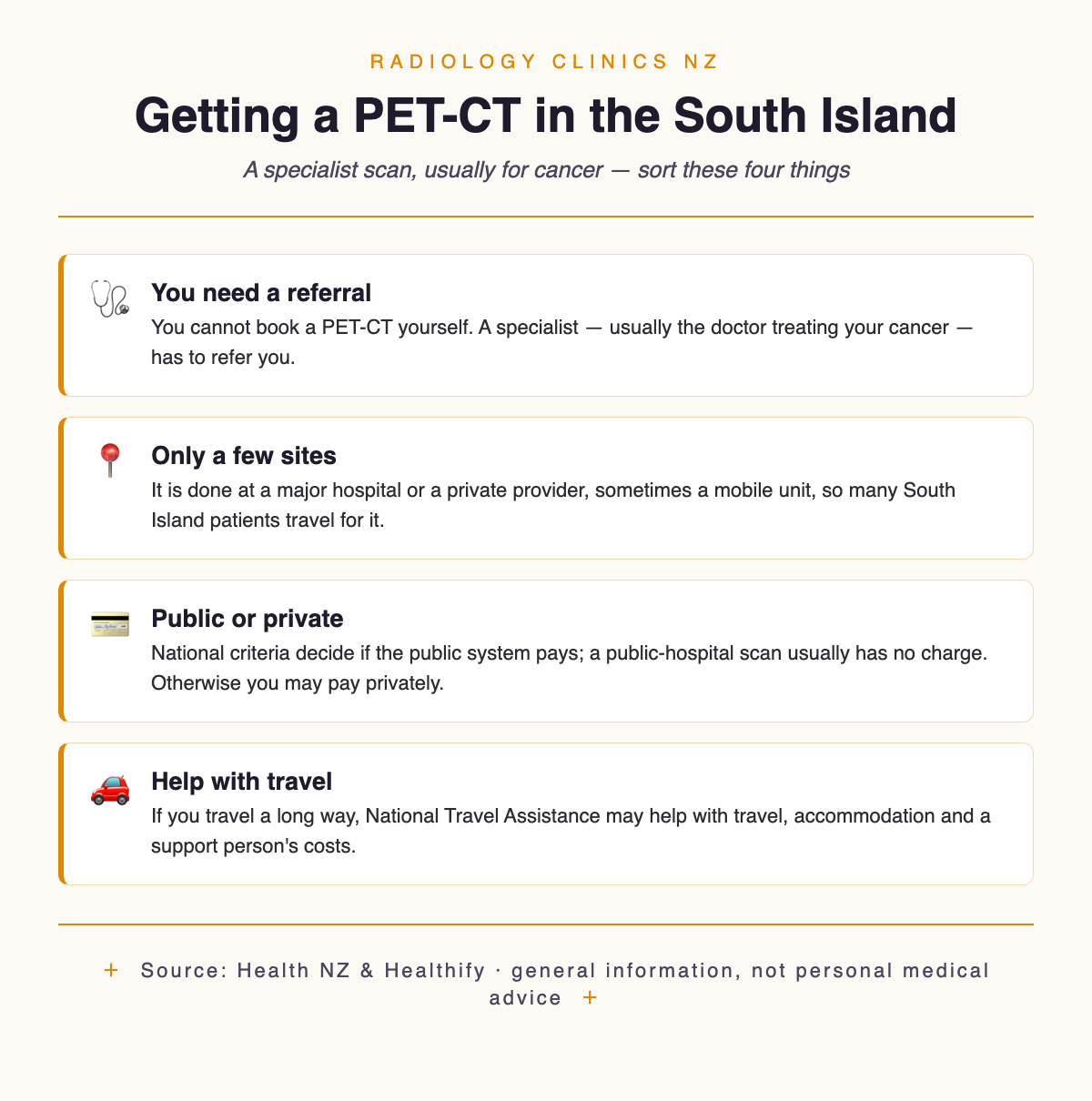
Short answer: A PET-CT is a specialist scan, usually for cancer, that you cannot book yourself — a doctor has to refer you. In the South Island it is done at only a few sites (a hospital or a private provider, sometimes a mobile unit), so many people travel for it. Whether the public system pays is set by national criteria that now apply the same way wherever you live; otherwise you may pay privately. If you travel far, National Travel Assistance may help. Ask your specialist which site you will attend and whether your scan is funded.
PET-CT (positron emission tomography combined with CT) is one of the more specialised scans in New Zealand imaging, and the South Island has only a small number of places that can do it — which is why travel, funding and getting a referral all come up more often for South Island patients than for a routine X-ray or ultrasound.
What a PET-CT scan is
A PET scan uses a special camera and a small amount of a radioactive substance called a radiotracer. The radiotracer shows up areas of the body where cells are very active. Because cancer cells are very active, this makes a PET scan particularly useful for showing up cancer, and it can also look for other kinds of abnormal function in your tissues and organs.
The PET pictures are usually taken together with a CT scan at the same time — that combination is what “PET-CT” means. Together they are used to assess cancers, brain diseases and heart-related diseases. Your doctor might send you for one to help diagnose a problem, to stage a cancer (see how far it has spread), to check whether treatment is working, or to look for a recurrence.
Where you can have a PET-CT in the South Island
PET-CT is not offered everywhere. A scan may be done at a major hospital, or at a private radiology provider — and that provider may be using a mobile unit that travels between locations. It is a specialised service, carried out by trained nuclear-medicine staff working with a specialist, and only a small number of sites across the South Island provide it.
In practice, the site you go to is decided by your referring specialist and where a service is available — you do not choose a PET-CT site the way you might pick a local X-ray clinic. Two things help you plan:
- Find out which site you will be referred to, and roughly how far you will need to travel.
- Use the Radiology Clinics NZ directory to find nuclear-medicine and imaging providers by location, then check availability before you arrange travel — PET-CT is not a service you can book yourself.
Our guide to finding a radiology clinic near you has more on searching the directory.
Who can refer you
You cannot self-refer for a PET-CT scan — a healthcare provider has to refer you. For cancer, that is usually the specialist looking after you (for example an oncologist, surgeon or respiratory physician) rather than a request you make directly. The scan can be arranged either through the public health system or privately.
Good to know: A PET-CT is usually ordered as part of working up or following a cancer, so the specialist looking after you is the person who decides whether it will add something your earlier scans cannot — and who arranges it. If you think you might need one, that is the person to raise it with.
Is it publicly funded?
A PET-CT can be done in the public health system or privately. Whether the public system pays for yours depends on national eligibility criteria. Health New Zealand approved and funds an updated National PET-CT indication list and criteria, developed by the Cancer Control Agency with clinical input, which set out the situations in which a PET-CT is publicly funded.
The point of a single national list is fairness: New Zealanders now have the same access to PET-CT scans no matter where they live. That change mattered in the South Island in particular — before the national criteria, men in the South Island had to pay for prostate PET-CT scans that men in most of the North Island did not pay for. The updated criteria were expected to publicly fund about 1,000 more PET-CT scans a year, at an estimated cost of about $3 million a year, and were in place across the country by mid-March 2024.
In the public system, a scan or x-ray done in a public hospital usually has no charge, and ACC usually pays when imaging is needed because of an accidental injury, though a part-payment may apply. Your specialist can tell you whether your scan meets the national criteria for public funding. If it does not, you may still be able to have it done privately, which you pay for yourself or through private insurance (policies differ).
As at August 2026.
Help with travel costs
Because PET-CT sites are few, you may need to travel — sometimes a long way. The National Travel Assistance (NTA) scheme helps people who need to travel long distances, or travel frequently, for specialist treatment. To use it, you must be referred by one specialist to another, and both specialists must be part of a government-funded service — a referral from your GP alone does not count.
Eligibility is based on how far and how often you travel. You may qualify if you can answer “yes” to one of the situations below.
National Travel Assistance eligibility, as at August 2026.
NTA can help towards travel costs (your own vehicle, public transport, or specialised transport such as a taxi, mobility taxi or air travel), accommodation (though accommodation is not usually approved for travel under 100km one way), and a support person’s costs. You may not be eligible if you can already get travel help from another provider such as ACC, Work and Income, or the Ministries of Social Development, Transport or Education.
How to set up National Travel Assistance
✓ Ask your hospital travel coordinator, specialist or nominated social worker to help you register — they send the form to Health New Zealand.
✓ Keep your receipts and proof of attendance from each visit.
✓ Put in your claim within 12 months of the appointment.
Preparing for your scan
When you are given your appointment, you will get instructions on how to prepare. Usually you are asked to avoid strenuous exercise for a couple of days beforehand and to stop eating 4 hours before the scan — you can still drink water. Before the scan, tell your provider if you:
- have ever had an allergic reaction to CT contrast dye;
- have been recently unwell, or have a condition such as diabetes, kidney disease or asthma;
- are taking any medicines, herbal supplements or vitamins;
- are pregnant or might be pregnant, or are breastfeeding;
- get scared of small spaces (claustrophobic).
You may need an injection of contrast dye for the CT part of the scan. A few people react to it, so you will be asked about any previous experiences with iodine contrast beforehand. Our imaging appointment checklist covers what to bring and have ready on the day.
A PET-CT can only go ahead with your informed consent — Rights 5, 6 and 7 of the Code of Health and Disability Services Consumers’ Rights. That means you must be told what is involved, you can ask as many questions as you need, you can have a support person with you, and you can ask for an interpreter if you would understand the information better in another language. If communication is a worry, our guide to asking for an interpreter or support at a radiology appointment may help.
What happens on the day
The radiotracer is injected into a vein in your arm, and you then rest quietly for about 45 to 60 minutes while it travels around your body and gathers in the more active areas. A PET scan usually covers the whole body from head to thighs, though sometimes it looks at just one part, such as the brain or heart.
After the rest period, you lie on a padded table that slides into the short tunnel of the scanner. It is important to keep very still so the pictures are clear. The scanner is reasonably quiet and the scan is painless, and the whole process usually takes up to 2 hours. The scan itself is carried out by a trained nuclear medicine technologist working with a radiologist or nuclear medicine specialist. Our list of questions to ask before your first scan can help you feel prepared.
After the scan and your results
A PET-CT is a safe procedure with no known serious complications — the radioactivity comes from a safe type of chemical and only a very tiny amount is used. Afterwards, that small amount of tracer flushes out of your body in your urine within a few hours, and drinking plenty of fluids helps. For those few hours it is recommended that you limit contact with others while the tracer clears, and you may be advised to limit contact with tamariki and pregnant women until the following day. You can get back to your usual activities and eating straight after the scan.
A radiologist views the images and writes a report, which is sent to the healthcare provider who asked for the test. They will then discuss the results with you — at a follow-up appointment, or by phone, email or text.
Frequently asked questions
Can I book a PET-CT scan myself?
No. You cannot self-refer for a PET-CT — a healthcare provider has to refer you, and for cancer that is usually the specialist looking after you. If you think you may need one, raise it with your treating team.
Do I have to travel a long way for a PET-CT?
Possibly. PET-CT is done at only a few specialist sites — a major hospital or a private provider, sometimes a mobile unit — so many South Island patients travel for it. If the site is far from you, look into National Travel Assistance, which can help with the cost.
Will the public system pay for my PET-CT?
It depends on national eligibility criteria. Health New Zealand funds a national set of PET-CT criteria that apply the same way wherever you live; a scan done in a public hospital that meets them usually has no charge. If your scan does not meet the criteria, you may be able to have it done privately instead.
How do I get help with the cost of travelling for the scan?
The National Travel Assistance scheme can help with travel and, sometimes, accommodation and a support person’s costs if you are referred between publicly funded specialists and meet the distance or frequency rules. Your hospital travel coordinator, specialist or social worker helps you register, and you claim within 12 months of the appointment.
Is a PET-CT scan safe?
Yes. Health New Zealand describes it as a safe procedure with no known serious complications, using only a very tiny amount of radioactivity that flushes out within a few hours. Tell your provider if you are pregnant, might be pregnant, or are breastfeeding, so they can advise you.
Sources and how this was checked
This guide was reviewed on 5 August 2026 against current public information from Health New Zealand, Healthify and the New Zealand Government. The key source pages are:
- Health NZ — PET-CT (positron emission tomography and CT) scan
- Healthify — Positron emission tomography (PET) scan and CT scan
- New Zealand Government — Access barriers to PET-CT scans removed (national PET-CT criteria)
- Health NZ — National Travel Assistance
- Health NZ — Scans and x-rays (cost and ACC)
This article is general information, not personal medical advice. Ask your referrer which service is available, and ask the clinic whether public funding or ACC cover applies and what you will need to pay.

Author: Dr. Mark Bekhit
Dr Mark Bekhit (MBChB, FRANZCR) is a musculoskeletal radiologist practising in Brisbane and an AHPRA-registered specialist in diagnostic radiology (MED0002920947). He spends as much time building software as reading scans: he founded Imaging Finder (Australia) and Radiology Clinics NZ to make imaging easier to find, and builds radiology dictation and pain-tracking tools with one aim — better patient outcomes and a smoother reporting workflow. Outside the reading room he's usually training, bringing the same performance mindset to imaging.
Sources, method, and medical context
This article is published by Radiology Clinics NZ and reviewed for medical-adjacent accuracy by Dr. Mark Bekhit, radiologist. It is general information only and does not replace advice from your own doctor, referrer, clinic, insurer, or Health New Zealand service.
Official references
- Health New Zealand: scans and X-rays
- Health New Zealand: community-referred radiology service
- Radiology Clinics NZ: how the directory is built
Related directory pages
Radiology clinics directoryCT Scan clinicsPET/CT clinicsBrowse by cityHow this directory is built
Last editorial review: 2026-06-30.
Leave a Reply