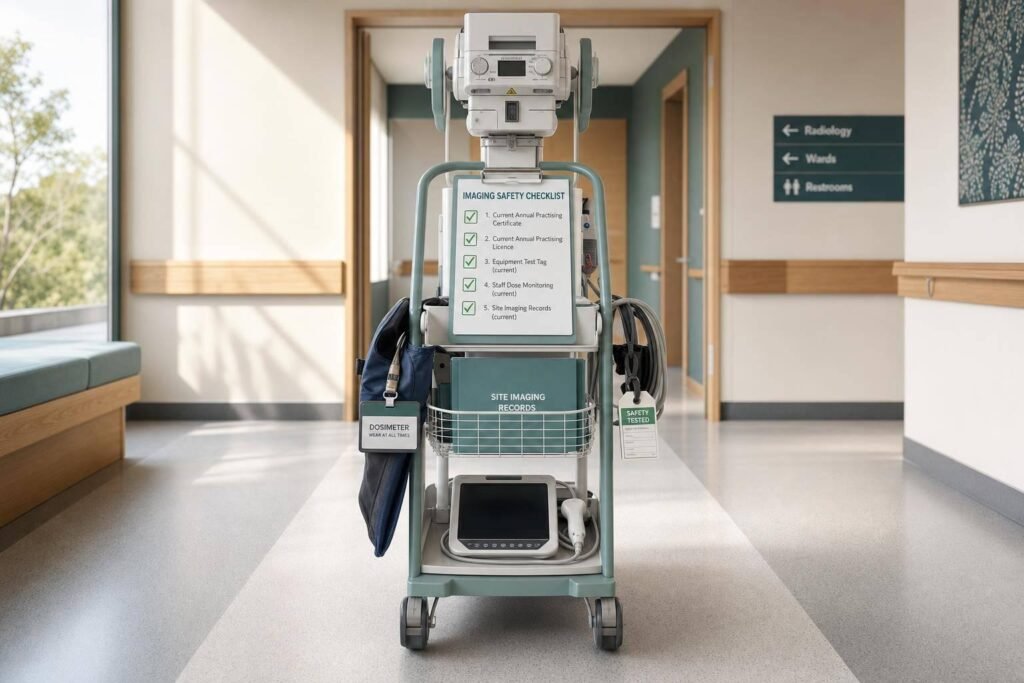
Dr. Mark Bekhit, Radiologist
Last updated July 2026
In brief
Short answer: A mobile scan brought to a home, ward or rest home can be as safe as one in a clinic, because the same New Zealand rules follow the machine. The person scanning must hold a current Medical Radiation Technologists Board practising certificate, and an X-ray or CT unit is used under the radiation licensing in the Office of Radiation Safety code. Before booking, it is fair to ask who holds the certificate, how family in the room are protected during an X-ray, and how the report reaches your doctor.
On this page
Which scans can be done as a mobile visit?
Mobile imaging brings the equipment to someone who cannot easily travel — most often an older or unwell person at home, on a hospital ward, or in a rest home. The two services you are most likely to arrange this way are a portable X-ray and an ultrasound, and they carry different kinds of risk.
An X-ray uses a small amount of ionising radiation — the same kind of exposure as any X-ray. Healthify puts that dose in perspective: you would have to be X-rayed many, many times over to receive an amount that would be bad for your health. An ultrasound uses high-frequency sound waves rather than radiation, so it is considered very safe — it is the same kind of scan used to image babies during pregnancy.
Larger scans — CT and PET-CT — also use ionising radiation and sit under the same radiation rules as X-ray, but they need far more space and power and are rarely brought to a private home. This guide focuses on the mobile X-ray and ultrasound visits that families most often arrange. If you are still deciding which test is needed, that is a conversation for the referrer, and the MRI versus CT guide explains how those choices are made.
Is mobile imaging as safe as going to a clinic?
It can be, because being off-site does not lower the standard. Two things carry that standard to the bedside: who is allowed to do the scan, and the rules for the radiation itself.
The person performing the scan must be qualified the same way as in a hospital department. The Medical Radiation Technologists Board requires a medical imaging practitioner to be registered and to hold a current Annual Practising Certificate to practise in New Zealand, and it is an offence to practise without one. In plain terms, the technologist who arrives at the door needs a current certificate, not just experience.
For X-ray and CT, the radiation side is governed by the Code of Practice for Diagnostic and Interventional Radiology, issued under the Radiation Safety Act 2016 and in force since December 2024. It covers anyone who deals with X-ray equipment — possessing it, managing it and using it — and a named licence holder is responsible at all times for each machine. Importantly, the law defines a “place” to include a dwelling or a vehicle, so a home or a rest-home room is held to the same requirements as a fixed radiology room, not treated as an exception.
The code also sets how the dose is handled: the practitioner must keep each exposure to the minimum needed to answer the clinical question at an acceptable image quality. This is the same “as low as reasonably achievable” principle described in the general guide to radiation dose in imaging. Safety is built up in a set order — the equipment and room setup first, then how the team works, then protective aprons and shields — rather than relying on a lead apron alone.
The one-line test: a mobile service should be able to name who holds the current practising certificate for the person scanning, and — for X-ray or CT — confirm the equipment is used under the radiation licensing the code requires.
Can I stay in the room during an X-ray?
This is the question families ask most, especially for a frightened or confused relative. The short answer: sometimes yes, but only on the team’s terms, and only after you have been told what it involves.
The radiation code has a specific role for this called a carer and comforter — a person who voluntarily (not as part of their job) helps care for, support and comfort a patient during the scan. Before anyone takes that role, the code requires the service to make sure they are correctly informed about the radiation risk, that they understand it, and that they agree to help. So a family member can stay to reassure a relative during an X-ray, but it is an informed, agreed step, not a casual one.
Two safeguards sit alongside that. Staff who might be exposed through their work should not be the ones holding or supporting the patient, so the person comforting a patient is usually a family member rather than a rest-home worker doing it repeatedly. And a lead apron may be draped over part of your body to shield you, as Healthify describes for any X-ray. Everyone who is not needed steps back or behind shielding while the picture is taken — the exposure itself lasts a moment.
If you are or might be pregnant, say so before the scan and let someone else be the carer in the room. The code requires the team to check pregnancy status before an X-ray that could give a meaningful dose to a baby, and this is one reason they ask.
What to tell the team before the scan
A mobile visit still starts with the same safety checks a clinic makes, and a home setting makes a couple of them more important. Healthify says to tell the radiographer — the person performing your X-ray — if you are or may be pregnant, have had an X-ray of the same part of your body before, or have metal such as a pacemaker or a surgical pin in the area being imaged.
Identity matters more than people expect. The radiation code requires the team to confirm the patient’s identity using an independent check, not just a name on a door. When the patient has dementia or cannot confirm their own details, have their full name, date of birth and National Health Index (NHI) number ready, and let a nurse or family member help confirm them. The general appointment checklist covers what else is useful to have on hand.
Have ready for the visit
✓ Whether the patient is or might be pregnant.
✓ Any pacemaker, surgical pin or other metal in the area being scanned.
✓ Previous imaging of the same body part, if known.
✓ Full name, date of birth and NHI number for identity checks — especially if the patient cannot confirm their own details.
How the results reach your doctor
A mobile scan is only finished when someone qualified has read it. As Healthify explains, a radiologist — a doctor who specialises in imaging — reviews the images and describes what they show, and that report is sent to the person who referred the patient, who then discusses it with you.
For an at-home scan it is reasonable to ask how that pathway works, because there is no front desk to chase. The current RANZCR Standards of Practice say a radiologist must be readily contactable to discuss an examination, that urgent or unexpected findings are communicated to the referrer (or someone who can act on them), and that the provider must have a documented process for passing on those urgent findings — including coordinating care if the referrer cannot be reached. The referral itself should carry the referrer’s contact details, with an after-hours option for urgent results.
When the report comes back, the guide to reading a radiology report explains what each part means and which questions to take back to the referrer.
What to check before you book a mobile scan
You do not need to audit a provider. A few direct questions tell you whether a service is holding the standard, and you can confirm the practitioner independently: the Medical Radiation Technologists Board public register lets anyone check by name whether a practitioner is registered and holds a current practising certificate.
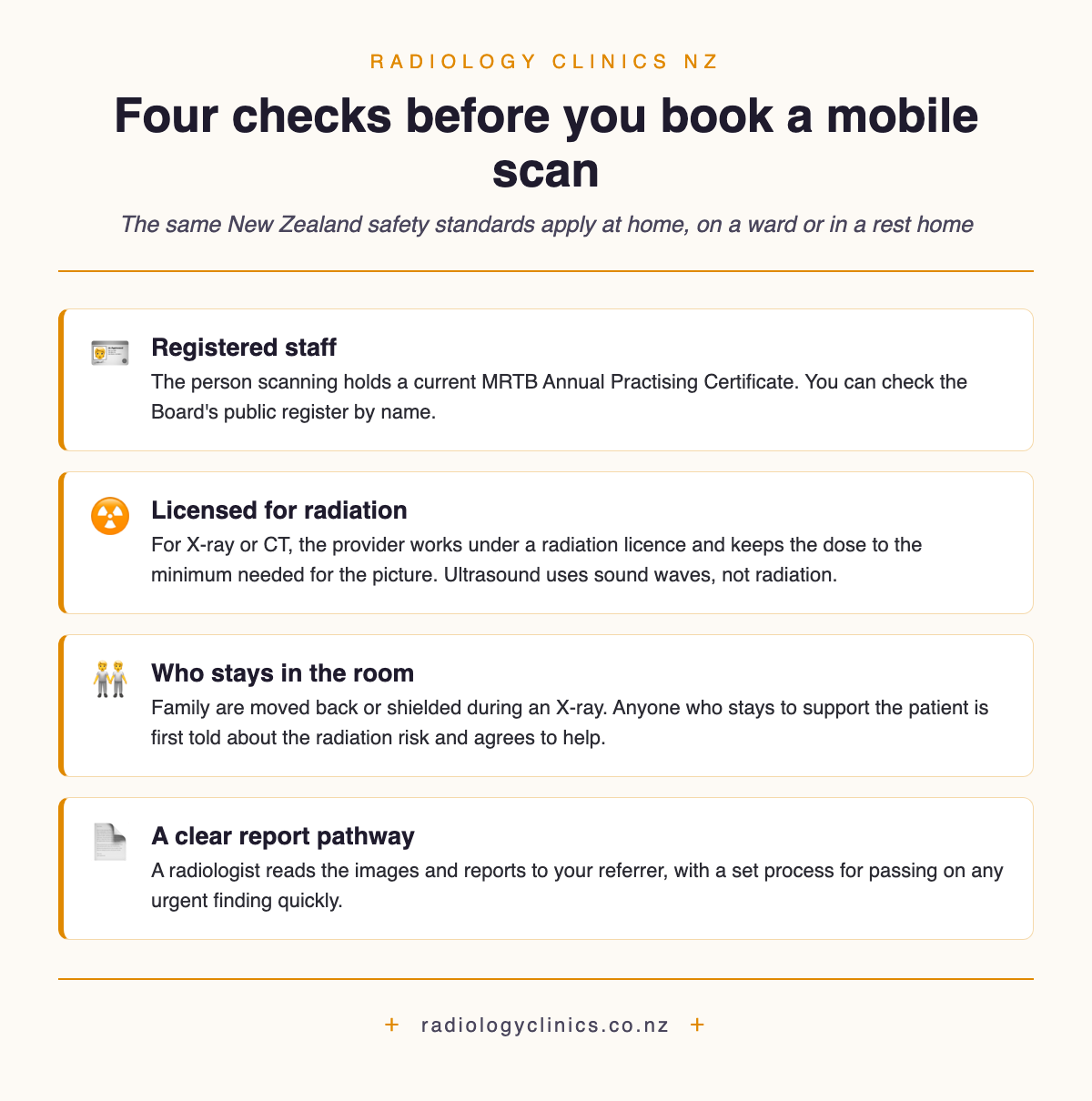
Ask before you book
✓ “Who will perform the scan, and do they hold a current MRTB practising certificate?”
✓ “For an X-ray, how are family members in the room protected?”
✓ “Which radiologist reads the images, and how do urgent findings reach my doctor?”
✓ “Is this funded through the public system or ACC, or is it private — and what will I pay?”
A directory can help you build a shortlist, but a listing is not proof of compliance. You can use the Radiology Clinics NZ directory to find imaging services, then confirm the practising certificate and reporting pathway with the provider directly. For a first appointment, the first-scan questions page adds a broader consent and results checklist.
Funding and cost in New Zealand
Imaging is arranged by referral — Health New Zealand notes you cannot self-refer, though some providers, including physiotherapists, may refer you for an X-ray. Who pays depends on why the scan is needed, and it is worth settling before the visit.
If the imaging is needed because of an accidental injury, Health New Zealand says ACC will usually pay, although you may still have to pay part of the cost. Otherwise the scan is either arranged through the public health system or done privately, and if you have insurance or can pay you can ask your healthcare provider about a private referral. Because a mobile visit is a service on top of the scan, ask the one direct question in the checklist above — how the booking is funded and what you will pay — before you confirm. You can browse more practical patient material in the Radiology Clinics NZ blog.
Frequently asked questions
Is a mobile X-ray at home safe?
Yes, when the same standards are met. The person scanning must hold a current MRTB practising certificate, and the equipment is used under the radiation rules in the Office of Radiation Safety code, which applies in a home just as it does in a clinic. The X-ray dose is small, and the team keeps it to the minimum needed for the picture.
Can I stay in the room while my relative has a mobile X-ray?
Often yes, as a “carer and comforter”. The radiation code says anyone who stays to support the patient must first be told about the radiation risk, understand it and agree to help, and may be given a lead apron. If you are or might be pregnant, let someone else take that role.
How do I check the person doing the scan is qualified?
Search the Medical Radiation Technologists Board public register by name to confirm the practitioner is registered and holds a current Annual Practising Certificate. It is an offence to practise without one.
Is a mobile ultrasound different from an X-ray for safety?
Yes. An ultrasound uses sound waves, not radiation, so there is no radiation exposure to manage and no exclusion of family for that reason. The operator still needs to be a registered practitioner.
How will I get the results of a mobile scan?
A radiologist reads the images and sends a report to the doctor who referred the patient, who discusses it with you. The RANZCR Standards of Practice require a documented process for passing on urgent findings, so it is fair to ask a mobile provider how that works.
How we check this guide
This guide was written against current New Zealand sources: the Office of Radiation Safety Code of Practice for Diagnostic and Interventional Radiology (in force December 2024), the Medical Radiation Technologists Board on registration and practising certificates, Healthify’s X-ray and ultrasound patient information, RANZCR’s 2025 Standards of Practice, and Health New Zealand on referral and funding. It describes the standards a mobile service should meet; it does not assess any individual provider, and your referral and the provider’s own checks still govern each scan.
- Office of Radiation Safety: Code of Practice for Diagnostic and Interventional Radiology (ORS C1)
- Medical Radiation Technologists Board: Annual Practising Certificates
- Healthify: X-ray
- Healthify: Ultrasound
- RANZCR: Standards of Practice for Clinical Radiology
- Health New Zealand: X-rays
This article is general information, not personal medical advice. Availability, public funding, ACC cover and billing can change — confirm the specifics with your referrer and the clinic.

Author: Dr. Mark Bekhit
Dr Mark Bekhit (MBChB, FRANZCR) is a musculoskeletal radiologist practising in Brisbane and an AHPRA-registered specialist in diagnostic radiology (MED0002920947). He spends as much time building software as reading scans: he founded Imaging Finder (Australia) and Radiology Clinics NZ to make imaging easier to find, and builds radiology dictation and pain-tracking tools with one aim — better patient outcomes and a smoother reporting workflow. Outside the reading room he's usually training, bringing the same performance mindset to imaging.
Sources, method, and medical context
This article is published by Radiology Clinics NZ and reviewed for medical-adjacent accuracy by Dr. Mark Bekhit, radiologist. It is general information only and does not replace advice from your own doctor, referrer, clinic, insurer, or Health New Zealand service.
How this list was selected
List-style articles on this site are based on visible directory signals such as clinic location, brand coverage, listed scan services, and whether the clinic has enough public information to compare. They are not paid rankings, clinical endorsements, or a guarantee that a clinic is the best option for a particular patient.
Official references
- Health New Zealand: scans and X-rays
- Health New Zealand: community-referred radiology service
- Radiology Clinics NZ: how the directory is built
Related directory pages
Radiology clinics directoryBrowse by scan typeBrowse by cityHow this directory is built
Last editorial review: 2026-06-30.
Leave a Reply