
Dr. Mark Bekhit
Last updated July 2026
In brief
Short answer: As at 30 July 2026, a recognised New Zealand radiology specialist is compared with a seven-year pathway: two years of general medical experience followed by five years of radiology training. Under the RANZCR standard, specialist interventional radiologists complete advanced IR training and IR staff need dedicated training and competence. A trainee may take part, but must be supervised. Ask who will perform the procedure, whether a trainee is involved, what sedation is planned, and who is responsible for follow-up.
On this page
How are interventional radiologists trained in New Zealand?
The Medical Council of New Zealand identifies RANZCR as the New Zealand vocational-training pathway in diagnostic and interventional radiology. As at 30 July 2026, MCNZ compares a recognised specialist with seven years of training: two years of general medical experience and five years of radiology training. Those five radiology years include three years of general training and two years of advanced, systems-focused rotations.
MCNZ lists patient care and safety, vascular imaging and intervention, teamwork, communication, patient support and advocacy in the curriculum. Trainees also complete examinations and keep a supervised logbook that records their participation, level of supervision and relevant follow-up.
As at 30 July 2026, the RANZCR Clinical Radiology Training Program is designed as five years in three competency-based phases. Training happens through accredited network sites, with rotations through several sites rather than one hospital alone. Completing the RANZCR training and examination requirements awards FRANZCR.
If a trainee is involved: RANZCR’s interventional-radiology standard requires appropriate supervision. Under New Zealand’s Code of Rights, you can ask who will perform each part of the procedure and about that person’s qualifications.
A qualification is the starting point, not a universal procedure list. Interventional radiology includes many different areas, and the relevant question is whether the doctor and facility have the training, team and support for the particular procedure proposed for you.
What does that training prepare an interventional radiologist to do?
The MCNZ vocational scope defines diagnostic and interventional radiology as diagnosis and treatment using imaging, including angiography, fluoroscopy, ultrasound, CT and MRI.
Health New Zealand gives practical examples: image-guided biopsies, drainage procedures and insertion of catheters or stents. These procedures are minimally invasive and can sometimes be an alternative to traditional surgery. That does not mean interventional radiology is the better option for every condition. The proposed procedure needs an individual assessment, and the available choices must be explained before you consent.
The radiologist does not work in isolation. Health NZ identifies radiology nurses as providing patient care and specialist support during procedures. The RANZCR standard adds nursing, medical-imaging and sonography roles as required, and an anaesthetic and recovery team when deep sedation or general anaesthesia is planned.
Referral routes are local. Health NZ Canterbury, for example, says its diagnostic and interventional services require a healthcare-provider referral. Health NZ Auckland lists GPs, nurse practitioners and medical specialists among the registered health professionals who can refer to its radiology services. Those examples do not create one requester rule for every procedure or region.
What is changing in specialist IR training?
The base RANZCR radiology programme already includes vascular imaging and intervention, and specialist interventional radiologists add advanced training. RANZCR is also formalising dedicated specialist programmes for interventional radiology (IR) and interventional neuroradiology (INR).
As at 30 July 2026, the College’s IR and INR programme update described accreditation of training settings as expected to start in early to mid-2026. That wording marks a transition; it is not evidence that every New Zealand setting is already accredited under the newer specialist programme.
The RANZCR standard requires specialist-role criteria matched to the level of procedures, appropriate trainee supervision, a trained team, monitoring, emergency support and a follow-up plan. A new programme label does not replace those procedure-level requirements.
Why might your procedure be at a larger centre?
Health NZ says several districts provide interventional services ranging from general to more specialised, with the more specialised services typically based in larger districts or regional tertiary centres. Under the RANZCR standard, a centre performing a complex intervention needs the required clinical team, plus anaesthesia, recovery, emergency or surgical support when the procedure calls for them.
Local pathways differ: Canterbury requires a healthcare-provider referral, while Auckland names GPs, nurse practitioners and medical specialists among its permitted referrers.
Ask your referrer: “Which local service can receive this referral?” For the general referrer-to-result pathway, see the handover guide. You can also browse the clinic directory.
What should safe, trained interventional care look like?
Training becomes visible in the way care is handed from one step to the next. RANZCR’s interventional standard requires dedicated training and competence for staff working in IR or INR, with procedure-level criteria for specialist roles and appropriate supervision for trainees. New Zealand’s current radiation code separately covers the equipment and radiation-safety roles used in interventional practice.
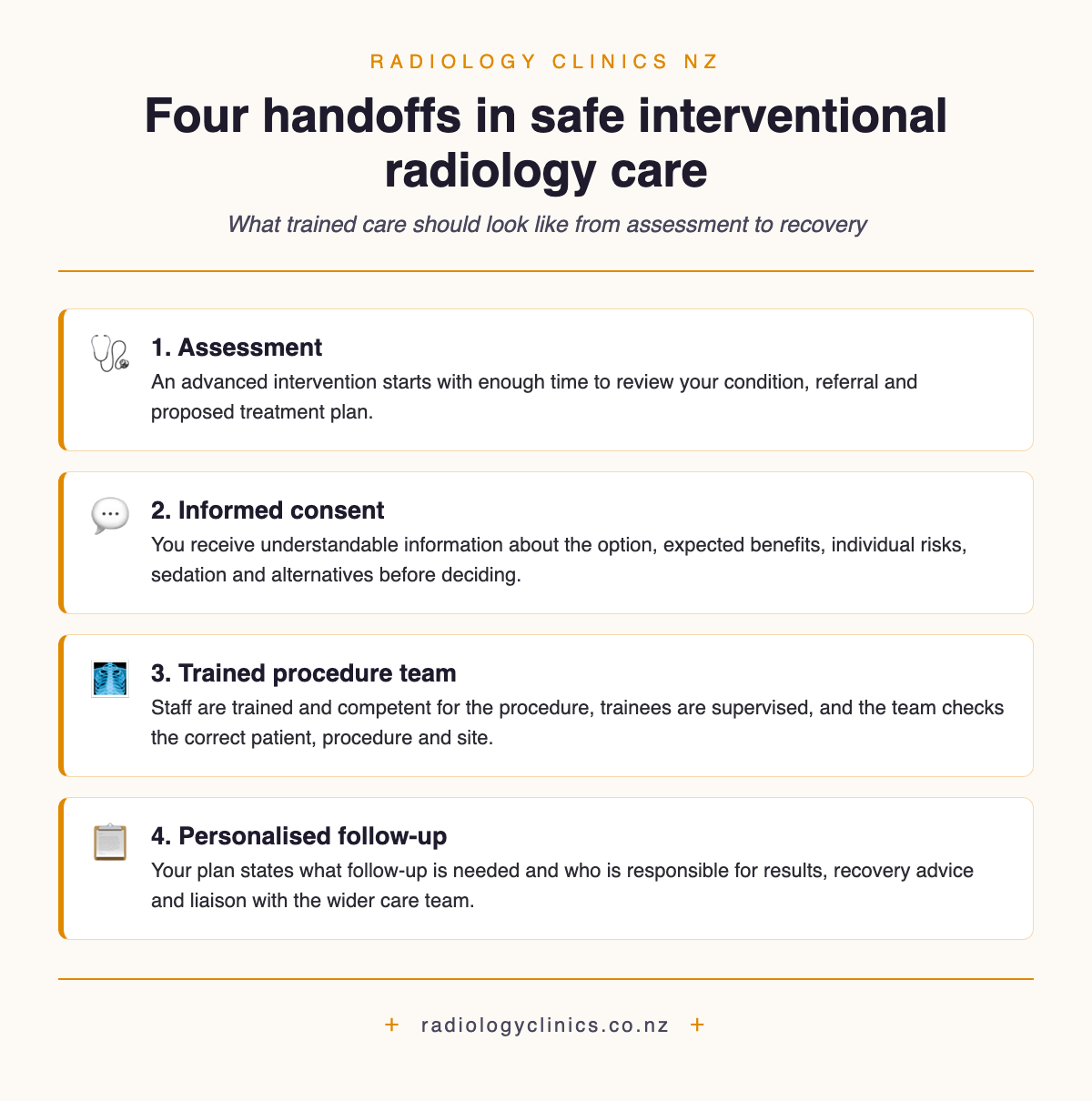
Assessment comes first. For an advanced intervention, the RANZCR standard calls for enough consultation time to review the patient before the procedure and explain the treatment plan. This is where the team reviews whether the proposed intervention is appropriate and what the treatment plan involves.
Consent is a conversation, not a signature alone. Under the RANZCR standard, consent covers the treatment plan, any sedation or pain medicine, and the procedure. The clinician performing the procedure, or a delegate with enough knowledge of its benefits and risks, conducts the consent process and discusses risks that are particularly relevant to you. The New Zealand Code of Rights adds the right to understandable information about options, expected risks, side effects, benefits and costs, and honest answers about the provider’s identity and qualifications.
The Code says services may be provided only after you make an informed choice and give informed consent, subject to its stated legal and common-law exceptions. You may refuse or withdraw consent. Consent must be in writing when general anaesthesia is planned or the procedure has a significant risk of adverse effects.
The procedure has active safety checks. RANZCR calls for a checklist that verifies the correct patient, procedure and site. When sedation is needed, it is given by appropriately trained personnel, with monitoring before, during and after the procedure so complications can be recognised early. Facilities also need documented arrangements for urgent transfer and emergency or surgical support if required.
Follow-up has an owner. The standard calls for clinically relevant follow-up, a plan tailored to the procedure and your circumstances, and clear responsibility for communicating with the wider team. Before you leave, ask what follow-up is planned and which team member will liaise with your wider care team. For help reading a written result, see the radiology report guide.
What should you ask before an interventional procedure?
You do not need to test the team on medical jargon. Five direct questions cover the parts of care you can see and act on. The Code of Rights supports asking about the provider’s identity and qualifications, the recommended option, expected risks and benefits, costs and how to obtain another opinion.
The RANZCR standard provides the basis for the questions about trainee supervision, the treatment plan, sedation, monitoring, emergency support and follow-up.
Ask before the procedure
✓ “What is the exact procedure, what is it meant to achieve, and what are the alternatives?”
✓ “Who will perform each part, and will a supervised trainee be involved?”
✓ “Which risks matter in my case, and will I have pain medicine, sedation or a general anaesthetic?”
✓ “What monitoring and emergency support are available for this procedure?”
✓ “What follow-up is planned, and who will liaise with my wider care team?”
For general preparation, see the imaging appointment checklist. For contrast-specific preparation, see the contrast reaction guide.
You also have a right to a support person unless safety could be compromised or another person’s rights would be unreasonably affected.
Frequently asked questions
Is an interventional radiologist a surgeon?
Health NZ describes an interventional radiologist as a radiologist: a specialist doctor who performs image-guided procedures. Examples include biopsies, drainages and insertion of catheters or stents; some can be alternatives to traditional surgery. Before consent, the RANZCR standard requires an assessment appropriate to the proposed treatment and an understandable explanation of the treatment options.
Can a trainee perform part of my procedure?
Yes, a trainee may participate, but the RANZCR standard requires appropriate supervision. You can ask which parts the trainee will perform and who is supervising. Under the Code of Rights, you are also entitled to honest answers about the identity and qualifications of the people providing your care.
Does every radiology clinic offer interventional procedures?
Do not assume so. Health NZ says several districts provide services ranging from general to more specialised, with specialised interventional and neurointerventional work typically in larger districts or regional tertiary centres. Ask your referrer: “Which local service can receive this referral?”
Will I be awake during interventional radiology?
Your individual treatment plan specifies whether pain medicine, sedation or possible general anaesthesia is planned. The RANZCR standard requires appropriately trained staff and suitable monitoring when sedation is given. Ask which approach is planned and what recovery time it requires.
Who do I contact after the procedure?
The RANZCR standard calls for a personalised follow-up plan and clear responsibility for liaison with the wider team. Before leaving, ask who gives the result, who manages follow-up questions and which contact to use.
Sources and review
This guide was reviewed against current sources accessed on 30 July 2026: the Medical Council of New Zealand vocational scope, RANZCR’s 2026 training material and IR/INR standards, Health New Zealand service information, the Ministry of Health radiation code and the Health and Disability Commissioner Code of Rights. They establish the training and care standards; they do not establish that every centre provides every procedure or that one intervention is suitable for an individual.
- Medical Council of New Zealand: diagnostic and interventional radiology
- RANZCR: Clinical Radiology Training Program
- RANZCR: IR and INR specialist training programme update
- RANZCR: Standards of Practice for IR and INR
- Health New Zealand: radiologists and interventional services
- Health and Disability Commissioner: Code of Rights
- Ministry of Health: Code of Practice ORS C1 2024
For a broader first-appointment question list, see questions to ask before your first radiology scan. More patient guides are available in the Radiology Clinics NZ blog.
This article is general information, not personal medical advice. Ask your referrer which service is available, and ask the clinic whether public funding or ACC cover applies and what you will need to pay.

Author: Dr. Mark Bekhit
Dr Mark Bekhit (MBChB, FRANZCR) is a musculoskeletal radiologist practising in Brisbane and an AHPRA-registered specialist in diagnostic radiology (MED0002920947). He spends as much time building software as reading scans: he founded Imaging Finder (Australia) and Radiology Clinics NZ to make imaging easier to find, and builds radiology dictation and pain-tracking tools with one aim — better patient outcomes and a smoother reporting workflow. Outside the reading room he's usually training, bringing the same performance mindset to imaging.
Sources, method, and medical context
This article is published by Radiology Clinics NZ and reviewed for medical-adjacent accuracy by Dr. Mark Bekhit, radiologist. It is general information only and does not replace advice from your own doctor, referrer, clinic, insurer, or Health New Zealand service.
Official references
- Health New Zealand: scans and X-rays
- Health New Zealand: community-referred radiology service
- Radiology Clinics NZ: how the directory is built
Related directory pages
Radiology clinics directoryBrowse by scan typeBrowse by cityHow this directory is built
Last editorial review: 2026-06-30.
Leave a Reply