Dr. Mark Bekhit, Radiologist
Last updated July 2026
In brief
Short answer: A CT contrast protocol is the imaging service’s plan for what contrast to use, how to give it and when to take the pictures. Some scans use a set wait; others watch contrast reach a vessel or use a small test injection first. You do not need to choose the method. Follow the Health NZ appointment instructions. Before iodinated contrast, tell the service about kidney disease, diabetes or metformin and a previous reaction, as the RANZCR safety guidance recommends. Mention possible pregnancy, which the RANZCR Standards require the service to consider.
On this page
Why can two CT scans use different contrast protocols?
The protocol follows the clinical question, not just the body part. The New Zealand OMNIPAQUE data sheet says the target structures, the condition being investigated, blood flow, patient factors and equipment all inform the contrast plan. That is why two CT examinations of the same area can use different plans.
The imaging service reviews the referral before accepting the examination. The current RANZCR Standards of Practice require that review to check clinical appropriateness. They also require documented processes for the type, concentration and volume of contrast, with a radiologist available when the conduct of the examination needs to change.
Patient factors change the plan too. The current New Zealand OMNIPAQUE data sheet says dose and technique are individualised for the examination, age, weight, how quickly the heart circulates blood, general condition, target anatomy and the condition being investigated. Its core rule is to use the lowest amount needed for clear enough pictures.
What shapes the plan: the condition being investigated, blood flow, your current health information, the area being examined and the scanner technique.
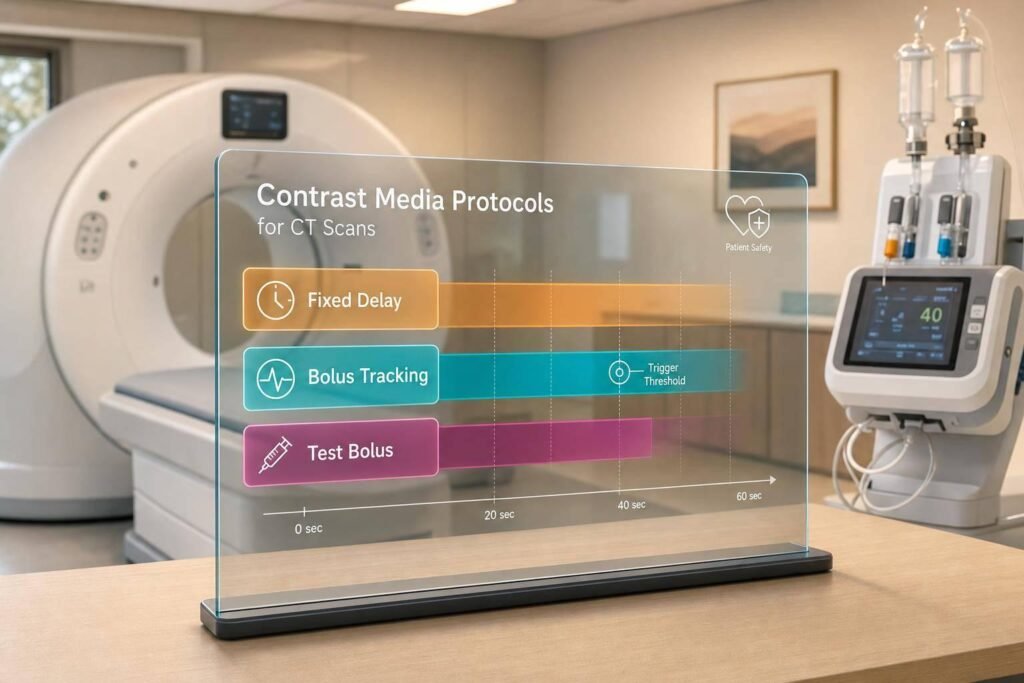
How do fixed timing, bolus tracking and a test bolus differ?
These names describe how the scanner decides when to collect the diagnostic images after an injection. They do not form a best-to-worst ladder. The right timing tool is the one that matches the examination and the way contrast is expected to move through that patient.
The American Association of Physicists in Medicine CT lexicon defines bolus tracking as triggering a scan when contrast reaches a planned level in a chosen region, and a test bolus as measuring travel time with a small injection. A technical Radiology review of contrast timing explains why circulation, contrast delivery and scanner factors all affect when the target becomes visible.
No timing method is always the most precise. The team chooses for the examination’s clinical question, target anatomy, how quickly contrast reaches the target and the scanner technique.
If you are comparing CT with another type of scan, use the separate MRI versus CT guide. Protocol timing answers how a CT is performed; it does not decide whether CT is the right modality in the first place.
What will contrast feel like during the scan?
Some CT examinations need no contrast. For others, Health New Zealand says contrast may be an iodine solution injected into a vein, a drink, or both to highlight internal structures. Healthify says oral contrast may be used to show the stomach and bowel more clearly.
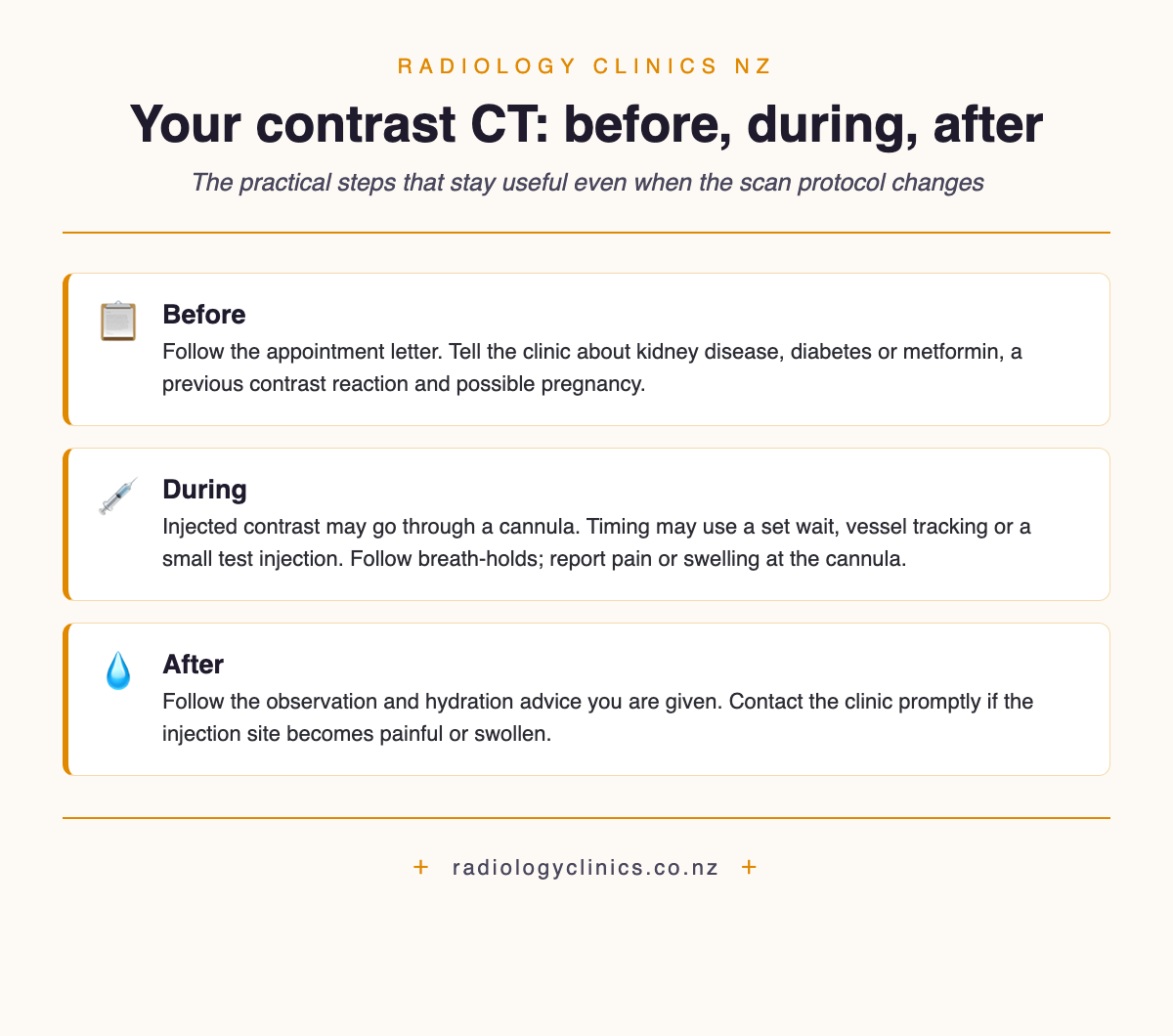
For an injection, Health NZ says intravenous CT contrast is usually given through a small plastic tube in an arm vein. As the contrast enters, you may briefly feel warm, notice a metallic taste or get a bladder-like sensation. Healthify describes these as expected sensations that normally pass quickly.
Painful pressure at the injection site is different. Report it promptly if the site becomes painful or swollen. The NZ OMNIPAQUE data sheet records that contrast can leak into the tissues around the vein; most cases settle, but the site needs prompt assessment rather than being treated as an expected warm flush.
Say it promptly: “The injection site is painful or swelling.” It needs assessment rather than being treated as an expected warm flush.
What should you tell the clinic before iodinated contrast?
Use the clinic’s questionnaire as a safety tool, not paperwork to rush through. The RANZCR iodinated-contrast guideline says non-emergency patients should be asked about known kidney disease, including a kidney transplant, diabetes and medicines containing metformin. If one applies, the team may need a recent kidney-function blood test before deciding how to proceed.
Tell the booking team about a previous reaction to CT contrast. The reaction guide explains what to do before another scan after a contrast reaction. Describe what happened, then follow the imaging service’s individual preparation instructions.
Also say if you are pregnant or think you might be. The RANZCR Standards of Practice require relevant pregnancy status, allergies, prior imaging and blood tests to be considered during referral review.
Tell the clinic before the appointment
✓ A previous reaction to CT or other injected contrast, asthma, significant allergies or eczema, and beta-blocker use.
✓ Kidney disease, a kidney transplant or dialysis.
✓ Diabetes and whether any medicine contains metformin.
✓ A known overactive thyroid or hyperfunctioning thyroid nodule (a nodule making too much thyroid hormone), or planned thyroid radioisotope imaging or treatment.
✓ Myasthenia gravis.
✓ Pregnancy or the possibility of pregnancy.
As at July 2026, the same RANZCR guideline says a known or suspected overactive thyroid needs assessment before iodinated contrast. Iodinated contrast can also reduce how well the thyroid absorbs the radioactive tracer used for thyroid scanning or treatment for up to eight weeks. The guideline says myasthenia gravis symptoms may worsen, although the risk is thought to be low.
Tell the service if you receive dialysis. For a dialysis patient who still passes urine, the RANZCR guideline says the team may seek advice from a kidney specialist before iodinated contrast.
Do not stop metformin or another medicine because of a number found online. Health NZ says to take normal medicines on the day unless you have been told otherwise.
Fasting instructions are examination-specific too. As at July 2026, Health NZ says most CT scans need no special preparation, while fasting for two to four hours is common for some contrast examinations. Your appointment letter controls your scan; if it is unclear, call the number on the letter before changing what you eat or drink.
What happens on the day of a contrast CT?
First, staff confirm your identity, referral, preparation and safety answers. The RANZCR Standards of Practice require valid informed consent for the examination and for contrast administration. The discussion should cover the expected benefit, risks that are material to you, reasonable alternatives and any associated cost.
The diagnostic pictures are fast. As at July 2026, Healthify says the scan acquisition usually takes seconds to a few minutes, although an appointment involving contrast may take up to 30 minutes. The appointment can therefore be longer than image acquisition itself.
Listen closely for breathing instructions. Healthify says you may be asked to hold your breath briefly and that staff can see, hear and speak with you.
Once the images are complete, Health NZ says a radiologist interprets them and sends a report to the healthcare provider who requested the examination. The radiology report guide explains what each part of that report is doing and which questions to take back to your referrer.
What should you do after the scan?
Follow the observation and hydration instructions from the service. As at July 2026, Healthify says most people can return to normal activities and may be asked to remain briefly after a contrast injection. The NZ OMNIPAQUE data sheet also calls for adequate hydration before and after use, but that does not override a fluid restriction prescribed for you.
If the injection site becomes painful or swollen after you leave, contact the imaging service promptly for advice. The separate contrast reaction guide covers possible delayed reactions.
If you are breastfeeding, the RANZCR iodinated-contrast guideline says iodinated contrast does not require stopping breastfeeding or expressing and discarding milk.
How do you book and ask about cost in New Zealand?
Health NZ says a CT scan needs a referral from a healthcare provider and can be performed through the public system or privately. Use the Radiology Clinics NZ directory to find imaging services, then ask whether they perform the examination written on your referral.
Funding and price are separate from whether contrast is clinically useful. Ask one direct question: “Is this booking through Health NZ, linked to an ACC claim, or private/self-pay, and what will I need to pay?” For injury-related radiology, ACC’s current service information says a co-payment may be charged, so having an ACC claim number does not by itself answer the cost question.
Ask whether the clinic needs a kidney-function blood test before the appointment. Healthify says preparation may include one.
If this is your first imaging appointment, the first-scan questions page gives a broader consent and results checklist. You can browse more practical patient material in the Radiology Clinics NZ blog.
Frequently asked questions
Who chooses the CT contrast protocol?
The imaging service does, after reviewing the referral and your relevant health information. The RANZCR Standards of Practice require clinical-appropriateness review and documented processes for contrast type, concentration and volume, with radiologist advice available when needed. Your job is to give accurate safety information and follow the preparation instructions, not select a timing method.
Which CT contrast timing method is best?
There is no universal winner. Fixed timing uses a planned wait, bolus tracking watches contrast reach a target area, and a test bolus measures transit with a small preliminary injection. The AAPM CT lexicon defines the latter two methods; the examination’s clinical question, target anatomy, your circulation and the scanner determine which approach fits.
Can I eat and take my medicines before a contrast CT?
Follow the appointment letter. As at July 2026, Health NZ says most CT scans need no special preparation, but fasting for two to four hours is common for some scans. Take normal medicines unless you receive a specific instruction otherwise; do not stop metformin from a generic online threshold.
Do I need to stop breastfeeding after iodinated contrast?
No routine interruption is required. The RANZCR iodinated-contrast guideline says breastfeeding does not need to stop and milk does not need to be expressed and discarded after iodinated contrast.
What if I reacted to contrast before?
Tell the clinic before the appointment and describe what happened if you can. The RANZCR guideline says the team should obtain the history and nature of a previous reaction. Follow the individual instructions you are given.
How we check this guide
This guide was reviewed against the current Health NZ and Healthify CT patient information, RANZCR’s 2025 Standards of Practice and current iodinated-contrast guideline, the current NZ OMNIPAQUE data sheet, ACC service information, the AAPM CT terminology lexicon and peer-reviewed CT timing literature. The technical timing descriptions explain the method only; they are not a protocol prescription. Your referral, current health information and the imaging service’s local equipment still determine the examination.
- Health NZ: CT scan
- Healthify: CT scan
- RANZCR: Iodinated Contrast Media Guideline
- Medsafe: OMNIPAQUE NZ data sheet
- AAPM: CT terminology lexicon
This article is general information, not personal medical advice. Availability, public funding, ACC cover and billing can change — confirm the specifics with your referrer and the clinic.

Author: Dr. Mark Bekhit
Dr Mark Bekhit (MBChB, FRANZCR) is a musculoskeletal radiologist practising in Brisbane and an AHPRA-registered specialist in diagnostic radiology (MED0002920947). He spends as much time building software as reading scans: he founded Imaging Finder (Australia) and Radiology Clinics NZ to make imaging easier to find, and builds radiology dictation and pain-tracking tools with one aim — better patient outcomes and a smoother reporting workflow. Outside the reading room he's usually training, bringing the same performance mindset to imaging.
Sources, method, and medical context
This article is published by Radiology Clinics NZ and reviewed for medical-adjacent accuracy by Dr. Mark Bekhit, radiologist. It is general information only and does not replace advice from your own doctor, referrer, clinic, insurer, or Health New Zealand service.
Official references
- Health New Zealand: scans and X-rays
- Health New Zealand: community-referred radiology service
- Radiology Clinics NZ: how the directory is built
Related directory pages
Radiology clinics directoryCT Scan clinicsBrowse by cityHow this directory is built
Last editorial review: 2026-06-30.
Leave a Reply