Important access and funding context
Radiology access, public funding, ACC coverage, screening eligibility, wait times, and appointment availability can change and may depend on referral details. Use this article as general orientation only, then confirm the current pathway with your doctor, referrer, clinic, insurer, ACC, or Health New Zealand service as relevant.
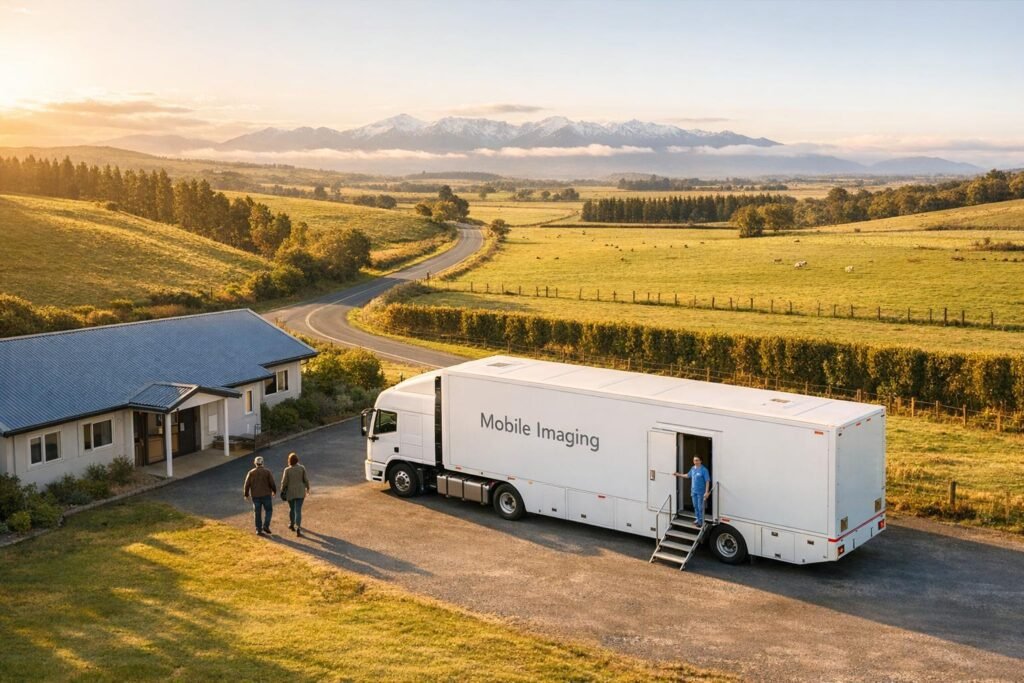
Rural patients in New Zealand face long wait times and significant travel challenges to access advanced imaging like PET-CT scans. Mobile imaging is changing this by bringing diagnostic services directly to regional communities.
Here’s what you need to know:
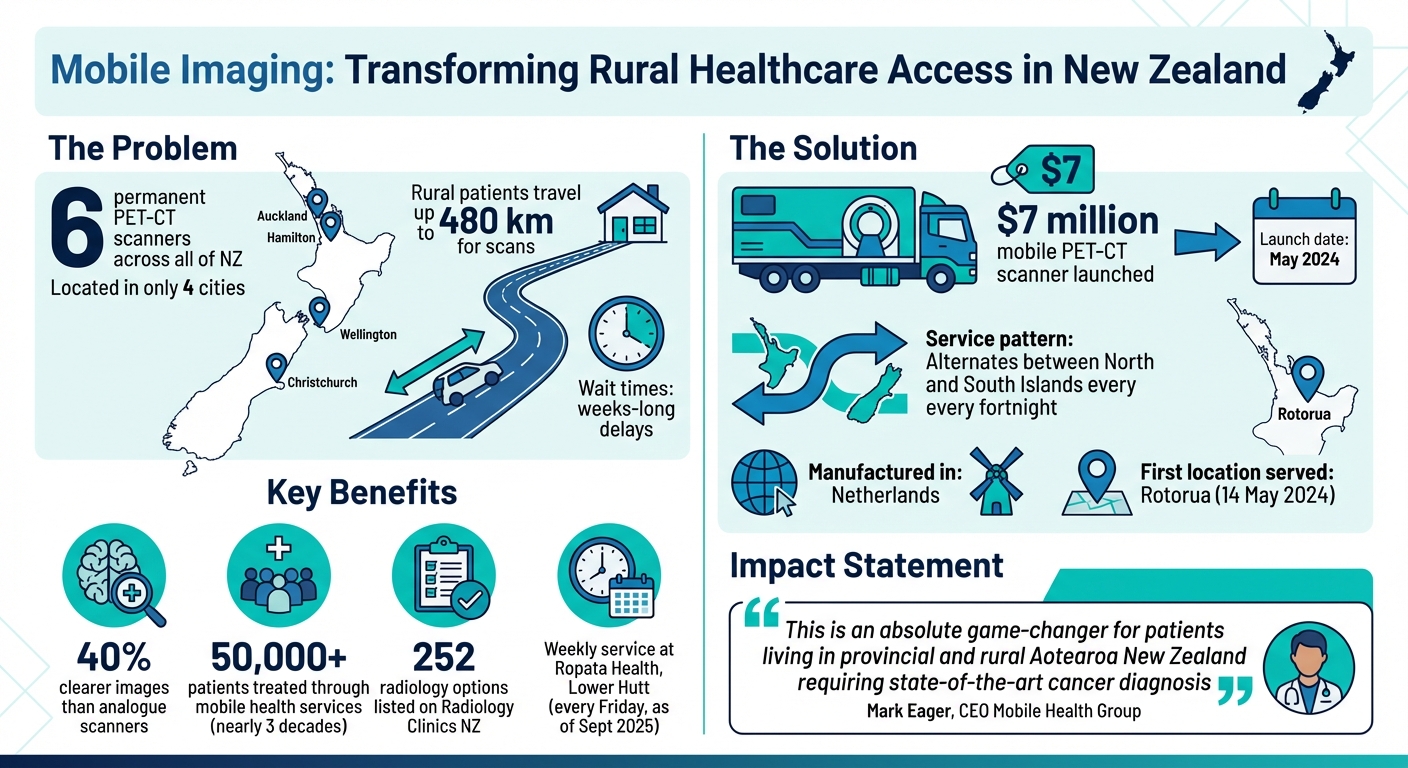
- Current Problem: Only six permanent PET-CT scanners exist across NZ, located in Auckland, Hamilton, Wellington, and Christchurch. Rural patients often face weeks-long delays and travel up to 480 km for scans.
- Mobile Imaging Solution: A $7 million mobile PET-CT scanner launched in May 2024 now alternates between the North and South Islands, reducing travel burdens and wait times.
- Key Benefits: Faster access to scans, reduced travel costs, and improved healthcare equity for rural populations, including Māori communities disproportionately affected by cancer.
- How to Access: Use platforms like Radiology Clinics NZ to locate mobile imaging services near you.
This approach is helping close the healthcare gap between urban and rural areas, ensuring timely diagnostics for all patients.
Mobile PET-CT Imaging Statistics and Benefits for Rural New Zealand Patients
Mobile Imaging Technology: A Solution for Rural Communities
What is Mobile Imaging Technology?
Mobile imaging technology delivers advanced diagnostic tools to rural areas via vehicles equipped with high-tech scanners. These "scanners-on-wheels" include devices like PET-CT and CT scanners, making it possible to offer diagnostic services in locations where permanent facilities aren’t feasible. For PET-CT scans, patients are given a small dose of radiotracer, enabling doctors to pinpoint specific areas of concern with remarkable accuracy. The results match the quality of imaging available in large urban hospitals, saving patients from the hassle of long-distance travel and ensuring quicker access to essential diagnostics.
How Mobile Imaging Brings Services to Remote Areas
Mobile imaging units are designed to break down barriers to healthcare access in remote regions. These units follow rotating schedules, allowing them to serve multiple communities effectively. For example, one provider alternates between the North and South Islands every fortnight, ensuring consistent access to diagnostic services across various locations. This approach tackles the issue of "equity of access", ensuring that a patient’s location no longer determines their ability to receive timely medical imaging. By bringing the technology directly to patients, these units reduce travel costs, minimise time away from home, and ease the physical burden on those already dealing with health challenges.
Mobile Imaging Examples in New Zealand
New Zealand has embraced this approach, with initiatives like the Southern Hemisphere’s first mobile digital PET-CT scanner. Launched in May 2024 by Mobile Health Group and Mercy Radiology, this NZ$7 million unit – manufactured in the Netherlands – began its services in Rotorua on 14 May 2024. Spearheaded by Mobile Health Group CEO Mark Eager and Mercy Radiology Medical Director Dr Remy Lim, the project aims to transform cancer diagnostics for rural and provincial communities.
"This is an absolute game-changer for patients living in provincial and rural Aotearoa New Zealand requiring state-of-the-art cancer diagnosis", said Mark Eager.
sbb-itb-16a0ccc
Benefits of Portable Imaging for Rural Patients
Better Access to Diagnostic Services
For rural patients, mobile imaging is a game-changer. Traditionally, advanced diagnostic tools like PET-CT scanners have been concentrated in urban areas, forcing patients from regional communities to undertake long, often exhausting journeys to access these services. Mobile imaging units change this dynamic, delivering these critical diagnostics directly to rural areas.
This shift eliminates the burden of travel-related expenses and physical strain, which have historically deterred some patients from seeking timely care. By bringing the service closer to home, mobile imaging ensures that no one has to forgo essential diagnostics simply because of where they live. This improved access sets the stage for earlier interventions and better health outcomes.
Faster Diagnoses and Treatment
In healthcare, speed can make all the difference – especially for cancer patients. Mobile imaging units not only increase capacity but also significantly reduce wait times. Equipped with digital PET-CT scanners, these units deliver images that are 40% clearer than older analogue models, allowing for more precise cancer detection and staging.
This enhanced accuracy, paired with faster service, means treatment can begin sooner. As Mobile Imaging points out:
"The quicker a diagnosis can be made and treatment can be monitored, the more cost‐effective the treatment will become".
By cutting down delays, mobile imaging not only speeds up individual diagnoses but also addresses the broader challenge of unequal healthcare access between urban and rural areas.
Reducing Healthcare Gaps Between Urban and Rural Areas
Mobile imaging plays a vital role in bridging the urban-rural healthcare divide. By delivering services directly to regional communities, it ensures that geographic location no longer determines access to critical diagnostics. Dr Remy Lim, Medical Director at Allevia Radiology, emphasised this point:
"What region you reside in should not matter when accessing your PET-CT scan".
The impact of mobile imaging is already evident. The NZ$7 million mobile unit, launched in May 2024, operates on a fortnightly schedule, alternating between the North and South Islands. By September 2025, the service had expanded further, offering a weekly PET-CT service every Friday at Ropata Health in Lower Hutt. Over nearly three decades, Mobile Health Group has proven the success of this approach, having treated more than 50,000 patients through various mobile health services. This model shows that bringing healthcare to the people is not just effective – it’s essential.
Finding Mobile Imaging Services with Radiology Clinics NZ

How Radiology Clinics NZ Can Help
Mobile imaging is making healthcare more accessible for rural communities, and Radiology Clinics NZ is here to make finding these services simple. This platform centralises 252 radiology options across New Zealand, helping rural patients easily locate diagnostic facilities. The directory includes a variety of providers – specialised clinics, hospitals, and accident and emergency centres – all searchable by location.
Each listing provides essential details like addresses, ratings, and reviews, so you can assess service quality before making a decision. For those in rural areas, the platform highlights regional providers in spots like Waiheke Island, Whangamata, Oamaru, and North Canterbury. It also features major providers such as Allevia Radiology and Pacific Radiology, which play a key role in offering mobile PET-CT and other portable diagnostic services to these communities. With its comprehensive database, Radiology Clinics NZ ensures that finding mobile imaging services is straightforward and efficient.
How to Find Clinics Offering Mobile Imaging
To locate mobile imaging services, start by visiting the Radiology Clinics NZ homepage. Use the location search tool to find facilities in your area. If you’re specifically after mobile PET-CT services, check clinics like Crest Hospital in Palmerston North or Ropata Health in Lower Hutt, where mobile units regularly visit. For portable X-ray services, explore listings under "Portable X-Ray Services" in the Auckland and Hamilton regions. These services provide bedside diagnostics for patients who can’t travel.
The directory also features a review system to help you gauge patient experiences. For example, Pacific Radiology in Porirua boasts a 5.0/5 rating, with glowing feedback about their customer service and friendly staff. Once you’ve identified clinics that meet your needs, use the contact details provided to confirm service availability and check whether they offer mobile outreach or host visiting diagnostic units.
Mobile PET CT Mercy Radiology – NewsHub Monday 6th 2024

Conclusion: Closing the Gap in Rural Healthcare
Mobile imaging technology is changing the way rural New Zealanders receive diagnostic care. The introduction of the $7 million mobile PET-CT scanner in May 2024 marks an important move away from the so-called "postcode lottery" in healthcare.
"The mobile diagnostic PET-CT scanner would be a ‘game changer’ for provincial and rural New Zealand".
These mobile units now travel on a fortnightly schedule between the North and South Islands, delivering cutting-edge diagnostic tools directly to regional communities. This approach not only removes the strain of long-distance travel but also helps reduce wait times for crucial diagnostic services.
Adding to this progress, Radiology Clinics NZ provides an easy way for patients to locate these services. Their directory allows users to search for radiology clinics by location, read reviews, and find providers offering mobile PET-CT and portable X-ray options.
With these advancements, rural New Zealand is moving closer to achieving healthcare access on par with urban areas. Mobile imaging technology, combined with user-friendly tools like Radiology Clinics NZ, is making this vision a reality.
FAQs
Who can get a mobile PET-CT scan?
Mobile PET-CT scans are accessible to both public and private patients across New Zealand, providing an essential service for those in rural or provincial areas where permanent imaging facilities might not be available. This initiative plays a key role in ensuring patients in under-resourced regions can still access critical diagnostic imaging.
How do I book a mobile PET-CT scan?
To arrange a mobile PET-CT scan in New Zealand, head to the Mobile Imaging website and fill out the Referral Pack Order Form. You’ll need to include your name, email, organisation, position, and the delivery address for couriered materials. Alternatively, you can kickstart the process by clicking the ‘Book Now’ link on their site. This service is set to roll out across the country in March 2024, catering to both public and private patients.
Is mobile PET-CT image quality as good as hospital scans?
Mobile PET-CT imaging delivers results that match the quality of traditional hospital-based scans. Thanks to digital PET-CT technology, these systems offer outstanding clarity and high-resolution images. This precision improves the detection of small lesions, ultimately boosting diagnostic accuracy.
Related Blog Posts
- Public vs Private Radiology: Comparing Your Options
- Top Clinics Offering High-Resolution Imaging in NZ
- Top PET Scan Clinics in NZ
- Guide to Patient-Centred Radiology in NZ

Author: Dr. Mark Bekhit
Dr Mark Bekhit (MBChB, FRANZCR) is a musculoskeletal radiologist practising in Brisbane and an AHPRA-registered specialist in diagnostic radiology (MED0002920947). He spends as much time building software as reading scans: he founded Imaging Finder (Australia) and Radiology Clinics NZ to make imaging easier to find, and builds radiology dictation and pain-tracking tools with one aim — better patient outcomes and a smoother reporting workflow. Outside the reading room he's usually training, bringing the same performance mindset to imaging.
Sources, method, and medical context
This article is published by Radiology Clinics NZ and reviewed for medical-adjacent accuracy by Dr. Mark Bekhit, radiologist. It is general information only and does not replace advice from your own doctor, referrer, clinic, insurer, or Health New Zealand service.
Official references
- Health New Zealand: scans and X-rays
- Health New Zealand: community-referred radiology service
- Radiology Clinics NZ: how the directory is built
Related directory pages
Radiology clinics directoryBrowse by scan typeBrowse by cityHow this directory is built
Last editorial review: 2026-06-30.
Leave a Reply