Being told your child needs a brain MRI is unsettling. The good news is that the scan itself is one of the safest tests in medicine. The part that actually needs planning is not the machine — it is whether your child can lie still, and where you go to get it done.
The short answer A brain MRI uses a strong magnet and radio waves, not X-rays, so there is no radiation. The whole challenge is holding still for clear pictures. Many older children manage this awake with headphones and a movie; a younger or very anxious child may need sedation or a short general anaesthetic. A scan at a public hospital is usually free, or you can find a private MRI clinic and pay or use insurance. Before you book, ask one question: does this clinic scan children, and can it arrange sedation or anaesthetic if needed?
Is a brain MRI safe for my child?
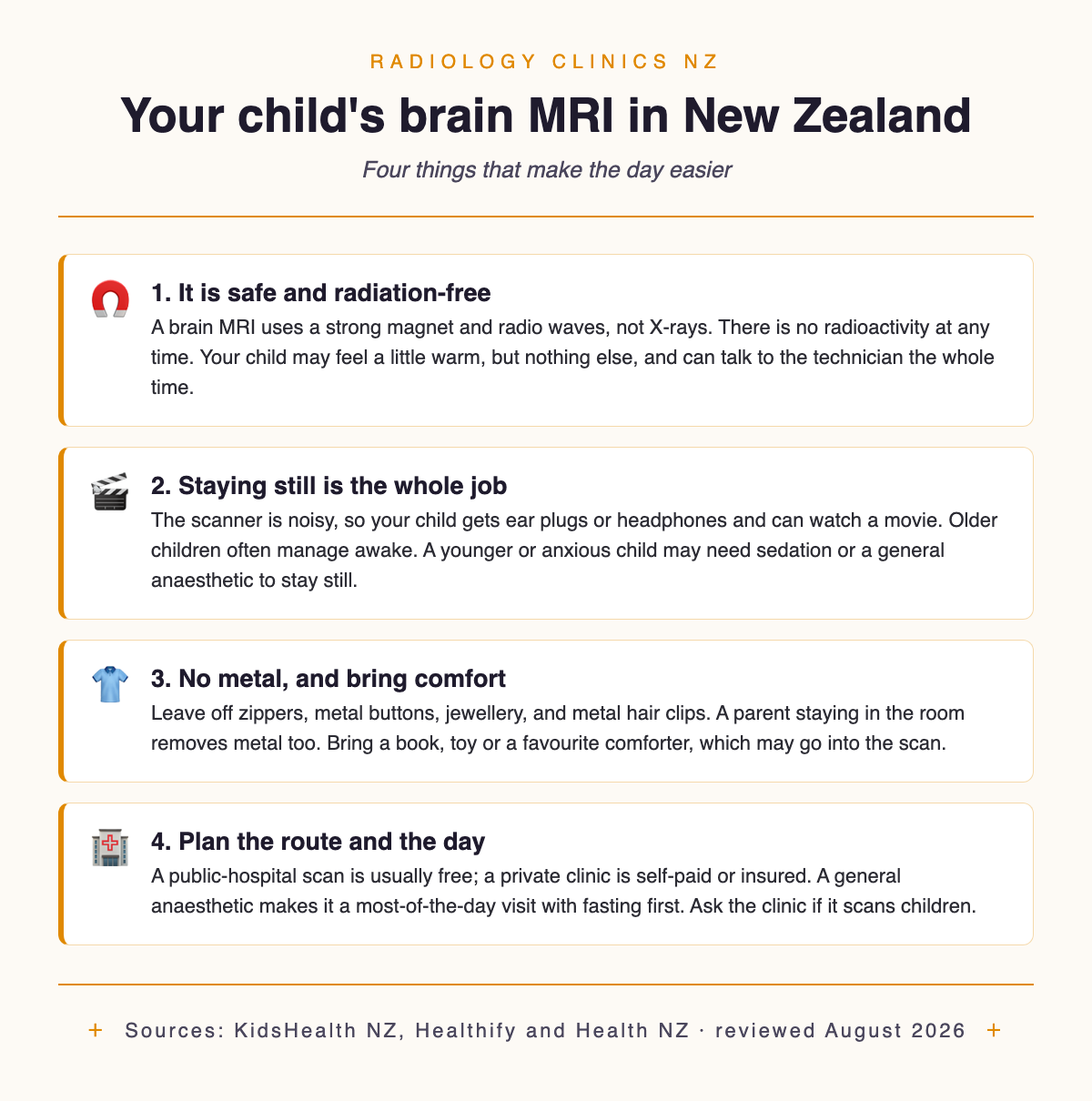
Yes, and it helps to know why. MRI makes its pictures with a powerful magnet and radio waves, so unlike an X-ray or CT scan there is no ionising radiation — the kind of exposure that carries a small radiation dose. There is no radioactivity at any time. Your child might feel a little warm while the pictures are being taken, but they feel nothing else, and they can talk with the technician the whole way through.
A brain MRI earns its place because of what it can see. It shows very small changes in the brain — the sort that can cause seizures or developmental delay — and it shows them in children far better than an X-ray or CT scan can. That detail is also why the scan is deliberately slow, which brings us to the only real catch.
Where to have it — public or private
Your child does not get here on their own. A GP, paediatrician or hospital team requests the scan, and you are sent an appointment; you cannot refer your child yourself. Where the scan happens then depends on that referral and on the route you choose.
Most children’s brain MRIs happen at a public hospital, and if your child needs a general anaesthetic that hospital pathway is usually where it is arranged. But not every family wants to wait, and private clinics do children’s MRI too. To see what is near you, browse the MRI clinics on Radiology Clinics NZ and open a listing for its location, contact details and website. As at 12 August 2026, current examples include Trinity MRI in Auckland, Bay Radiology MRI at Tauranga Hospital, and Midland MRI in Hamilton. These are examples, not a ranking or a full list.
Ask the clinic when you book
✓ “Do you scan children of my child’s age?”
✓ “If my child cannot lie still, can you arrange sedation or a general anaesthetic — or would that need a hospital?”
✓ “Is any contrast (dye) planned, and do we need to arrive earlier?”
That first question matters more than it sounds. Not every MRI clinic is set up for young children or for anaesthetic, so confirming it before you book saves a wasted trip. If you are still weighing whether MRI is even the right test, our guide on MRI versus CT may help, and Auckland families can start with our family radiology overview.
Awake, sedated or asleep?
Here is the honest heart of it: the magnet is harmless, but the pictures blur if your child moves, so staying still is the whole job. Breathing normally, blinking and staying relaxed are all fine — it is wriggling that spoils the scan. How your child manages that depends on their age and temperament, not on any danger, which is why the same scan is done three different ways.
A scan usually takes about 30 to 60 minutes, sometimes as little as 15 or as long as 90. Sedation may be preferred to a general anaesthetic for babies up to 12 months old, and your doctor talks this through before the day. If a general anaesthetic is the plan, an anaesthetist checks your child, explains what will happen and asks you to sign a consent form, and your child stays a while to recover afterwards. None of this means the scan is risky — it means the team would rather your child sleep through it than white-knuckle it.
Getting your child ready
The single hard rule is metal. The scanner is a powerful magnet, so your child should wear no metal — that means zips, metal buttons and press studs, jewellery, metal hair ties and clips, and even clothes with glitter or sequins. Comfy clothes without metal are ideal, and a hospital gown is there if you forget. If you plan to stay in the room with your child, you will need to take off your own metal too.
Tell staff first: mention anything metal inside the body — for example a cochlear implant, an infusion pump or another implanted device. It is uncommon in children, but it is a genuine safety check the team must make before the scan. Also let staff know if your child could be pregnant or has reacted to scan dye before.
Comfort does the rest. Bring something to keep your child busy while you wait, and a favourite soft toy or comforter can often go into the scan with them. Some hospitals have play specialists who help children feel at ease, and a simple, honest explanation beforehand — pitched to your child’s age — usually helps more than anything a clinic can do. The scanner is noisy, with loud knocking sounds, so your child is given ear plugs or headphones and can often watch a movie through a mirror while the pictures are taken.
On the day and after
If your child is having a general anaesthetic, they cannot eat or drink for a set time beforehand. Hospitals give you exact instructions, but a common pattern is no milk or food for at least six hours, with clear fluids allowed up to an hour before. During the anaesthetic, the anaesthetist stays with your child the whole time and watches them closely to keep them asleep and safe. Your job is smaller but real: answer your child’s questions honestly rather than promising it will be nothing.
An MRI technician takes the pictures, and afterwards a radiologist — a doctor — reviews the images and sends a report to whoever requested the scan. That person, usually your GP or specialist, is who talks the results through with you. If you would like to walk in prepared, our list of questions to ask before a scan works just as well for a child’s appointment, and the guide to how imaging referrals work in New Zealand explains the pathway your referral follows.
Strip away the worry and a child’s brain MRI is a safe, painless test whose only real demand is stillness. Decide how your child will manage that, confirm the clinic is set up for children, and the appointment stops being something to dread.
Sources
This guide draws on current New Zealand sources: KidsHealth NZ — MRI Scans For Children and MRI Of The Brain In Children; KidsHealth NZ — Anaesthesia & Children; Healthify — MRI scan; and Health New Zealand — Scans and x-rays. Directory clinic examples were confirmed on the Radiology Clinics NZ listings and each provider’s website on 12 August 2026.
This article is general information, not personal medical advice. Ask your referrer which service is available, and ask the clinic whether public funding or ACC cover applies and what you will need to pay.
Last updated August 2026.

Author: Dr. Mark Bekhit
Dr Mark Bekhit (MBChB, FRANZCR) is a musculoskeletal radiologist practising in Brisbane and an AHPRA-registered specialist in diagnostic radiology (MED0002920947). He spends as much time building software as reading scans: he founded Imaging Finder (Australia) and Radiology Clinics NZ to make imaging easier to find, and builds radiology dictation and pain-tracking tools with one aim — better patient outcomes and a smoother reporting workflow. Outside the reading room he's usually training, bringing the same performance mindset to imaging.
Sources, method, and medical context
This article is published by Radiology Clinics NZ and reviewed for medical-adjacent accuracy by Dr. Mark Bekhit, radiologist. It is general information only and does not replace advice from your own doctor, referrer, clinic, insurer, or Health New Zealand service.
Official references
- Health New Zealand: scans and X-rays
- Health New Zealand: community-referred radiology service
- Radiology Clinics NZ: how the directory is built
Related directory pages
Radiology clinics directoryMRI clinicsBrowse by cityHow this directory is built
Last editorial review: 2026-06-30.
Leave a Reply