
Dr. Mark Bekhit, Radiologist
Last updated July 2026
At a glance
Short answer: An imaging clinic supports a referrer at four handoffs: it checks that the request names the clinical question and a contact for urgent findings; reviews the examination, urgency and safety details; sends a report that answers the question; and directly communicates an urgent or significant unexpected finding to someone able to act. A strong referral does not need a long history. It needs the right identifiers, the decision the scan must inform, relevant prior imaging and safety information, and a reliable route back to the referrer.
On this page
How does an imaging clinic support a referral before the scan?
The first job is not booking. It is deciding whether the request is clear, safe and clinically appropriate. The current Royal Australian and New Zealand College of Radiologists (RANZCR) Standards of Practice for Clinical Radiology, version 12, require every examination to have a valid referral. The referral must also carry contact details or an out-of-hours alternative pathway, so an urgent or unexpected finding can reach someone able to act.
The clinic then reviews the requested examination rather than treating it as a fixed order. RANZCR requires timely review and acceptance only after the requested examination has been judged clinically appropriate. The review also looks for relevant prior imaging and safety issues such as allergy, pregnancy, metal in or on the body, and relevant blood tests.
This is where radiologist access matters. The same standard requires a clinical radiologist to be readily contactable to discuss and, when necessary, alter the examination or procedure. If the question and the requested scan do not line up, a short clinician-to-clinician conversation is more useful than a silent rejection or an examination that cannot answer the question.
The useful test: if the clinic changed the examination, could the referrer see why? RANZCR lists a record of the change and its rationale among the evidence of a coordinated referral process.
For patients comparing modalities, our magnetic resonance imaging (MRI) versus computed tomography (CT) guide explains the broad differences. The final choice still follows the clinical question, the patient’s safety information and the radiologist’s review.
What should happen from triage to the final report?
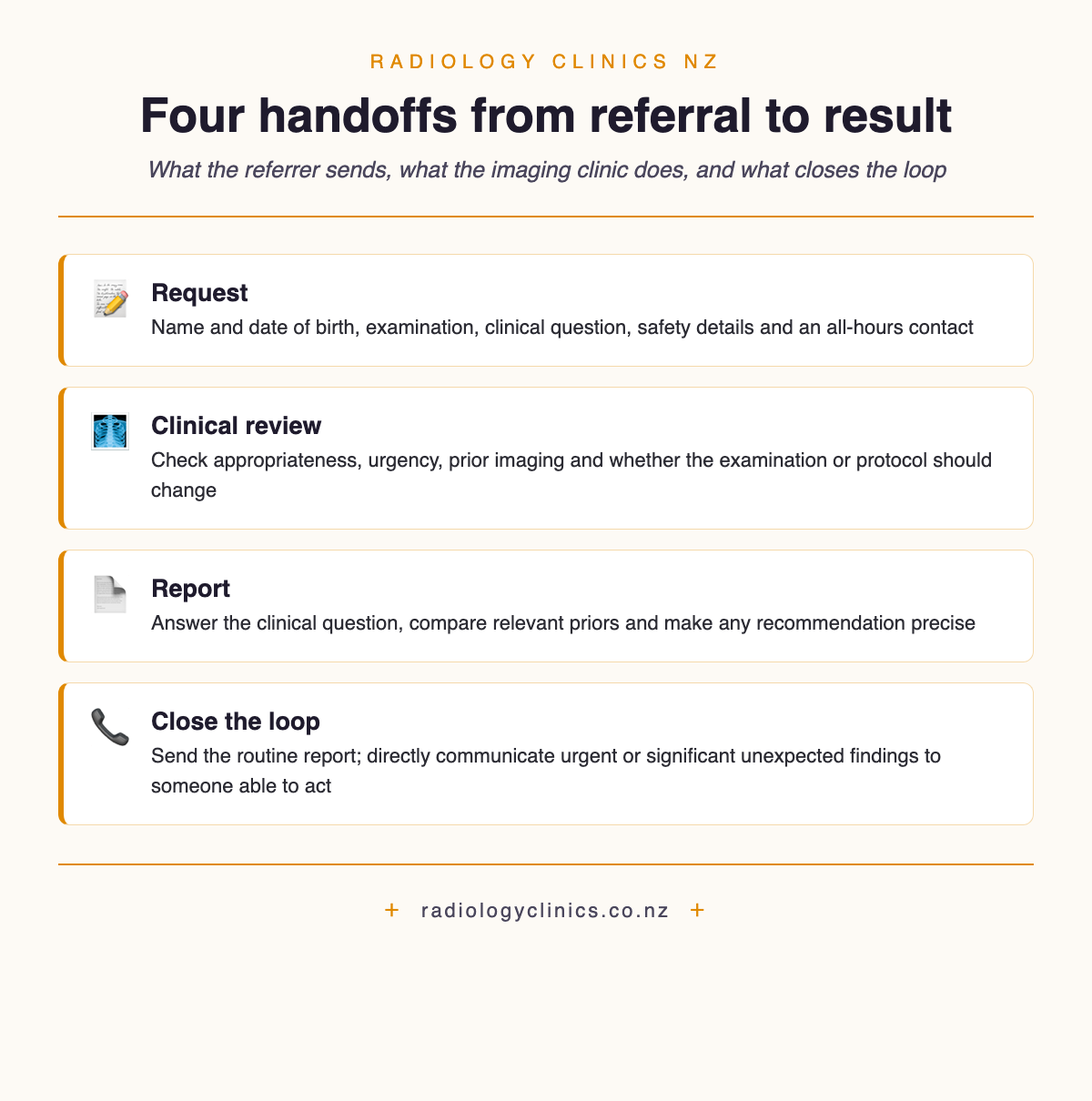
A good service makes four handoffs visible. Each one has a sender, a receiver and a clear finish. If any handoff is missing, the patient feels the gap as a delayed booking, a repeat phone call, an examination that answers the wrong question or a result that reaches nobody able to act.
The reporting half is not merely administrative. The RANZCR standard requires routine reports in a clinically appropriate, timely manner and prefers a structured template. It also requires direct communication for urgent or significant unexpected findings. The referrer should therefore know both routes: where the routine report will arrive and who will receive a call when the result cannot wait.
What makes an imaging referral ready to triage?
A triage-ready request lets the clinic identify the patient, understand the decision and reach the referrer. RANZCR’s examples include the patient’s name and date of birth, the examination, clinical indication, clinical question, referral date, referrer authentication, consent, referrer contact details and Health Provider Index or provider number.
The patient’s National Health Index (NHI) number is useful when it is already known. Health New Zealand describes the NHI as a unique number that helps providers identify the right patient and access the right health information. That makes it useful for identity matching, but the cited RANZCR standard still names the patient’s name and date of birth among the referral identifiers.
“Back pain — MRI” makes the radiologist reconstruct the question. “New left foot weakness; assess for a compressive lumbar cause that changes urgent surgical referral” tells the clinic what matters. It also gives the report a question it can answer directly.
The patient-facing counterpart is our imaging appointment checklist. For a previous contrast reaction, the contrast reaction guide explains which details should travel with the referral.
How should the report answer the referral?
The RANZCR Clinical Radiology Written Report Guideline is explicit: specific questions asked by the referrer must be addressed. If imaging cannot answer them, the report should explain why and recommend a more appropriate way to answer them.
A useful conclusion is concise and clinically relevant. If it recommends another test, treatment or referral, the recommendation should be precise and explain how the next action contributes to diagnosis or management. “Clinical correlation advised” is not enough when the imaging finding supports a specific next step.
Comparison also needs a visible audit trail. The guideline says the report should state whether relevant previous imaging was available, and identify the date and practice location of the prior examination used. That matters when a change in size, alignment or disease extent alters the decision.
The report goes to the referrer for clinical interpretation with the rest of the patient’s story. Our patient guide to reading a radiology report explains the usual sections without turning the report into a diagnosis by itself.
If a patient questions the interpretation, the radiology second-opinion guide explains how the referrer can request clarification or re-evaluation.
What should happen when a finding is urgent or unexpected?
A final report in an inbox is not enough for a finding that needs prompt action. RANZCR Standard S9.1 requires urgent or significant unexpected findings to be communicated directly to the referrer, or to an appropriate representative with the capacity to understand and act. Requirement R9.1 also requires coordination of care when the referrer cannot be contacted.
Close the loop: put an all-hours pathway on the request. A mobile, duty clinician, urgent-care team or hospital service is useful only if the person who answers can identify the patient and act on the finding.
The referrer and clinic should agree what “urgent” means for that service and which route carries it. The cited RANZCR standard does not set one national turnaround number; it requires routine reports in a “clinically appropriate, timely manner”. The transferable rule for an urgent or significant unexpected finding is direct communication to someone able to act.
Preliminary and final reports also need a correction pathway. RANZCR requires the provider to reconcile a difference that could change diagnosis or management and communicate it to the referrer. An amendment or addendum should be clearly identified, dated and attributed rather than silently replacing the original text.
How do Health NZ, ACC and private pathways change the handover?
In the public pathway, Health New Zealand’s community referred radiology service lets general practitioners (GPs), urgent care doctors and primary-care nurse practitioners refer directly for diagnostic x-ray, CT and ultrasound under national clinical criteria.
As at July 2026, Health NZ’s page says qualifying community referred radiology will be free and projects a fully implemented, consistent programme from July 2026; it does not confirm that no-charge access is operational everywhere. The same page describes a planned design of four regional hubs that will triage routine referrals, audit urgent referrals and provide liaison and advice on alternative pathways. Tell the patient what has been confirmed for their referral rather than promising no-charge access from the referral alone.
Electronic access also differs by region. In Auckland and Northland, CareConnect web e-referrals are offered to providers who currently refer into Health NZ by fax or letter, have a Health Provider Index (HPI), also labelled a Common Person Number (CPN), and are not using an integrated general-practice system. Health NZ lists private specialists, midwives, optometrists, physiotherapists and dentists among the users. The cited CareConnect service is local to Auckland and Northland, not a national e-referral route.
The Accident Compensation Corporation (ACC) is a separate injury pathway. ACC’s radiology service description says most ACC-registered providers can refer within their scope, and that the report returns to the treatment provider for discussion of the result and plan. ACC also says a co-payment may apply. Do not label an examination “ACC-funded” until the injury claim and relevant service pathway support it.
Health NZ’s patient information says a person with medical insurance or the ability to pay can discuss referral to a private provider with their healthcare provider, and that insurance may cover only some of the cost. The practical differences are covered in our public versus private radiology comparison and New Zealand imaging funding guide. Clinics and locations can be searched in the Radiology Clinics NZ directory.
For the patient’s cost, ask two concrete questions: has this referral been accepted under the relevant Health NZ or ACC pathway, and what will the patient pay?
What should a referrer ask before sending a patient?
Most workflow problems are easier to solve before the patient is booked. A clinic should be able to explain what it offers, how it receives requests, how radiologist advice is accessed, where reports are delivered and how urgent findings are communicated. RANZCR requires providers to make information available about imaging options, preparation, aftercare and patient management.
Agree these details with the clinic
✓ Which referral channel should this practice use, and how is receipt acknowledged?
✓ How can a referrer discuss the examination or protocol with a radiologist?
✓ Which prior images can the clinic access, and how should outside studies be supplied?
✓ Where will the final report arrive, and who receives an amended report?
✓ What daytime and after-hours contacts does the clinic use for urgent findings?
Write the answers into the practice workflow rather than relying on memory. For the patient, name who will explain the result and what to do if no follow-up arrives. The rest of the site’s practical scan guides are collected on the Radiology Clinics NZ blog.
Frequently asked questions
What should the clinical question on an imaging request say?
Name the decision the result should inform. RANZCR lists a clinical question among its evidence examples for accepted referrals, and its written-report guideline requires the radiologist to address any specific question asked. State the cause, extent or complication the result needs to resolve, so the report can answer a specific question.
Should prior imaging be listed if it was done elsewhere?
Yes, when it is relevant. Give the date and location so the clinic can request or locate it. The RANZCR report guideline says a report should identify the prior date and practice location used for comparison, and state whether relevant previous imaging was available.
Can a radiologist change the requested examination?
The request is reviewed for clinical appropriateness, and the responsible imaging team can recommend a different examination or protocol when it better answers the question. RANZCR requires a radiologist to be contactable to discuss and alter the conduct of the examination when necessary, with the rationale recorded.
Who can refer directly through Health NZ community radiology?
Under the current Health NZ criteria, GPs, urgent care doctors and primary-care nurse practitioners can refer directly for diagnostic x-ray, CT and ultrasound when the clinical criteria are met. That Health NZ page does not extend the listed direct pathway beyond those referrers and modalities.
Is sending the final report enough for an urgent finding?
No. RANZCR requires direct communication of an urgent or significant unexpected finding to the referrer or another representative able to act. The provider also needs a process for coordinating care when the named referrer cannot be reached.
What sources and methodology were used?
This guide draws on primary documents current at July 2026: RANZCR’s 2025 Standards of Practice for Clinical Radiology and its written-report guideline; Health New Zealand’s pages for community referred radiology, Auckland and Northland CareConnect, the National Health Index and private imaging; and ACC’s provider service description. The four-handoff table and infographic restate the duties those documents set out.
This article is general information, not personal medical advice. Availability, public funding, ACC cover and billing can change — confirm the specifics with your referrer and the clinic.

Author: Dr. Mark Bekhit
Dr Mark Bekhit (MBChB, FRANZCR) is a musculoskeletal radiologist practising in Brisbane and an AHPRA-registered specialist in diagnostic radiology (MED0002920947). He spends as much time building software as reading scans: he founded Imaging Finder (Australia) and Radiology Clinics NZ to make imaging easier to find, and builds radiology dictation and pain-tracking tools with one aim — better patient outcomes and a smoother reporting workflow. Outside the reading room he's usually training, bringing the same performance mindset to imaging.
Sources, method, and medical context
This article is published by Radiology Clinics NZ and reviewed for medical-adjacent accuracy by Dr. Mark Bekhit, radiologist. It is general information only and does not replace advice from your own doctor, referrer, clinic, insurer, or Health New Zealand service.
How this list was selected
List-style articles on this site are based on visible directory signals such as clinic location, brand coverage, listed scan services, and whether the clinic has enough public information to compare. They are not paid rankings, clinical endorsements, or a guarantee that a clinic is the best option for a particular patient.
Official references
- Health New Zealand: scans and X-rays
- Health New Zealand: community-referred radiology service
- Radiology Clinics NZ: how the directory is built
Related directory pages
Radiology clinics directoryBrowse by scan typeBrowse by cityHow this directory is built
Last editorial review: 2026-06-30.
Leave a Reply