By Dr. Mark Bekhit, Radiologist. Last updated July 2026.
The short version
Short answer: a previous reaction to contrast dye does not automatically rule out a contrast scan, but it does change the plan. In RANZCR’s current iodinated contrast guideline (version 2.3, March 2018), mild reactions after non-ionic low-osmolality iodinated contrast happen in up to 1% of people, and severe anaphylactic reactions in fewer than 1 in 100,000. A previous iodinated-contrast reaction raises your risk about tenfold, so the department adds precautions. Tell them before the day, not on the table.
On this page
- Can you still have contrast after a reaction?
- What does a contrast reaction look like?
- Which histories raise your risk — and which don’t?
- What should a prepared department do differently?
- What should you do if symptoms start after you leave?
- What should you say about kidney bloods and metformin?
- Does a CT contrast reaction mean you will react to MRI contrast?
- What should you get in writing before you leave?
- How do you book the next scan in New Zealand?
- What questions do people ask about contrast reactions?
Can you still have contrast after a reaction?
A previous reaction does not automatically rule contrast out — but it does turn the scan into a risk-benefit decision the department makes deliberately, rather than a formality. The RANZCR iodinated contrast media guideline says severe anaphylactic reactions are uncommon, at fewer than 1 in 100,000 patients, and its first move for a higher-risk patient is to consider a non-contrast scan or a test that needs no iodinated contrast before proceeding with added precautions.
What changes the outcome is when you tell them. The guideline lists four things the department wants before the injection: what your previous contrast reaction was and how it was treated, whether you have asthma, whether you have had significant allergic reactions to anything else or have eczema, and whether you take a beta-blocker. Healthify New Zealand puts the patient’s half of that plainly for CT: “Please inform the staff if: you’ve had a previous reaction to contrast dye [or] you have any kidney problems.”
Say it at booking, not at the scanner. The Medsafe data sheet for iohexol, one of the iodinated agents used here, is explicit that a history of allergy, asthma or a previous contrast reaction means a course of action should be planned in advance, with the drugs and equipment ready before anyone injects. A radiographer told at 8:55 for a 9:00 appointment cannot plan in advance. Told a week out, booking staff can put it in front of the radiologist, who decides whether to change the agent, change the scan, or premedicate you.
Sometimes the better answer is a different test. If you are weighing MRI against CT, our guide to choosing between an MRI and a CT scan covers what each one answers.
What does a contrast reaction look like?
Most of what people remember as “a reaction” sits at the mildest end of the scale. The guideline classes flushing, nausea, itch, vomiting, headache and mild hives together as mild reactions, and says they are usually self-limited and resolve without any specific treatment. That grading matters, because a warm flush during the injection, written into a file as “allergic to contrast”, can follow someone through the health system for years and cost them the right scan. If that is what happened to you, the fix is to get the episode described accurately, not to accept the label.
A genuine hypersensitivity reaction is graded by what it does to you, and the grade decides the response. The grades and symptoms below come from section 2.1.1 of the RANZCR iodinated contrast guideline, dated March 2018.
There is also a slower version that catches people out. Delayed reactions happen anywhere between one hour and one week after the injection, usually showing up as a blotchy rash rather than anything dramatic; the reported incidence is 4% or less, and they are not typically associated with wheeze or throat swelling.
One piece of reassurance about the drug itself: the current non-ionic low-osmolar agents are of the order of 5 to 10 times safer for mild and moderate reactions than the older high-osmolar agents.
Which histories raise your risk — and which don’t?
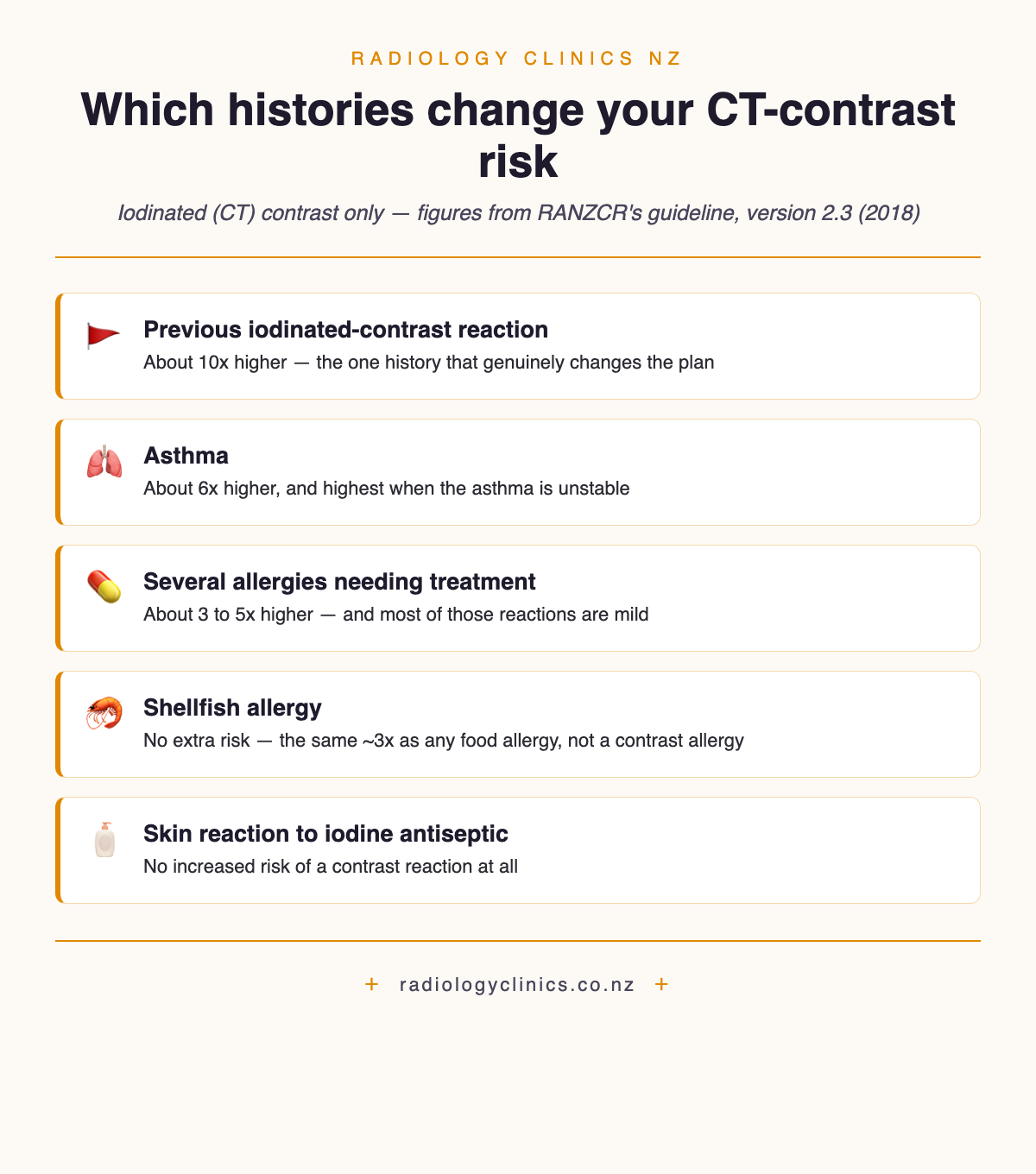
This is where most advice goes wrong, so here are the actual numbers, all from section 2.1 of the RANZCR guideline as at March 2018, the current version at the time of writing. Every figure here is for iodinated contrast — the kind used in CT. It does not carry across to the gadolinium agents used in MRI, which are a separate drug with their own, separate risks.
The shellfish myth: iodinated contrast contains iodine, and so does shellfish — but the link stops there and has never been supported. RANZCR states outright that shellfish allergy carries no increased contrast risk beyond the roughly threefold shared by any other food allergy, and that a skin reaction to iodine antiseptic is not associated with any increase at all.
The first row is the one to take seriously. A genuine previous reaction carries real weight, and the reported recurrence range is wide enough that nobody can promise you a quiet run. The chart below is the same table in a form you can save or show the booking desk.
What should a prepared department do differently?
Two different things are happening here, and it helps to keep them apart. Some safeguards apply to everyone who is injected with iodinated contrast. Others are added specifically because you have reacted before. Every point below is a recommendation in the RANZCR guideline — R2, R3, R31, R33, R39 and R55.
Standard wherever contrast is injected
A doctor who can treat anaphylaxis, in the building. A medical practitioner, ideally a radiologist, must be immediately available and trained to recognise and treat severe contrast reactions. This is not a precaution reserved for higher-risk patients; it applies wherever iodinated contrast is given.
The full kit, in or beside the room. The room, or one next to it, must hold adrenaline 1:1000, oxygen, suction, airways, a bag-and-mask, IV saline and a defibrillator.
Adrenaline early if it is needed. The guideline is unusually blunt on this point: adrenaline is potentially life-saving, must be used promptly, and withholding it out of misplaced concern about side effects can lead to deterioration and death. If you are ever in the room when a family member reacts badly, that is the standard being applied.
Added because you have reacted before
A different agent. Where possible, use a different non-ionic low- or iso-osmolar contrast agent from the one that caused the reaction. This is the strongest argument for knowing the brand name of what you had — without it, the department is guessing.
Longer watching, cannula still in. The Medsafe data sheet for iohexol says everyone should be observed for at least 30 minutes, since most serious side effects occur inside that window. The college guideline sets a general minimum of at least 15 minutes with the cannula still in, increased to 30 minutes for someone at higher risk. After a previous reaction, plan on the longer wait and do not leave early.
Premedication is considered, not automatic. For someone at increased risk after a previous reaction, the radiologist weighs up whether oral steroid premedication is worth using — it is a judgement call, not a default, and the decision sits with the doctor reviewing your history. A typical adult regimen is prednisolone 50 mg by mouth 13 hours before the scan and again 1 hour before, and it has to start at least 6 hours ahead, which is why it must be arranged before the appointment. The evidence has two halves and both belong in the conversation: corticosteroids, with or without antihistamines, have been shown to reduce the likelihood and severity of anaphylactic reactions, but there is no evidence they reduce the likelihood of death from a reaction that breaks through them, and no convincing evidence they reduce the rate of severe reactions to non-ionic contrast at all. A reasonable precaution, not a shield, and never a substitute for the department being ready.
What should you do if symptoms start after you leave?
Most serious reactions happen while you are still in the department, but not all do, and the RANZCR guideline notes that a second wave can follow a severe reaction hours later. Treat breathing or circulation symptoms as an emergency, not as something to ring the clinic about in the morning.
Call 111 straight away if any airway, breathing or circulation warning sign appears — swelling of the tongue or lips, tightness in the throat, a hoarse voice or trouble talking; difficult or noisy breathing, wheeze or a persistent cough; persistent dizziness, or collapse and going pale and floppy. Lie the person down, use an adrenaline auto-injector if one is on hand, and stay with them — do not let them get up even if they start to feel better. These are Healthify New Zealand’s ABC anaphylaxis signs.
A delayed reaction is usually a blotchy rash and is not typically linked with wheeze or throat swelling, but it still deserves a clinical check. The Medsafe iohexol data sheet says hypersensitivity can appear up to a few days later and that mild symptoms may be the first sign of a serious reaction. Contact your GP or Healthline when a rash appears, and have the imaging department record the exact agent used.
What should you say about kidney bloods and metformin?
Kidney function comes up in the same conversation as allergy, but it is a separate question with a narrower answer than people expect. The guideline’s screening question is short: before contrast, you should be asked whether you have known kidney disease including a transplant, whether you have diabetes, and whether you take metformin. Answer yes to any of those in a non-urgent scan and an eGFR should be obtained first. Answer no to all three and a pre-scan blood test is not routine — Healthify’s CT page says one may be done, and “may” is doing real work in that sentence.
Above an eGFR of 45, the college guideline puts the risk of contrast-related acute kidney injury from an intravenous injection at likely non-existent, with no special precautions recommended.
If you take metformin, tell whoever orders the scan and the imaging department. The New Zealand product information and the college guideline give different instructions, so there is no single threshold that is safe to apply in general. Your referrer and the department decide whether it is paused, and for how long, from your latest eGFR and whether the contrast is injected into a vein or an artery. Do not stop a diabetes medicine on your own.
One exception is worth knowing. In an emergency — stroke, major bleeding, trauma — a contrast scan is not delayed to wait for kidney results.
Does a CT contrast reaction mean you will react to MRI contrast?
No — they are different drugs. A contrast-enhanced CT generally uses an iodinated agent, while MRI contrast is gadolinium-based, and both scans can also be done with no contrast at all. Reacting to one does not by itself mean you will react to the other. The history still belongs on the MRI safety questionnaire: Healthify tells patients to declare any previous contrast reaction, and RANZCR notes that gadolinium still carries some risk after a severe reaction to iodinated contrast.
Gadolinium’s other main safety question is kidney function. In RANZCR’s gadolinium guideline, version 3, November 2019, the risk of nephrogenic systemic fibrosis is extremely small at an eGFR of 30 to 60, although caution with the less stable agents may still be appropriate across that group, particularly in patients who are pregnant or breastfeeding. Below 30, gadodiamide, gadoversetamide and gadopentetate are contraindicated. As at that November 2019 guideline, the estimates after a higher-risk agent are about 0.1% per dose at an eGFR of 15 to 30 and about 1% below 15; haemodialysis raises it above 1%, while the guideline says to avoid all gadolinium agents during peritoneal dialysis. This is why the MRI questionnaire asks about your kidneys.
What should you get in writing before you leave?
If you do react, your next scan is only as good as the record of what happened — and the single most useful item is easy to get before you leave. Recommendation R63 of the RANZCR guideline says patients who react should be given the exact name of the contrast agent used, and prompted to consider recording it on a MedicAlert bracelet. Those two are the ones the guideline puts on the department.
The two the guideline asks the department for
✓ The exact agent name — brand and generic, e.g. “Omnipaque (iohexol)”, not “the dye”. This is the item that lets the next department choose something different.
✓ A prompt to consider a MedicAlert bracelet recording that agent.
Beyond those two, a few details make the next department’s job easier if you can get them added to your copy: what the reaction was and how soon after the injection it started, what treatment you were given and whether it worked, and how long you were observed before you were discharged. They are worth asking for, but the one item that changes your next scan is the agent’s exact name. Photograph the page before you leave so you keep your own copy. Our imaging appointment checklist covers the rest.
How do you book the next scan in New Zealand?
Publicly funded imaging comes through a referral. Under Health New Zealand’s community referred radiology criteria, GPs, urgent care doctors and nurse practitioners can refer people directly for x-rays, CT scans and diagnostic ultrasounds without a specialist assessment first, and imaging is free to patients who meet the clinical criteria. As at 23 July 2026, that page still projects a consistent national programme from July 2026; it does not confirm that rollout is complete everywhere. We cover eligibility in who qualifies for free imaging in New Zealand, and current radiology wait times separately.
If the scan relates to an injury, ACC is the relevant pathway. Its no-fault scheme covers everyone, including visitors, injured in an accident in Aotearoa New Zealand. ACC’s treatment-cost guidance says it may pay only part of a covered treatment cost.
For a private scan, Health New Zealand says you can use medical insurance or pay yourself; insurance may cover only some of the cost. The trade-offs are set out in our comparison of public and private radiology.
Whichever route you are on, put the reaction on the referral, not just in your head. When you ring to book, ask one set of questions: will a radiologist review my previous reaction beforehand, which agent is planned this time, and what will I pay? Our questions to ask before a scan cover the rest, and how to read a radiology report explains what arrives afterwards.
What questions do people ask about contrast reactions?
The reaction figures in this section are from RANZCR’s March 2018 guideline; the Medsafe iohexol observation advice was checked on 23 July 2026.
Does a shellfish allergy mean I can’t have contrast?
No. The RANZCR guideline states that shellfish allergy carries no increased risk beyond the roughly threefold risk shared by any food allergy. Declare it as a food allergy, not as an allergy to iodinated contrast.
I felt hot and flushed during my last CT. Does that count as a reaction?
It sits at the mildest end of the scale. The RANZCR guideline groups flushing with nausea, itch and mild hives as mild reactions that usually settle without treatment. Mention it so it is recorded accurately, because “flushing, settled by itself” and “allergic to contrast” lead to different plans next time.
How long do I have to stay after the injection?
The Medsafe data sheet for iohexol says at least 30 minutes for everyone. RANZCR sets at least 15 minutes with the cannula still in for general iodinated contrast use, and 30 minutes for someone at increased risk. After a previous reaction, expect the longer wait and do not leave early.
Can I breastfeed after a contrast CT?
Yes. Recommendation R29 of the RANZCR guideline says stopping breastfeeding, or expressing and discarding milk, is not required after iodinated contrast. MRI gadolinium agents are covered by a separate guideline.
A rash appeared three days after my scan. Is that related?
It can be. The RANZCR guideline puts delayed reactions between one hour and one week, usually as a blotchy rash, with a reported incidence of 4% or less. Contact your GP or Healthline the same day; call 111 for any airway, breathing or circulation symptom. Get the agent’s name from the department.
What sources and methodology were used?
Clinical and funding statements were checked against the current primary documents on 23 July 2026. Reaction rates, risk multipliers, observation, premedication and emergency readiness come from RANZCR’s Iodinated Contrast Media Guideline, version 2.3, March 2018, which the college has scheduled for review in 2026. Gadolinium and kidney thresholds come from its version 3 guideline of November 2019. New Zealand observation advice comes from the Medsafe OMNIPAQUE data sheet. Emergency signs are from Healthify; access pathways are from Health New Zealand and ACC.
What this article does not tell you is which New Zealand clinic stocks which contrast agent, or what any department’s premedication protocol is. That is not published anywhere we could verify, and guessing would be worse than saying so. Your referrer and the department holding your previous record are the two places your reaction history needs to reach.
This article is general information, not personal medical advice. Availability, public funding, ACC cover and billing can change — confirm the specifics with your referrer and the clinic.

Author: Dr. Mark Bekhit
Dr Mark Bekhit (MBChB, FRANZCR) is a musculoskeletal radiologist practising in Brisbane and an AHPRA-registered specialist in diagnostic radiology (MED0002920947). He spends as much time building software as reading scans: he founded Imaging Finder (Australia) and Radiology Clinics NZ to make imaging easier to find, and builds radiology dictation and pain-tracking tools with one aim — better patient outcomes and a smoother reporting workflow. Outside the reading room he's usually training, bringing the same performance mindset to imaging.
Sources, method, and medical context
This article is published by Radiology Clinics NZ and reviewed for medical-adjacent accuracy by Dr. Mark Bekhit, radiologist. It is general information only and does not replace advice from your own doctor, referrer, clinic, insurer, or Health New Zealand service.
Official references
- Health New Zealand: scans and X-rays
- Health New Zealand: community-referred radiology service
- Radiology Clinics NZ: how the directory is built
Related directory pages
Radiology clinics directoryBrowse by scan typeBrowse by cityHow this directory is built
Last editorial review: 2026-06-30.
Leave a Reply