How to use this patient guide
This guide is intended to help you prepare questions and understand practical directory information. It does not replace advice from your doctor, referrer, clinic, insurer, ACC, or Health New Zealand service. Confirm any instructions, preparation steps, timing, and costs with the clinic before your appointment.
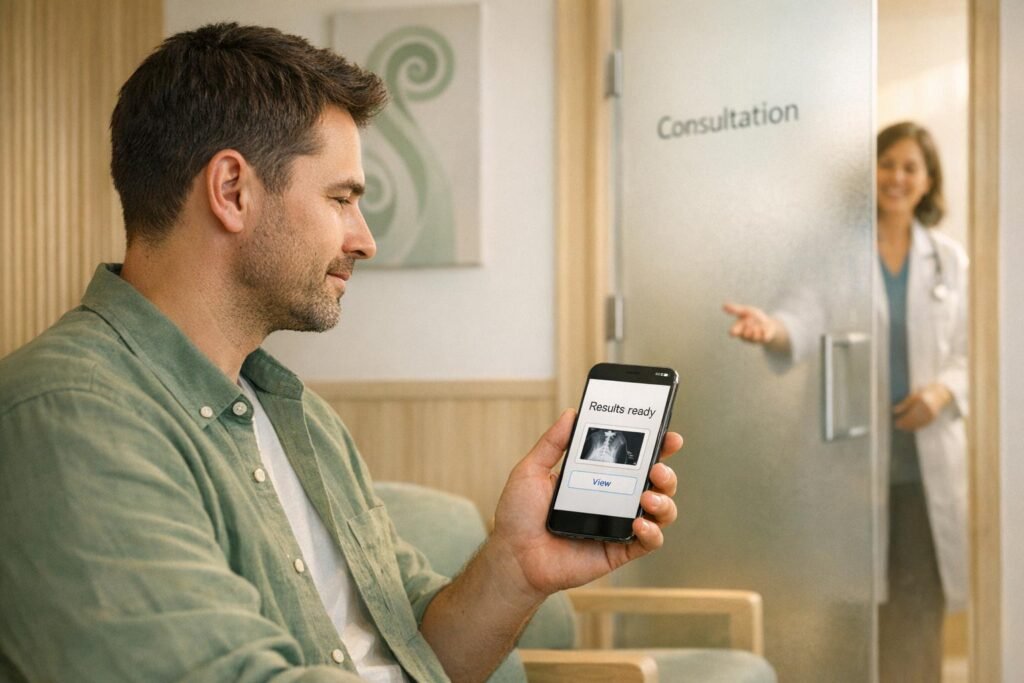
Accessing radiology results in New Zealand has shifted significantly with the introduction of online portals like myImaging, offered by providers such as Pacific Radiology, Auckland Radiology, and Bay Radiology. These portals allow patients to view their images instantly and access verified reports within two weeks. While this offers convenience and flexibility, in-person consultations still play a critical role, particularly for urgent or complex findings.
Key Points:
If a portal report raises a concern, use the New Zealand radiology second-opinion pathway to ask for clarification, re-evaluation or another opinion.
Key Points:
- Online Portals: Immediate access to imaging, delayed reports (up to 2 weeks), easy sharing, but may confuse patients with technical terms.
- In-Person Consultations: Provide clarity, emotional support, and context but can involve delays due to appointment availability, especially in rural areas.
- Privacy: Both methods comply with New Zealand’s strict privacy laws, ensuring data security.
Quick Overview:
- Online portals are ideal for routine or follow-up imaging.
- In-person consultations are better for urgent or sensitive cases.
- A hybrid approach – using online access for images and in-person discussions for reports – can combine the strengths of both.
Choosing the right method depends on your needs, urgency, and access to technology.
How Imaging Results Are Delivered in New Zealand
From Imaging to Results: The Basic Pathway
Once you’ve had your scan, a radiologist creates a detailed report, which is then sent to your referring doctor. While the actual images are usually available immediately, the formal report can take up to two weeks to appear in the portal. This delay gives your doctor time to review the findings and contact you promptly if urgent action is required. Radiology clinics across New Zealand use a variety of methods to deliver these results.
Delivery Methods Used in New Zealand
Radiology clinics in New Zealand employ several ways to share imaging results. These include:
- GP or specialist consultations: Your results are explained within the context of your overall health.
- Online patient portals (e.g., myImaging): Images can be accessed immediately, while the detailed reports follow within two weeks.
- Electronic report delivery systems: Platforms like Medical-Objects send reports directly to your GP’s practice management software.
- Referrer portals: Tools such as InteleConnect allow specialists to access high-quality imaging data online.
| Delivery Method | Speed | Who Receives It |
|---|---|---|
| GP or specialist consultation | Depends on appointment availability | Patient (with clinical context) |
| Online patient portal (e.g., myImaging) | Images: immediate; reports: up to 2 weeks | Patient |
| Medical-Objects (to GP’s PMS) | Real-time | GP or specialist |
| InteleConnect (referrer portal) | Real-time | Referring clinician |
For example, Medical-Objects integrates directly with systems like Medtech32 or MyPractice, ensuring your doctor often receives your results before they’re visible in patient portals. Similarly, InteleConnect provides specialists with immediate access to complete imaging data. While urban centres rely heavily on digital systems, rural areas may still depend on GP consultations or phone updates for result delivery.
Regardless of the method, strict privacy protections are in place to safeguard your imaging data.
Privacy and Security Standards
In New Zealand, patient imaging data is safeguarded under the Privacy Act 2020 and the Health Information Privacy Code (HIPC) 2020, which set rules for how health information is collected, stored, and shared. Access to radiology systems is restricted to authorised personnel who must comply with privacy agreements and undergo regular audits. Bay Radiology, for instance, highlights the importance of strong privacy protocols and consistent auditing.
Patient portals use multi-factor authentication – such as an email link combined with an SMS code – to ensure your records remain secure. Additionally, you have the option to opt out of sharing certain examinations, restricting access to radiology clinic staff only. Under Rule 6 of the HIPC, you can formally request access to your medical records, and the agency must respond within 20 working days.
sbb-itb-16a0ccc
Online Portals for Radiology Results
What Online Portals Offer Patients
Online portals like myImaging, widely used by New Zealand providers such as Pacific Radiology, Auckland Radiology, and Bay Radiology, give patients the ability to access their imaging studies from virtually any device. Once the images are available, patients can download reports as PDFs and use a web viewer to explore their scans – zooming, panning, and scrolling through sequences. On mobile devices, navigation is made even easier with pinch-to-zoom and swipe gestures. Plus, the "Share Exam" feature allows patients to securely share their full DICOM-quality images with another clinician, without needing to reveal their login details.
This digital approach reflects New Zealand’s commitment to making healthcare more accessible and patient-friendly. Features like these are especially helpful for those who need quick and remote access to their results.
"Your report will be available in the portal within two weeks of the report being verified by your radiologist. Some reports, including those reviewed by more than one specialist, may take a little longer to verify. Images are available immediately." – Pacific Radiology
Advantages of Online Portals
The convenience of immediate access to imaging results is just the beginning. These portals eliminate the need for follow-up appointments that are solely about viewing scans, which is a big deal for patients who live far from major healthcare centres. For rural patients, sharing results digitally with specialists in urban areas is far easier than organising physical copies or making long trips.
| Benefit | Why It Matters in New Zealand |
|---|---|
| Immediate image access | Reduces the stress of waiting for results |
| DICOM-quality sharing | Makes it easier for rural patients to consult specialists in larger cities |
| Mobile compatibility | Handy for patients who primarily use smartphones |
| Centralised history | Provides access to older scans, with records dating back to 2003 |
Access to these portals is free for patients, and the secure sharing options ensure that specialists receive high-quality, clinically useful data when additional input is required.
Disadvantages of Online Portals
While the delay in report availability ensures that doctors can provide context when discussing findings, it can be frustrating for patients who want immediate answers. In-person consultations can sometimes address this gap more effectively. Additionally, radiology reports often include technical terms like "mild degenerative change" or "incidental finding", which can be difficult to interpret without a healthcare professional’s explanation.
Digital accessibility is another hurdle. Registering for the portal requires both a valid mobile number for SMS verification and an email address, which may be challenging for older individuals or those in lower-income households. The system is also restricted to patients aged 16 and over, and activation codes expire after one month if not used. For people less familiar with technology, the process of using the portal might feel like an obstacle rather than a convenience.
Another limitation is that myImaging only includes studies from its affiliated clinics. This can make it harder to manage your imaging history if your scans are spread across multiple providers.
In-Person Results and Consultations
When In-Person Results Are Used
In-person discussions about radiology results typically happen during a GP or specialist appointment after your doctor has reviewed the radiology report. In hospital or emergency settings, clinicians might share provisional verbal results before the formal report is completed to enable timely decisions about care. For serious findings – like suspected cancer or other critical conditions – a face-to-face conversation is often prioritised to provide clarity and support. This approach highlights both the strengths and challenges of in-person consultations, as outlined below.
Advantages of In-Person Consultations
One of the biggest strengths of in-person consultations is the ability to interpret results in the context of your complete medical history, physical examination, and symptoms – something online portals can’t provide. If imaging reveals a potential issue, your doctor can quickly arrange additional tests or referrals. For sensitive diagnoses, such as metastatic disease, discussing results in person ensures emotional support and a clear plan for next steps. Dr David Rogers, Radiologist and Lead Medical Officer at Astra Radiology, puts it this way:
"We aim to support better health outcomes by identifying concerns early and providing our patients with clear, accurate information about their bodies."
Another benefit of in-person visits is the immediate advice on follow-up care, including when repeat imaging might be needed.
Disadvantages of In-Person Consultations
That said, in-person consultations aren’t without their challenges. One major issue is the difficulty of securing an appointment. In 2024, 25.7% of New Zealand adults cited long wait times as the main barrier to accessing in-person care – more than double the 11.6% reported in 2022. Access is even harder for rural patients, who often face significant travel requirements. Additionally, short appointment times can make it tough for patients to fully understand complex findings.
| Limitation | Real-World Impact |
|---|---|
| Long wait times | Delays in reviewing results, especially for non-urgent cases |
| Travel requirements | Increased burden for rural patients or those with mobility challenges |
| Information overload | Difficult to process complex details in a short appointment |
| Administrative risk | Follow-up reminders can be missed by busy staff |
Another systemic risk is that radiology reports can sometimes fall through the cracks if they aren’t formally acknowledged by the ordering clinician. This is particularly problematic over weekends or public holidays when administrative staff are unavailable. A 2023 report from the Health and Disability Commissioner highlighted cases where such gaps led to significant delays in care. These challenges underscore the trade-offs of in-person consultations compared to the immediate access provided by online portals.
Online Portals vs. In-Person Results: A Direct Comparison
Online Portals vs. In-Person Radiology Results in New Zealand
Comparing the Two Methods Side by Side
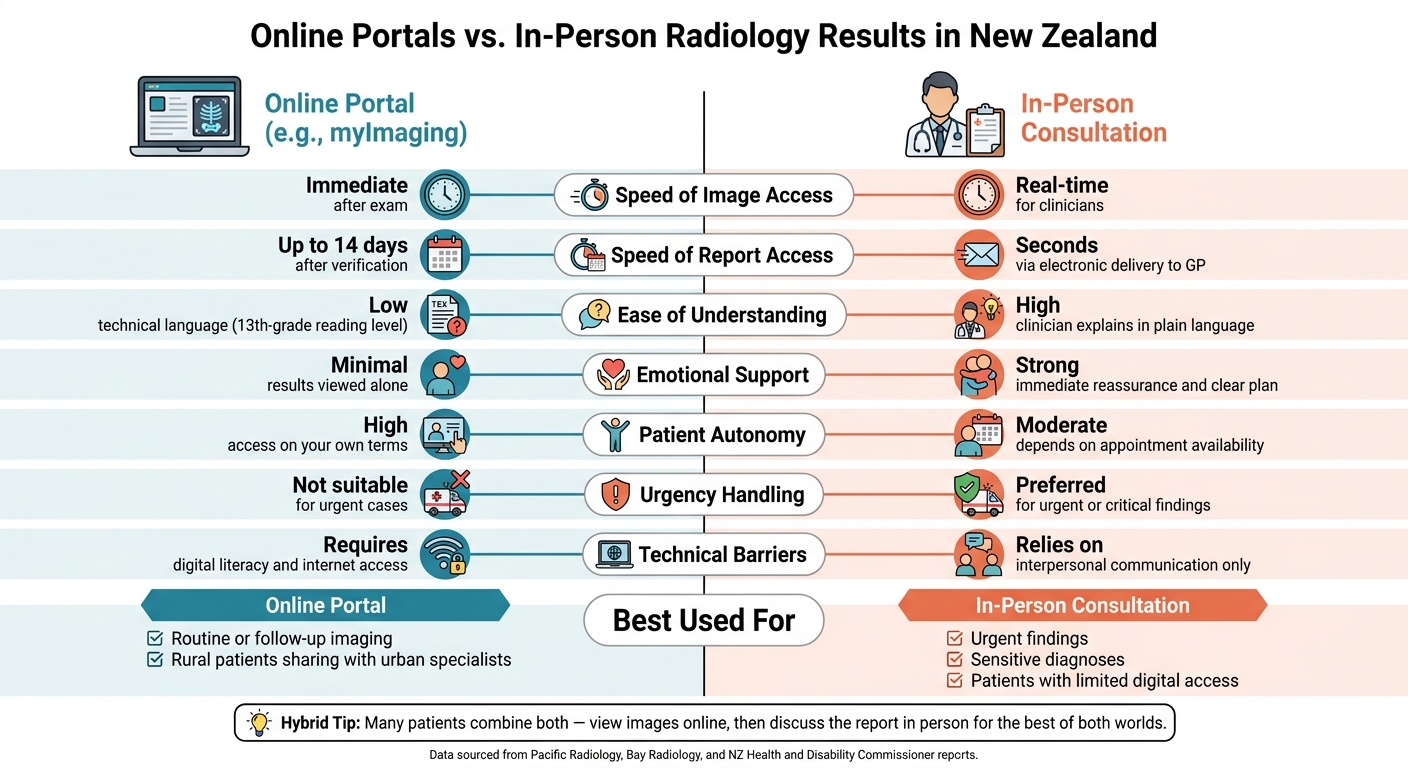
Both online portals and in-person consultations have their advantages, but they cater to different patient needs. The table below highlights how these methods measure up across key factors that impact patient experience and care.
| Factor | Online Portal | In-Person Consultation |
|---|---|---|
| Speed of image access | Immediate after exam | Real-time for clinicians |
| Speed of report access | Up to 14 days after verification | Seconds via electronic delivery to your GP |
| Ease of understanding | Low – technical language may be difficult to understand | High – clinician explains findings in plain language |
| Emotional support | Minimal – results viewed alone | Strong – immediate reassurance and a clear plan |
| Patient autonomy | High – access on your own terms | Moderate – timing depends on appointment availability |
| Urgency handling | Inadequate for urgent cases | Preferred for urgent, critical findings |
| Technical barriers | Requires digital literacy and internet access | Relies on interpersonal communication only |
These differences highlight a key trade-off: convenience for the patient versus clinical oversight and support. While online portals put control in the hands of patients, in-person consultations offer immediate clarity and reassurance, particularly for urgent or complex cases.
Safety and Clinical Considerations
The choice between online and in-person methods isn’t just about convenience – it also involves clinical risks. With online portals, the main concern is misinterpretation. Reports often contain technical terms that can confuse patients without medical guidance. For instance, seeing terms like "lesion" or "opacity" might cause unnecessary alarm, even if the findings are minor.
"The average radiology imaging report was found to be written at a 13th-grade, or college, reading level, while the average American has an 8th-grade reading level." – Aidan Farrell, Thomas Jefferson University
In-person consultations shift the risk toward system failures. If follow-up actions aren’t properly managed, delays in care can occur. Deputy Health and Disability Commissioner Vanessa Caldwell highlighted this issue:
"The lack of follow-up from Te Whatu Ora after receiving the report was a serious departure from the accepted standard of care"
Both methods have their own weaknesses, whether it’s the risk of misunderstanding results online or administrative errors in in-person processes. Choosing the right method depends on the situation and the patient’s specific needs.
Access and Equity in New Zealand
When deciding between these methods, it’s essential to consider how accessible they are for all patients. Online portals, for example, require digital literacy and reliable internet access, which can be challenging for older adults or low-income households. Additionally, these portals are typically limited to patients aged 16 and older.
For rural communities, in-person consultations present their own hurdles. Travel to imaging facilities, long wait times, and staff shortages in regional areas can make accessing care difficult. In fact, New Zealand has struggled to meet outpatient CT and MRI wait time targets since 2013, with a 15% gap for CT scans and a 25% gap for MRIs. For Māori and Pacific peoples, these challenges are often compounded by systemic inequities and distance from specialist services.
Practical solutions, like GP-led referral pathways, can help address these gaps. For example, the ACC GP-led MRI programme has reduced wait times by two to three weeks, while also minimising time away from work. ACC Chief Executive Megan Main explained the programme’s benefits:
"GPMRI demonstrates the impact that strong collaboration between ACC and primary care can have in improving recovery outcomes for injured New Zealanders, while also supporting the long-term sustainability of the scheme."
Ultimately, no single method perfectly balances speed, clarity, and equity. Both approaches have their place, but ensuring fair access and clear communication remains critical for all patients.
Choosing the Right Approach for Your Situation
When to Use Online Portals vs. In-Person Consultations
Deciding how to access your imaging results often comes down to weighing the need for speed against the importance of expert guidance. For routine or follow-up imaging, such as checking on a known condition or evaluating a minor injury, online portals are a practical choice. They provide quick access to images and standard report turnaround times. However, if your imaging is investigating a potentially serious issue or your doctor has flagged specific concerns, an in-person or telehealth consultation is the better route. Sensitive findings are best discussed directly with a clinician, who can explain the details, answer your questions, and guide you on the next steps. If you’re unsure which method suits your situation, check in with your GP or the doctor who referred you before the scan. Many patients find that combining these approaches works well.
Hybrid Approaches to Results Communication
A blended approach is common among patients: accessing images immediately through an online portal while saving the formal discussion for a later consultation. Viewing your scans beforehand can help you prepare thoughtful questions for your discussion. Portals also allow secure sharing of images with your clinician ahead of time, ensuring they have all the necessary diagnostic-quality data before your appointment. This method balances the convenience of online access with the reassurance of professional input, tailoring the process to your specific needs.
Practical Tips for Patients in New Zealand
Here are some handy tips to help you navigate your options effectively:
- Before your scan: Ask your referring doctor how your results will be delivered. Check if a follow-up appointment has already been scheduled. If your case is urgent, contact your referrer directly instead of waiting for portal updates.
- When accessing results online: Radiology reports often contain technical terms. If anything is unclear, reach out to your referrer for clarification rather than relying on online searches or AI tools.
- Finding a radiology clinic: Use Radiology Clinics NZ to locate imaging facilities across New Zealand. The site includes clinic addresses, contact details, and patient reviews to help you choose a provider near you.
Conclusion
Online portals and in-person consultations each play a key role in delivering radiology results across New Zealand, catering to different clinical situations and personal preferences.
Looking at both options highlights how they complement each other. Online portals like myImaging – used by providers such as Auckland Radiology Group, Pacific Radiology, and Bay Radiology – offer benefits like instant access and secure sharing of high-quality DICOM scans. However, they come with limitations, including delayed availability of verified reports, restricted access for those under 16, and a reliance on digital literacy.
On the other hand, in-person consultations remain essential. They provide vital clinical context, accommodate patients less familiar with digital tools, and are indispensable for minors and urgent cases.
Ensuring equitable access is critical. A solely digital approach risks excluding some groups, but maintaining both options ensures all New Zealanders can access care in a way that works for them. This dual approach reflects the country’s dedication to patient-centred and inclusive healthcare.
FAQs
Why can my GP see my report before it shows in the portal?
Your GP can review your report sooner as it becomes instantly accessible through their clinical systems or referral process. However, reports uploaded to the online portal go through a verification process by a radiologist, which may take up to two weeks. This step ensures the information is accurate before it’s shared with you.
What should I do if my portal report looks worrying or confusing?
If your portal report feels confusing or concerning, reach out to your referrer or healthcare provider for clarification. They can help explain the findings and address any worries you might have. It’s always better to discuss your questions with a medical professional instead of trying to interpret the results by yourself.
Can I share my scans from the portal with another doctor securely?
Yes, many online platforms provide a secure way to share your scans and medical reports with authorised healthcare providers. These systems prioritise patient privacy while ensuring your doctor or specialist can access the information they need with ease.
Related Blog Posts

Author: Dr. Mark Bekhit
Dr Mark Bekhit (MBChB, FRANZCR) is a musculoskeletal radiologist practising in Brisbane and an AHPRA-registered specialist in diagnostic radiology (MED0002920947). He spends as much time building software as reading scans: he founded Imaging Finder (Australia) and Radiology Clinics NZ to make imaging easier to find, and builds radiology dictation and pain-tracking tools with one aim — better patient outcomes and a smoother reporting workflow. Outside the reading room he's usually training, bringing the same performance mindset to imaging.
Sources, method, and medical context
This article is published by Radiology Clinics NZ and reviewed for medical-adjacent accuracy by Dr. Mark Bekhit, radiologist. It is general information only and does not replace advice from your own doctor, referrer, clinic, insurer, or Health New Zealand service.
Official references
- Health New Zealand: scans and X-rays
- Health New Zealand: community-referred radiology service
- Radiology Clinics NZ: how the directory is built
Related directory pages
Radiology clinics directoryBrowse by scan typeBrowse by cityHow this directory is built
Last editorial review: 2026-06-30.
Leave a Reply