How to interpret technology claims
Technology and AI information in radiology can change quickly and may not apply equally across every clinic. Treat this article as general background, not a promise about what a specific provider uses or whether a tool is suitable for a particular patient.
Artificial intelligence (AI) is reshaping radiology in New Zealand by addressing critical issues like long diagnostic delays and rising workloads. Key highlights include:
- AI as a “co-pilot”: Tools like Nicolab’s StrokeViewer are being trialled to prioritise urgent cases, reduce errors, and improve access to stroke therapies for 850 more patients annually.
- Efficiency gains: AI cuts MRI scan times, streamlines workflows, and reduces reporting delays. For example, AI in chest X-rays and CT scans is already helping radiologists manage growing demands.
- Challenges: Outdated equipment, over-reliance on AI, and high implementation costs remain barriers. Nearly 44% of imaging staff report working with obsolete tools.
- Future plans: A national Radiology AI Orchestrator is being developed to integrate AI solutions across public hospitals, improving consistency and safety.
AI tools are not replacing radiologists but are designed to support them by improving accuracy and patient outcomes. However, modernising infrastructure and addressing risks like automation bias are critical for long-term success.
Recent Studies on AI in New Zealand Radiology
AI Initiatives in NZ Hospitals and Clinics
Recent research highlights how AI is reshaping radiology in New Zealand. Health New Zealand‘s AI Lab is building a robust foundation for handling high-volume radiology examinations, a critical area of demand in the healthcare system. These AI tools are not intended to replace radiologists but serve as a dependable secondary reviewer, enhancing the accuracy and reliability of diagnoses.
Collaborative efforts are also yielding promising results. In September 2025, Professor Anna Ranta launched a two-year national study to implement Nicolab’s StrokeViewer AI solution across 30 hospitals. This initiative is projected to save the health sector NZ$5 million in short-term costs.
In the Waikato region, researcher Harmony A. Thompson examined the use of AI in primary care settings. Her study involved 304 skin lesion images captured with a DermLite camera and analysed using an AI algorithm. The AI demonstrated a sensitivity of 99.04% and a specificity of 85.71% in identifying potentially cancerous lesions. These results were on par with teledermatologists, who achieved 98.78% sensitivity.
AI and Digital Imaging Improvements
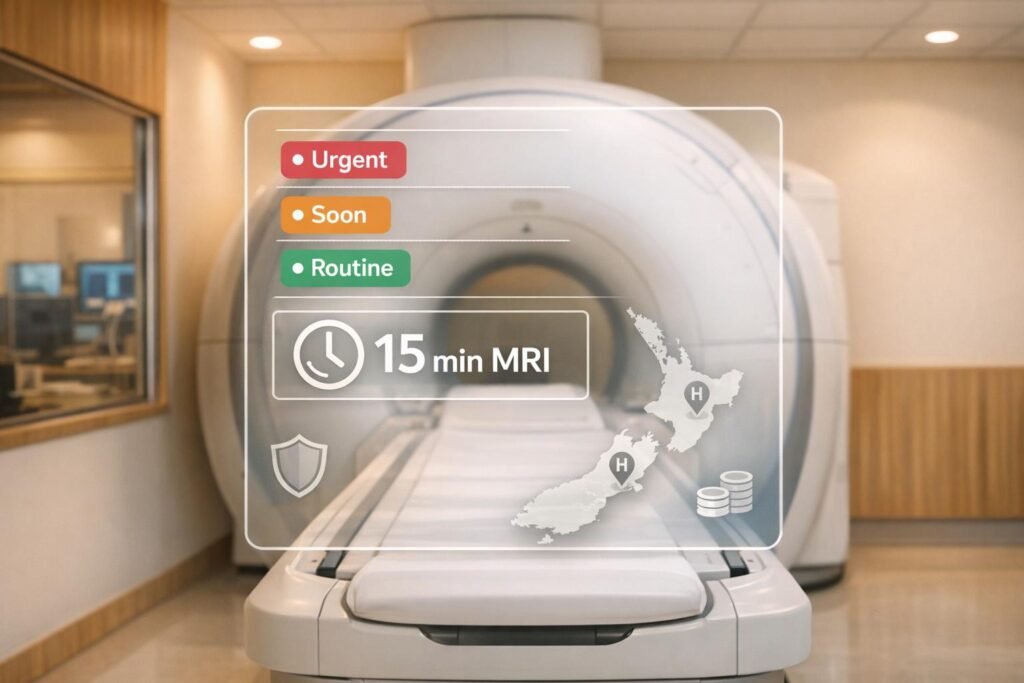
AI is bringing noticeable advancements to digital imaging, particularly in MRI scan processing. New reconstruction algorithms are cutting down the time patients spend in MRI machines without compromising diagnostic quality. This has led to shorter waiting lists and more effective use of imaging resources.
However, local validation remains critical. A ResNet50-based AI model for melanoma detection achieved 95.1% accuracy on international benchmark datasets but dropped to 78.4% when tested on New Zealand patient data. This disparity highlights the need to tailor AI tools to local populations, as global performance metrics may not always align with regional realities.
sbb-itb-16a0ccc
Global AI Developments and NZ Applications
Deep Learning for Image Interpretation
Deep learning is reshaping the way radiologists interpret medical images on a global scale, and New Zealand is embracing these advancements. Take the private radiology network I-MED, for example, which implemented the deep learning tool Annalise CXR in early 2025. This tool helps radiologists by flagging urgent findings in chest X-rays, allowing them to handle high workloads while still maintaining control over final reports. These international breakthroughs are influencing New Zealand’s approach to enhancing diagnostic efficiency in healthcare.
AI systems today can simultaneously screen for over 100 clinical findings. This is especially beneficial for public hospitals, where Health New Zealand’s AI Lab is concentrating on high-demand areas like chest X-rays, fracture detection, and CT brain scans.
Global strides in reconstruction algorithms and MRI processing are also playing a role in local radiology improvements. These advancements are helping to reduce scanning times and make better use of imaging resources across New Zealand.
"These solutions never get tired of looking at X-rays or CT scans. They can improve safety, and in turn help us as radiologists to improve quality of the service that we provide, and enhance patient flow" – Sharyn MacDonald, Chief of Radiology at Health NZ Waitaha Canterbury
These technological advancements are paving the way for more efficient and automated radiology workflows.
Workflow Automation in Radiology
Beyond diagnostics, AI is transforming radiology’s administrative and clinical workflows. In June 2024, the Whanganui Radiography Department transitioned from manual Excel-based rostering to RosterLab‘s AI-powered software. Led by Associate Clinical Manager Mike Petersen, the project showed how AI could handle complex union requirements and staffing needs with greater efficiency.
Health New Zealand is now looking to move beyond standalone tools with plans for a national Radiology AI Orchestrator. In October 2025, a Request for Information detailed the vision for a unified platform that would automatically route imaging studies to suitable AI models and integrate results seamlessly into existing systems. These efforts underline a nationwide commitment to integrating AI into both clinical and administrative processes, aiming to improve radiology outcomes across the board.
The StrokeViewer platform is a prime example of how workflow automation can speed up critical processes, like the time from diagnosis to treatment for stroke patients.
"This initiative is about more than technology, it’s about improving access to life-saving treatment for stroke patients across the country" – Michael Macilquham, CEO of Nicolab
eHealth Webinar – How AI can improve clinical workflow and experience for clinicians
Challenges and Recommendations for AI in NZ Radiology
Benefits vs Risks of AI in Radiology: A Comprehensive Comparison
Implementation Barriers
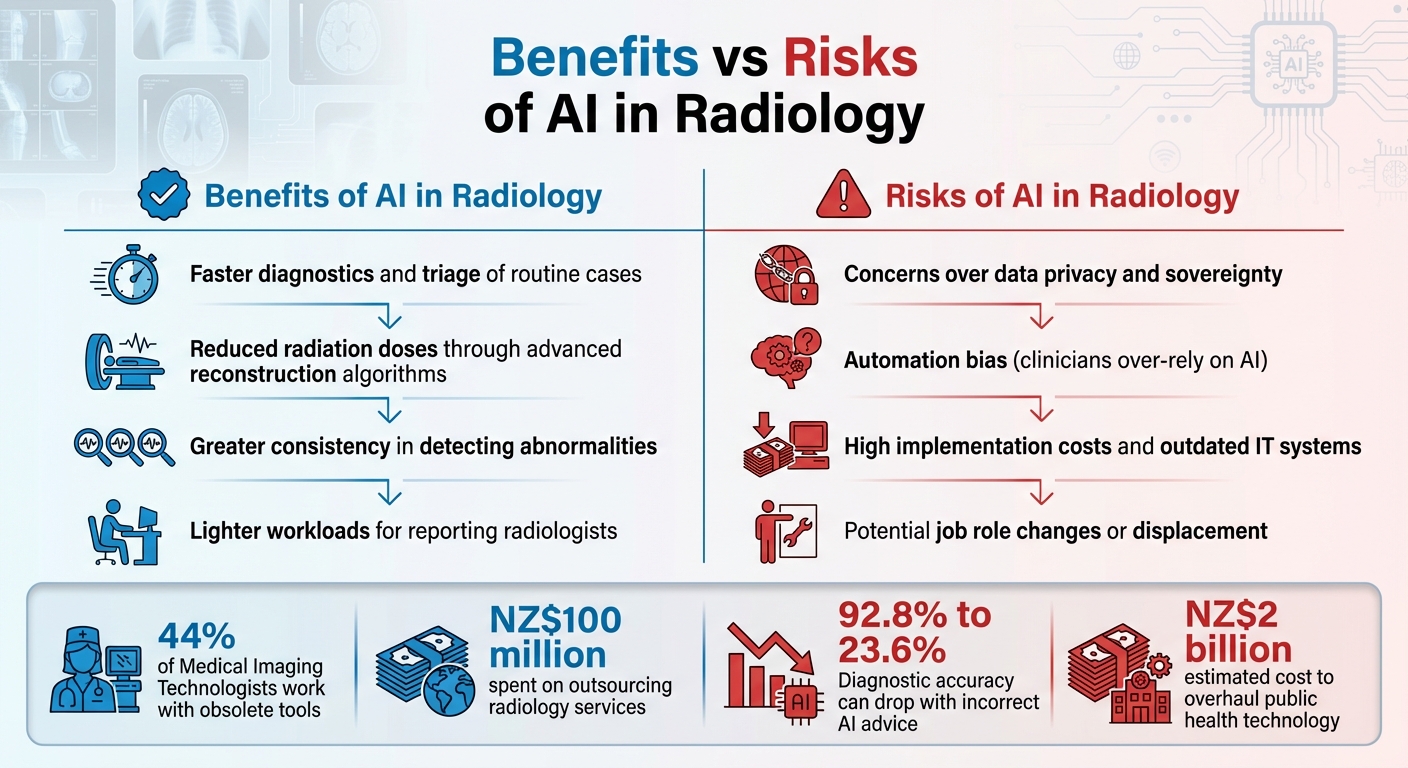
Adopting AI in New Zealand’s radiology sector isn’t without its challenges. Over NZ$100 million has been funnelled into outsourcing radiology services, leaving fewer resources for much-needed internal upgrades. As a result, many public facilities are stuck with outdated equipment. In fact, 44% of Medical Imaging Technologists report working with tools that are broken, obsolete, or even unsafe.
The reliance on legacy infrastructure adds to these issues. For example, outdated Radiology Information Systems often lose or fail to properly link critical patient reports, raising safety concerns. Modernising these systems is no small feat either, with estimates suggesting an overhaul of New Zealand’s public health technology could exceed NZ$2 billion. Compounding this, many radiology departments lack the specialised AI expertise needed to integrate and manage these technologies effectively.
Another concern is the potential over-reliance on AI. Studies show that when clinicians receive incorrect AI advice, diagnostic accuracy can plummet from 92.8% to just 23.6%.
"Thoughtful explanation design is not just an add-on; it’s a pivotal factor in ensuring AI enhances clinical practice rather than introducing unintended risks." – Dr Paul H Yi, Director of Intelligent Imaging Informatics, St Jude Children’s Research Hospital
These barriers highlight the need for a careful balance between leveraging AI’s potential and addressing its risks.
Benefits and Risks Comparison
The use of AI in radiology presents a mix of opportunities and challenges. Here’s a closer look at the trade-offs:
| Benefit of AI in Radiology | Risk of AI in Radiology |
|---|---|
| Faster diagnostics and triage of routine cases | Concerns over data privacy and sovereignty |
| Reduced radiation doses through advanced reconstruction algorithms | Automation bias, where clinicians over-rely on AI |
| Greater consistency in detecting abnormalities | High costs of implementation and risks tied to outdated IT systems |
| Lighter workloads for reporting radiologists | Potential job role changes or displacement |
Recommendations for Moving Forward
To tackle these challenges, experts suggest redirecting the funds currently spent on outsourcing back into the public sector. This could allow for hiring more staff and investing in modern AI-ready equipment. Identifying "AI champions" within radiology teams can also help drive adoption and foster a culture of innovation. For high-risk AI tools, implementing rigorous, risk-based validation processes is essential to ensure safety and reliability. Lastly, standardised clinical checklists can mitigate automation bias, ensuring that AI serves as a tool to support – not replace – clinical judgment.
How Radiology Clinics NZ Helps Patients
Finding Radiology Services
Navigating the radiology system in New Zealand can feel overwhelming. According to ACC reviews, the mix of providers and funding models often leaves patients feeling "confusing and stressful" when trying to access care. Radiology Clinics NZ steps in to simplify this process by offering a centralised directory. This directory allows patients to quickly find clinics, compare services, and access essential details about each provider.
With MRI scans costing anywhere between $750 and $1,400 – and private providers charging 17% to 53% more than ACC rates – having clear and accessible information is crucial. As private practices grow and GPs gain more direct referral options, tools like this directory make navigating the system much easier.
Improving Patient Access and Transparency
Beyond just helping patients find clinics, Radiology Clinics NZ enhances access to critical service information. By centralising details in one place, the platform fills the information gaps that often exist in New Zealand’s healthcare system. It also provides insights into how AI is being used in routine radiology exams, including chest X-rays, fracture detection, and CT brain scans.
Patients can also learn about factors like wait times and radiation safety. AI advancements have made significant strides in these areas, with innovations that reduce radiation doses and speed up triaging. Armed with this knowledge, patients can make informed decisions about which providers best meet their needs. This approach not only simplifies access but also aligns with New Zealand’s focus on integrating technology with patient care.
Conclusion
AI is reshaping radiology in New Zealand by improving patient safety, boosting diagnostic precision, and streamlining workflows. It has already demonstrated its value by lowering error rates in detecting conditions like lung cancer and fractures. Additionally, AI helps radiologists manage increasing imaging demands – growing by 7% annually – by prioritising urgent cases more effectively.
"These tools are about improving quality, not replacing expertise" – Stuart Barnard, Clinical Director of Radiology, Health NZ Counties Manukau
The success of AI in radiology depends on clinician-led implementation and strong safeguards. New Zealand’s approach ensures that AI supports, rather than replaces, human expertise. The national AI Orchestrator and Application Marketplace, introduced in October 2025, establishes consistent standards while addressing challenges like computing power and data sovereignty. High-risk tools undergo rigorous validation, while lower-risk applications are continuously monitored. These efforts are already delivering measurable improvements in clinical care.
Private clinics have been early adopters, showcasing AI’s ability to cut reporting times and enhance patient flow. These real-world applications are helping shape national strategies, ensuring AI solutions align with New Zealand’s healthcare needs.
Making these advancements accessible to patients is equally crucial. Radiology Clinics NZ simplifies the process by centralising information on clinic options, wait times, and available AI diagnostics. As AI becomes more integrated into routine imaging, this transparency enables patients to make informed decisions about their care.
Looking ahead, the challenge lies in balancing innovation with practical implementation. New Zealand’s commitment to equity – particularly improving access for Māori and rural communities – ensures that AI benefits are distributed fairly. By investing in training, regulatory oversight, and infrastructure, AI can elevate radiology services while maintaining the human expertise and judgement that are vital to quality healthcare.
FAQs
Will AI change how long I wait for scans or results?
AI has the potential to streamline processes in healthcare, reducing wait times for scans and results. By prioritising scans more efficiently and accelerating their interpretation, it enables faster diagnoses and treatments. For patients in New Zealand, this could translate to receiving care more promptly within the healthcare system.
How safe is AI in radiology if it can be wrong?
AI has the potential to transform radiology by improving efficiency and reducing diagnostic errors. However, it’s not without its flaws. Research indicates that AI can sometimes make subtle errors in interpreting images or drafting diagnostic notes. These mistakes could lead to overdiagnosis or even jeopardise patient safety.
In New Zealand, healthcare authorities are approaching AI adoption carefully. Their priority is rigorous testing and oversight to minimise risks and ensure that AI tools are implemented safely and effectively to support patient care.
What is the national Radiology AI Orchestrator, and why does it matter?
The national Radiology AI Orchestrator, proposed by Te Whatu Ora, is designed to streamline and expand the use of AI in radiology across New Zealand. This platform integrates AI tools directly into existing workflows, aiming to minimise disruption while ensuring their safe and effective application. By focusing on governance, model validation, and ongoing monitoring, the initiative seeks to improve efficiency, enhance patient safety, and promote fair access to diagnostic services – particularly benefiting rural areas and Māori communities.
Related Blog Posts
- Understanding Radiology Wait Times in NZ: A Guide
- Top Clinics Offering High-Resolution Imaging in NZ
- Guide to Patient-Centred Radiology in NZ
- Radiation Dose Optimisation in Imaging

Author: Dr. Mark Bekhit
Dr Mark Bekhit (MBChB, FRANZCR) is a musculoskeletal radiologist practising in Brisbane and an AHPRA-registered specialist in diagnostic radiology (MED0002920947). He spends as much time building software as reading scans: he founded Imaging Finder (Australia) and Radiology Clinics NZ to make imaging easier to find, and builds radiology dictation and pain-tracking tools with one aim — better patient outcomes and a smoother reporting workflow. Outside the reading room he's usually training, bringing the same performance mindset to imaging.
Sources, method, and medical context
This article is published by Radiology Clinics NZ and reviewed for medical-adjacent accuracy by Dr. Mark Bekhit, radiologist. It is general information only and does not replace advice from your own doctor, referrer, clinic, insurer, or Health New Zealand service.
Official references
- Health New Zealand: scans and X-rays
- Health New Zealand: community-referred radiology service
- Radiology Clinics NZ: how the directory is built
Related directory pages
Radiology clinics directoryBrowse by scan typeBrowse by cityHow this directory is built
Last editorial review: 2026-06-30.
Leave a Reply