
Finding the right radiology clinic in New Zealand can feel overwhelming, but it doesn’t have to be. Here’s a quick guide to help you make the best choice:
- Use Online Directories: Platforms like Radiology Clinics NZ list hundreds of clinics, making it easy to compare options by location, services, and ratings.
- Read Reviews: Patient feedback highlights service quality, staff professionalism, and wait times.
- Check Credentials: Ensure clinics are accredited by IANZ and radiologists hold FRANZCR qualifications.
- Consider Location: Proximity, parking, and public transport options can save time and reduce stress.
- Ask Your GP: Referrals from healthcare providers often lead to trusted clinics with high diagnostic accuracy.
- Evaluate Services: Look for clinics offering a wide range of imaging technologies and advanced equipment.
- Simplify Booking: Opt for clinics with online booking, clear referral requirements, and transparent payment options.
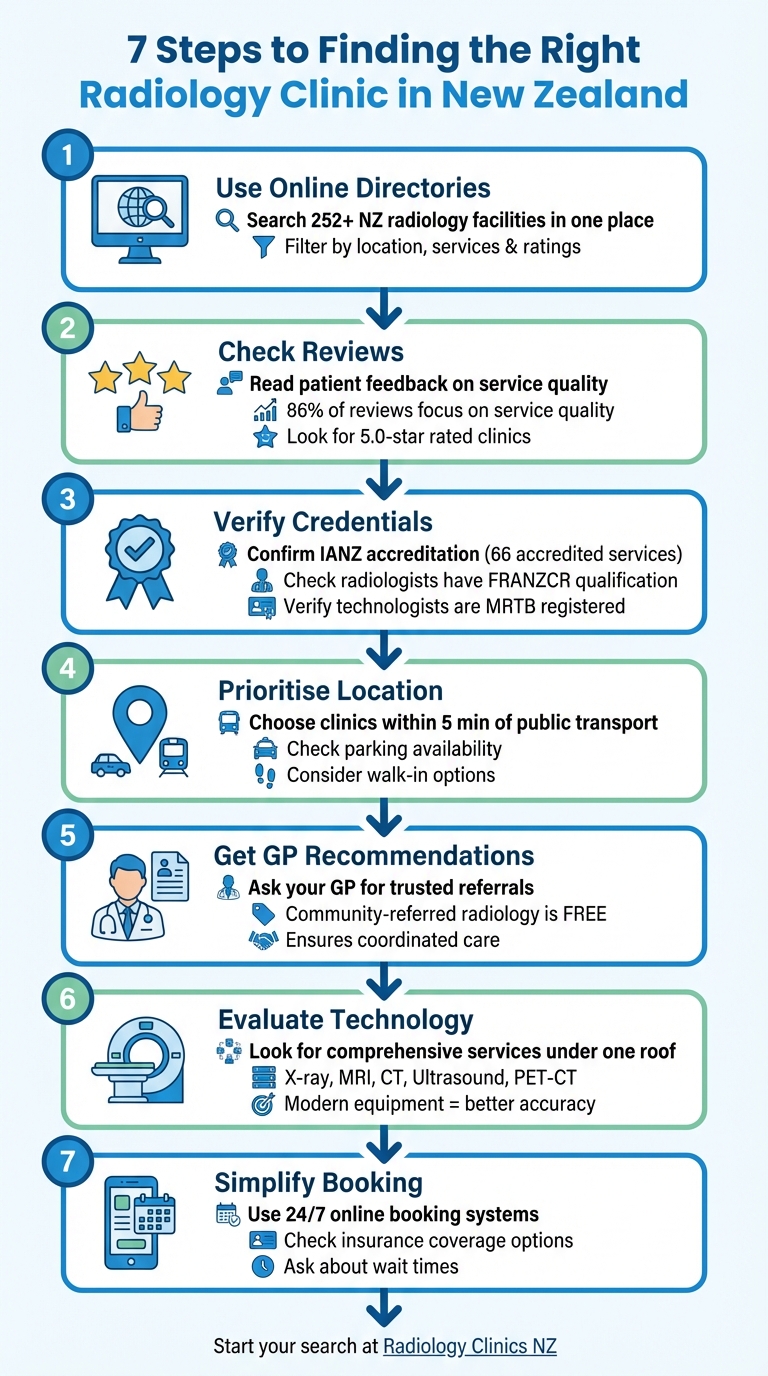
7-Step Guide to Finding the Right Radiology Clinic in New Zealand
1. Use Online Directories Like Radiology Clinics NZ
Manually checking individual clinic websites can take up a lot of time and make it harder to compare options side by side. Online directories address this issue by consolidating hundreds of providers into one easily searchable platform. Instead of hopping between multiple sites, you can explore all your options in one place, making it much easier to evaluate and compare clinics.
Take Radiology Clinics NZ, for example. This directory lists 252 radiology imaging facilities across New Zealand, including 29 Accident & Emergency centres and 24 ultrasound clinics. The platform allows you to narrow down options by facility type, search based on postcode or city, and access detailed clinic profiles. These profiles include key information like physical addresses, contact numbers, and even direct booking links. Plus, with integrated maps, you can pinpoint clinic locations and plan your travel or commute with ease.
Ratings also play a big role in decision-making, with some clinics earning perfect 5.0-star reviews. For instance, Linda Wong shared her experience with Greenlane Clinical Centre, saying:
Staff at the Greenlane Clinical Centre Radiology Dept delivered excellent customer service in the communication lead up and on the day care.
To avoid unnecessary phone calls or being redirected after arrival, use the service filters to confirm the clinic offers the specific imaging technology you need – whether it’s MRI, CT, 3D mammography, or PET-CT. Entering precise postcodes in your search can also save time, especially in larger cities where clinic options are more spread out. This way, you can feel confident that the clinic you choose meets your requirements and is conveniently located.
2. Check Online Reviews and Patient Feedback
Once you’ve shortlisted clinic options using the directory, the next step is to delve into patient reviews. These reviews offer a glimpse into the real patient experience – beyond the polished image clinics present on their websites. They can help you gauge critical aspects like wait times, staff behaviour, and how well procedures are explained. Interestingly, about 86% of patient comments focus on service quality rather than technical performance, emphasising the importance of everyday care.
A useful starting point is Radiology Clinics NZ, a platform that compiles reviews and star ratings for over 250 radiology facilities across New Zealand. This site provides a wealth of feedback, and some clinics even boast perfect 5.0-star ratings, reflecting consistently high standards of service.
When reading reviews, look for recurring themes rather than focusing on isolated opinions. For instance, in top-performing clinics, 98% of positive reviews mention the professionalism of technologists, while 79% highlight the courtesy of reception staff. On the flip side, in lower-rated clinics, 70% of negative feedback centres on receptionist behaviour, and 60% points to long wait times. Recent reviews also mention issues like delayed appointments or unprofessional interactions during visits.
Pay attention to the specifics. Reviewers often comment on whether procedures were painless, if staff provided clear explanations, or how long they had to wait. For example, a patient from Nelson shared:
Reception was friendly, patient and helpful. Every stage in process explained well and well informed about what will happen to reports.
Similarly, a reviewer from Papamoa noted:
Professional radiology service with a really lovely clinician providing insight and care. Felt like how healthcare should be.
For the most accurate and relevant insights, focus on reviews from the past 6–12 months and filter by location to get suburb-specific feedback. This approach ensures you’re basing your decision on current and reliable information.
3. Verify Clinic Credentials and Radiologist Qualifications
Before booking your appointment, it’s crucial to confirm that the clinic and its radiologists meet New Zealand’s professional standards. This ensures you’re receiving care from properly trained specialists in accredited facilities.
Start by checking the clinic’s accreditation with International Accreditation New Zealand (IANZ). IANZ is the official authority that accredits radiology services across the country. As of February 2026, there are 66 accredited medical imaging services in New Zealand. You can visit the IANZ website and use their directory to confirm whether a clinic is accredited for the specific imaging service you require – be it CT scans, MRIs, ultrasounds, or mammograms.
For radiologists, look for the FRANZCR designation (Fellow of the Royal Australian and New Zealand College of Radiologists). This qualification signifies that the radiologist has completed around seven years of specialist training and passed the necessary exams. To ensure their credentials are valid, check the Medical Council of New Zealand‘s online register, which will confirm their vocational registration in "Diagnostic and interventional radiology".
It’s also important to verify that technologists are registered with the Medical Radiation Technologists Board (MRTB) and hold a current Annual Practising Certificate (APC). The MRTB provides a public register where you can search by name or scope of practice to confirm their certification. The MRTB emphasises:
"You cannot legally practise in a protected scope of practice in New Zealand unless you’re registered and hold an annual practising certificate (APC) – within the appropriate scope".
If you’re considering specialised procedures, such as CT Coronary Angiography or screenings for occupational lung conditions, check whether the radiologist has additional credentials from relevant committees, like the Experts in Occupational Dust Lung Disease (EODLD).
Taking these steps ensures you’re selecting a clinic that not only offers advanced imaging services but also complies with New Zealand’s rigorous healthcare standards.
4. Prioritise Proximity and Accessibility
Picking a radiology clinic close to home can make life a lot easier. It cuts down on travel time and stress, especially if you need multiple visits or have mobility issues. Health New Zealand (Te Whatu Ora) is working to ensure diagnostic services are more accessible within communities.
Before scheduling an appointment, consider the parking situation. If the clinic is part of a hospital complex, plan for an extra 20–40 minutes to find parking and navigate the area. On the other hand, standalone clinics often provide dedicated parking spots, including free patient parking and nearby on-street options. This setup not only makes access simpler but also eliminates the need to deal with lifts or long walks.
If driving isn’t an option, look for clinics with good public transport connections. Clinics located within a 5-minute walk of bus stops or train stations are easier and more affordable to reach. Make sure these transit stops have step-free access, ramps, and clear signage to accommodate different mobility needs [38,39]. Without these features, transportation challenges can make it harder to attend appointments.
Another helpful option is finding clinics that allow walk-in appointments. Many regional clinics accept walk-ins for services like X-rays or non-contrast CT scans, which is a real time-saver for urgent imaging needs. Additionally, community-referred radiology that meets national clinical guidelines is free, reducing costs and making local clinics even more practical by cutting out travel expenses.
sbb-itb-16a0ccc
5. Seek Recommendations from Healthcare Providers
Start by consulting your GP or specialist. They can point you towards clinics known for reliable diagnostic accuracy and high-quality reporting. This kind of trusted advice connects you with clinics that not only meet clinical standards but also ensure your care is well-coordinated.
Getting a referral from your GP does more than just direct you to a clinic – it helps integrate your imaging results into your overall medical care. When your GP refers you, the imaging reports are automatically linked to your medical history, making follow-up care smoother. Plus, community-referred radiology that meets national standards is free for patients.
"With access to diagnostic imaging, community and primary healthcare providers can make better decisions about where to refer patients next, or whether they can provide care closer to home." – Health New Zealand | Te Whatu Ora
If you’re seeking an ACC-funded MRI for a knee or spine injury, it’s essential to check if your GP is accredited under the GP Referred MRI (GPMRI) programme. If they aren’t, ask if they can refer you to a General Practitioner with a Special Interest (GPSI), who may have access to a broader range of diagnostic options. For injuries less than six months old, ACC can cover up to three appointments, including the MRI review.
Your healthcare provider can also guide you to clinics that offer quick turnaround times for reports. Looking ahead, the fully implemented national community-referred radiology programme, expected by July 2026, aims to simplify and standardise this process across all regions. These recommendations from your provider can be a valuable addition to your search for a clinic that suits your needs.
6. Evaluate Services and Technology Offered
When choosing a clinic, it’s crucial to ensure they offer a comprehensive range of imaging services under one roof. This includes essentials like X-rays, ultrasound, CT scans, and MRI, which eliminates the hassle of travelling between locations. Some clinics go further, providing specialised diagnostic options such as PET-CT for cancer detection, mammography for breast imaging, and bone density scans. Others may also offer interventional radiology, which uses image-guided procedures to diagnose and treat conditions with minimal invasion.
The quality of the equipment directly impacts the accuracy and detail of the scans. Modern imaging tools produce high-resolution images that allow for precise diagnoses. For example, some clinics now use EOS scanners, which provide detailed spinal and body imaging while reducing radiation exposure compared to traditional methods. Others have upgraded their mammography systems with advanced GE Pristina Via™ machines for improved imaging. These advancements ensure faster and more accurate results while enhancing patient care.
"At Beyond Radiology, we use the very latest in imaging technology to bring total clarity to doctors, specialists and patients." – Beyond Radiology
When evaluating a clinic, it’s worth checking if they highlight their use of cutting-edge digital technology on their website. Clinics that invest in advanced tools often deliver quicker and more reliable results. Some are even incorporating artificial intelligence into their processes to detect subtle abnormalities that might otherwise go unnoticed. These innovations not only speed up diagnoses but also improve the overall patient experience.
Practical features also matter. Look for clinics that offer walk-in availability for X-rays or provide online access to images through patient portals. If you’re claustrophobic, check if the clinic has open MRI or wide-bore scanners to ensure a more comfortable experience.
7. Consider Booking and Contact Options
How you handle your appointment can greatly influence your overall radiology experience. Once you’ve evaluated location, credentials, and services, these booking tips can help you make a final decision. Many clinics now offer 24/7 online booking, allowing you to check available slots instantly. As the I-MED Radiology Network points out:
Booking online is the easy way to make your radiology appointment. It saves you waiting on the phone, and lets you browse for a time and clinic to suit you.
If you’re using your mobile, you can often upload a photo of your referral directly during the booking process. This makes managing your appointment both secure and convenient.
For urgent or complex procedures that may require additional screening, phone bookings remain a key option. However, some patients have noted delays when calling. For instance, a patient at Pacific Radiology in Timaru mentioned experiencing long hold times, which negatively impacted their experience. For routine matters, such as submitting referrals or requesting cost estimates, email can be a more efficient alternative.
Before booking, double-check your referral requirements. Most scans require a referral from a GP, specialist, or physiotherapist, but certain screenings allow for self-referral if you meet age criteria. Some clinics even accommodate walk-ins for X-rays without needing an appointment.
Payment options depend on your insurance provider. Clinics typically bill Southern Cross directly, but for providers like NIB, Accuro, or UniMed, you might need pre-approval or pay upfront and claim later. Even with ACC coverage, a surcharge is often applied, so it’s wise to request a cost estimate when booking. Payment is generally expected on the day of your scan unless your insurance fully covers it.
Finally, ask about wait times when contacting the clinic. Some facilities provide estimated wait times on public dashboards or through self-booking apps. If your local clinic has a long queue, consider asking your doctor to send your referral to a clinic with shorter wait times. Alternatively, request to be added to a cancellation list – clinics often reach out to patients when earlier slots become available.
Conclusion
Choosing the right radiology clinic becomes much simpler with a clear plan. Start by exploring Radiology Clinics NZ, which lists 252 radiology options across the country in one convenient directory. This resource provides a detailed look at clinics in your area, complete with patient reviews and essential clinic information to help you make an informed decision. From there, focus on finding a clinic that delivers high-quality care and meets professional standards.
Make sure the radiologists are FRANZCR-certified and, if necessary, specialise in fields like paediatric or breast imaging. Patient reviews can also be a helpful guide – clinics with 5.0/5 ratings often highlight friendly, supportive staff. Factor in practical considerations like location, parking availability, and whether the clinic offers online booking to streamline your experience.
Lastly, check your insurance coverage and payment options beforehand to avoid unexpected expenses. By following these steps, you can confidently choose a radiology clinic that aligns with your needs.
FAQs
What should I bring to my scan?
Before your appointment, make sure to bring your referral or appointment confirmation, along with a valid ID if it’s required. Dress in loose, comfortable clothing, as this will make the process easier. You’ll likely need to remove items like jewellery, glasses, watches, hearing aids, or hair clips before the scan, so it’s a good idea to leave these at home if possible.
If you have conditions such as claustrophobia, inform the staff ahead of time – this is important as you may need a sedative to help you through the procedure. Lastly, follow any specific instructions provided by your healthcare provider or the clinic to ensure everything goes smoothly.
How do I check if a clinic is IANZ-accredited?
To check if a clinic holds IANZ accreditation, head to the IANZ website and browse their directory of accredited medical imaging services. This guarantees the clinic adheres to New Zealand’s national quality and safety standards. For the latest details, you can also refer to updates like the December 2025 list, which provides the most up-to-date information on accredited clinics.
Will my scan be free or do I have to pay?
Whether your scan is free or involves a fee depends largely on your insurance plan and the specific service being provided. Some clinics might require payment on the day unless your insurer has pre-approved the procedure or it’s covered under government programmes like ACC. It’s a good idea to check with both your clinic and insurer in advance to clarify any potential costs.
Related Blog Posts

Leave a Reply