
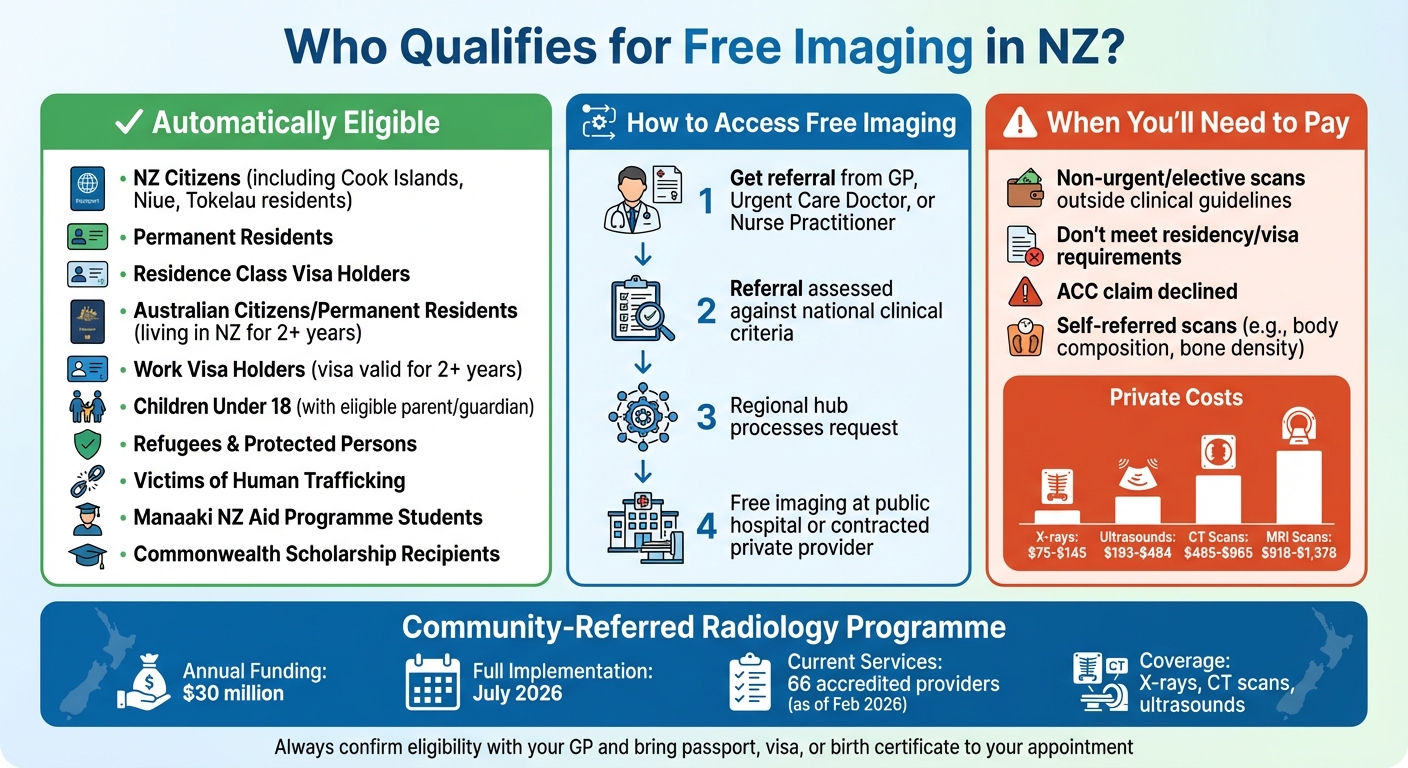
In New Zealand, free public imaging services like X-rays, CT scans, and ultrasounds are available to those who meet specific eligibility criteria. These services are funded by Health New Zealand (Te Whatu Ora) and aim to remove financial barriers to essential diagnostic care. Here’s what you need to know:
- Who Qualifies?
- NZ citizens, permanent residents, and residents from the Cook Islands, Niue, or Tokelau.
- Work visa holders with visas valid for at least two years.
- Australian citizens or permanent residents living in NZ for at least two years.
- Refugees, protected persons, and their dependents, as well as children under 18 with eligible parents.
- How It Works:
- Referrals must come from GPs, Urgent Care Doctors, or Nurse Practitioners.
- Imaging must meet national clinical criteria to qualify for public funding.
- Services are delivered through public hospitals and private providers contracted by Te Whatu Ora.
- When You May Need to Pay:
- Non-urgent or elective scans outside clinical guidelines.
- Imaging for those not meeting residency or visa requirements.
- Private imaging costs range from $75 for X-rays to over $1,300 for MRIs.
The Community-Referred Radiology programme, funded with $30 million annually, ensures free access to eligible patients, with full implementation expected by July 2026. Always check your eligibility with your GP and bring necessary documents like a passport or visa to your appointment.
Who Qualifies for Free Imaging in New Zealand: Eligibility Guide
Who Qualifies for Publicly Funded Imaging
General Eligibility for Public Health Services
In New Zealand, free imaging services are available to those who meet the basic eligibility criteria for publicly funded health care. New Zealand citizens automatically qualify, including individuals from the Cook Islands, Niue, or Tokelau. If you hold a residence class visa or are a resident or permanent resident, you’re also eligible.
Work visa holders can access these services if their visa allows them to stay in New Zealand for at least two years, including any time already spent in the country. Similarly, Australian citizens and permanent residents qualify if they have lived in New Zealand, or plan to, for at least two consecutive years. Children under 18 are covered if their parent or legal guardian meets these requirements.
Some groups automatically qualify regardless of visa type or length of stay. This includes refugees, protected persons, victims of human trafficking, and individuals applying for or appealing these statuses. Students on the Manaaki New Zealand Aid Programme or Commonwealth Scholarship are also eligible. Temporary visitors from the UK or Australia may access urgent or necessary imaging under reciprocal health agreements, though this typically excludes routine imaging referred by a GP.
These rules form the foundation for accessing the Community-Referred Radiology (CRR) programme.
Community-Referred Radiology Programme
Beyond the general eligibility, the Community-Referred Radiology (CRR) programme offers free diagnostic imaging – such as X-rays, CT scans, and ultrasounds – to eligible patients. Referrals are made by GPs, Urgent Care Doctors, or Nurse Practitioners. This streamlined process is designed to speed up diagnoses and treatment.
To qualify for free imaging, referrals must meet specific national clinical criteria. These referrals are assessed by four Regional Community Referred Radiology hubs, which use evidence-based guidelines to ensure the imaging is clinically necessary. Health New Zealand explains:
Community referred radiology that meets these criteria will be free for patients to access, to eliminate any financial barriers. Where copayments existed, these have now been removed.
sbb-itb-16a0ccc
Clinical Requirements and Referral Criteria
National Clinical Criteria and Priority Assessment
Health New Zealand (Te Whatu Ora) uses national clinical guidelines, informed by international research and the Community HealthPathways platform, to decide which imaging requests qualify for public funding. Once a referral is submitted, a regional hub evaluates it. Routine requests are prioritised to focus on imaging that delivers the most benefit, while urgent cases undergo audits to ensure they meet the required standards.
To ensure the referral is effective, your referrer must include key details such as a physical assessment, medical history, prior imaging, and – if relevant – pregnancy status. These elements help determine the urgency of the scan and ensure it addresses the specific clinical need [[9]](https://fyi.org.nz/request/17691/response/70043/attach/html/6/Radiology Referring for Medical Imaging R15.pdf.html). For acute cases – like a CT head scan within 24–48 hours for a suspected transient ischaemic attack – your GP must also provide either a specialist’s endorsement or a reference from decision support tools.
This framework helps identify common scenarios eligible for public funding.
Common Situations Covered by Public Funding
Public funding is allocated to clinical situations where timely imaging can make a significant difference. Emergency and acute care take precedence, especially for life-threatening or "life or limb" conditions. For these cases, CT scans are expected to be reported within 1–2 hours, while X-rays have a target of 4 hours [[9]](https://fyi.org.nz/request/17691/response/70043/attach/html/6/Radiology Referring for Medical Imaging R15.pdf.html). Additionally, new CT pathways are being introduced to support earlier cancer detection, reducing the need for secondary care referrals.
Funding also extends to ACC cases involving musculoskeletal injuries, such as those affecting the spine, knee, or neck. These injuries must generally be recent (less than six months old) and meet specific clinical guidelines. In some instances, six weeks of rehabilitation is required before an MRI is approved under ACC funding. Other publicly funded imaging includes maternity-related scans and follow-up imaging for specific conditions in cardiology (e.g., chest X-rays), oncology (e.g., CT scans), and orthopaedics (e.g., post-surgery assessments) [[9]](https://fyi.org.nz/request/17691/response/70043/attach/html/6/Radiology Referring for Medical Imaging R15.pdf.html).
| Imaging Type | Typical Publicly Funded Situations | Key Requirements |
|---|---|---|
| CT Scan | Early cancer detection, emergency "life or limb" conditions, neurological issues | Must meet national criteria; specialist endorsement needed for after-hours cases [[9]](https://fyi.org.nz/request/17691/response/70043/attach/html/6/Radiology Referring for Medical Imaging R15.pdf.html) |
| MRI (ACC) | Musculoskeletal injuries (e.g., knee, lumbar spine, cervical spine) | Recent injury (less than 6 months); often requires 6 weeks of rehabilitation first |
| X-ray | Fractures, chest conditions (cardiology/oncology), orthopaedic follow-ups | Referral from GP, NP, or specialised clinic nurses [[9]](https://fyi.org.nz/request/17691/response/70043/attach/html/6/Radiology Referring for Medical Imaging R15.pdf.html) |
| Ultrasound | Diagnostic needs in community care, maternity imaging | Must adhere to Community HealthPathways criteria |
When You Need to Pay for Imaging
Situations Not Covered by Public Funding
In New Zealand, only scans that meet national clinical criteria are eligible for free public funding. This means that certain types of imaging, particularly non-urgent or elective scans, often fall outside of this funding. Examples include body composition scans or bone density tests for individuals over 45 who opt to self-refer.
If you’re seeking imaging through ACC, keep in mind that surcharges may apply. Additionally, if ACC declines your claim, you’ll be responsible for covering the full private cost of the scan. Last year, ACC funded roughly 40% of all privately performed scans in New Zealand, spending close to $130 million on imaging services. However, surcharges – especially for ultrasounds – are still common.
You’ll also need to pay for pregnancy scans, routine X-rays not related to ACC claims, and imaging if you don’t meet New Zealand residency or visa requirements. On top of that, there are small administrative fees, such as approximately $12 for accessing your images digitally or on a USB drive, which you’ll need to cover yourself.
For those who want greater flexibility with appointment times or faster service, private imaging providers are an option.
Private Imaging and Self-Payment Options
Private imaging services offer the advantage of quicker appointments and the ability to choose your provider. Before booking, it’s a good idea to request a written quote, as costs can increase if additional scans or contrast media are required.
Prices for private imaging vary widely depending on the type of scan. Here’s a general breakdown:
- Plain X-rays: $75–$145
- Ultrasounds: $193–$484
- CT scans: $485–$965
- MRI scans: $918–$1,378 (or up to $1,958 for multi-region studies).
If you hold a Gold Card or Community Services Card, you may qualify for a 10% discount on these services.
For those with private health insurance, it’s worth checking if your provider is a Southern Cross Affiliated Provider. If they are, they can bill your insurer directly, leaving you to pay only the excess. For other insurers, you’ll typically need to pay upfront and then apply for reimbursement. Make sure to get prior approval and provide your insurer with both your referral and a cost estimate. Payments for private imaging are usually required on the day of your appointment and can be made via EFTPOS, credit card, or internet banking.
How to Access Funded Imaging Services
Referral and Booking Steps
To access publicly funded imaging services, your journey typically begins with a visit to a General Practitioner (GP), Urgent Care Doctor, or Nurse Practitioner. These healthcare professionals assess your condition and determine if it meets the national criteria for publicly funded imaging services.
If your GP or Nurse Practitioner decides you need imaging, they can refer you directly through the Community Referred Radiology (CRR) programme. This programme covers X-rays, CT scans, and diagnostic ultrasounds, with Health New Zealand allocating $30 million annually to ensure equitable access across the country. Once the referral is submitted, it goes through a regional hub system for processing. If accepted, the radiology provider will contact you to arrange your appointment. This streamlined system prioritises fast, cost-free access to essential imaging.
For injury-related imaging under ACC, there are specific pathways like the GP Referred MRI (GPMRI) programme. Through this, accredited GPs can directly refer patients for ACC-funded scans, provided certain conditions are met. For example, the injury must involve the knee or spine and be less than six months old.
Confirming Eligibility and Practical Advice
Before heading to your appointment, it’s a good idea to confirm with your GP whether your referral qualifies for public funding under the Community Referred Radiology programme.
Make sure to bring proof of eligibility, such as a passport, visa, or birth certificate, to confirm your residency status. If the scan is related to an injury, you’ll also need your ACC claim number to avoid being charged as a private patient. For certain scans, like those requiring contrast (e.g., specific CT scans), you may need to provide recent blood test results to check your kidney function [[9]](https://fyi.org.nz/request/17691/response/70043/attach/html/6/Radiology Referring for Medical Imaging R15.pdf.html).
If you’re uncertain about wait times or imaging facilities near you, the Radiology Clinics NZ website (https://radiologyclinics.co.nz) can help. It allows you to search by location and provides details like clinic addresses, available services, and user reviews, making it easier to plan your visit.
Summary
In New Zealand, publicly funded imaging services are available to a specific group of people: New Zealand citizens, permanent residents, Australian citizens planning to stay for at least two years, and work visa holders eligible to remain for two years or more. Certain groups, like refugees, protected persons, and children under 18 with eligible parents or guardians, are also covered.
The process begins with a referral from a General Practitioner (GP), Urgent Care Doctor, or Nurse Practitioner. According to Health New Zealand | Te Whatu Ora, “Community referred radiology that meets these criteria will be free for patients to access, to eliminate any financial barriers. Where copayments existed, these have now been removed”. However, if you don’t meet the eligibility criteria or your imaging doesn’t align with the national clinical guidelines, you’ll need to pay privately or use health insurance. For injury-related imaging, the Accident Compensation Corporation (ACC) covers costs for all residents and visitors. Non-injury imaging outside the public programme, such as MRI scans, can cost around $800 out of pocket.
The national imaging programme is being rolled out in stages, with full implementation expected by July 2026. As of February 2026, there are 66 accredited medical imaging services operating across the country. Before attending your appointment, confirm your eligibility with your GP and ensure you have the necessary documents, such as a passport, birth certificate, or visa, to avoid any issues.
FAQs
How do I prove I’m eligible for free imaging?
To access free imaging services in New Zealand, you’ll need to provide documents such as a passport or birth certificate to confirm your eligibility. The good news? In most cases, you’ll only need to show these once. It’s a good idea to keep these records easily accessible for that initial verification process.
What happens if my referral doesn’t meet the criteria?
If your referral doesn’t align with the national criteria for access to community radiology, you might not be eligible for publicly funded imaging services. In such cases, you may need to pay for the imaging yourself. It’s best to reach out to your healthcare provider for advice on what to do next.
How long will I wait for a funded scan?
Waiting times for publicly funded scans, such as CT or MRI, in New Zealand often stretch beyond 42 days. By June 2025, more than 18,000 patients had been waiting longer than this benchmark. These delays can differ depending on the demand and available resources in your specific region.
Related Blog Posts
- 7 Tips for Finding a Radiology Clinic Near You
- Understanding Radiology Wait Times in NZ: A Guide
- Public vs Private Radiology: Comparing Your Options
- Checklist for Choosing Accessible Radiology Clinics

Leave a Reply