In New Zealand, choosing between public and private radiology services often comes down to cost, waiting times, and access to advanced equipment. Public radiology is free for eligible residents but comes with long wait times – up to 11 weeks for non-urgent scans. Private radiology offers faster access, often within days, but costs are high, with MRI scans ranging from $1,300 to over $3,500.
Here’s a quick breakdown:
- Public Radiology: Free for eligible patients; long wait times; older equipment.
- Private Radiology: Short wait times; modern equipment; high out-of-pocket costs unless covered by ACC or insurance.
The government is addressing delays by investing $30 million annually in new Community Referred Radiology (CRR) hubs, offering free scans for patients meeting clinical criteria. These hubs aim to reduce wait times by allowing GPs to refer patients directly, bypassing specialists.
If time is critical, private radiology may be worth considering despite the cost. For non-urgent cases, public radiology remains a cost-effective option, though patience is required.
Public vs Private Radiology in New Zealand: Cost, Wait Times and Equipment Comparison
Cost Comparison: Public vs Private Radiology
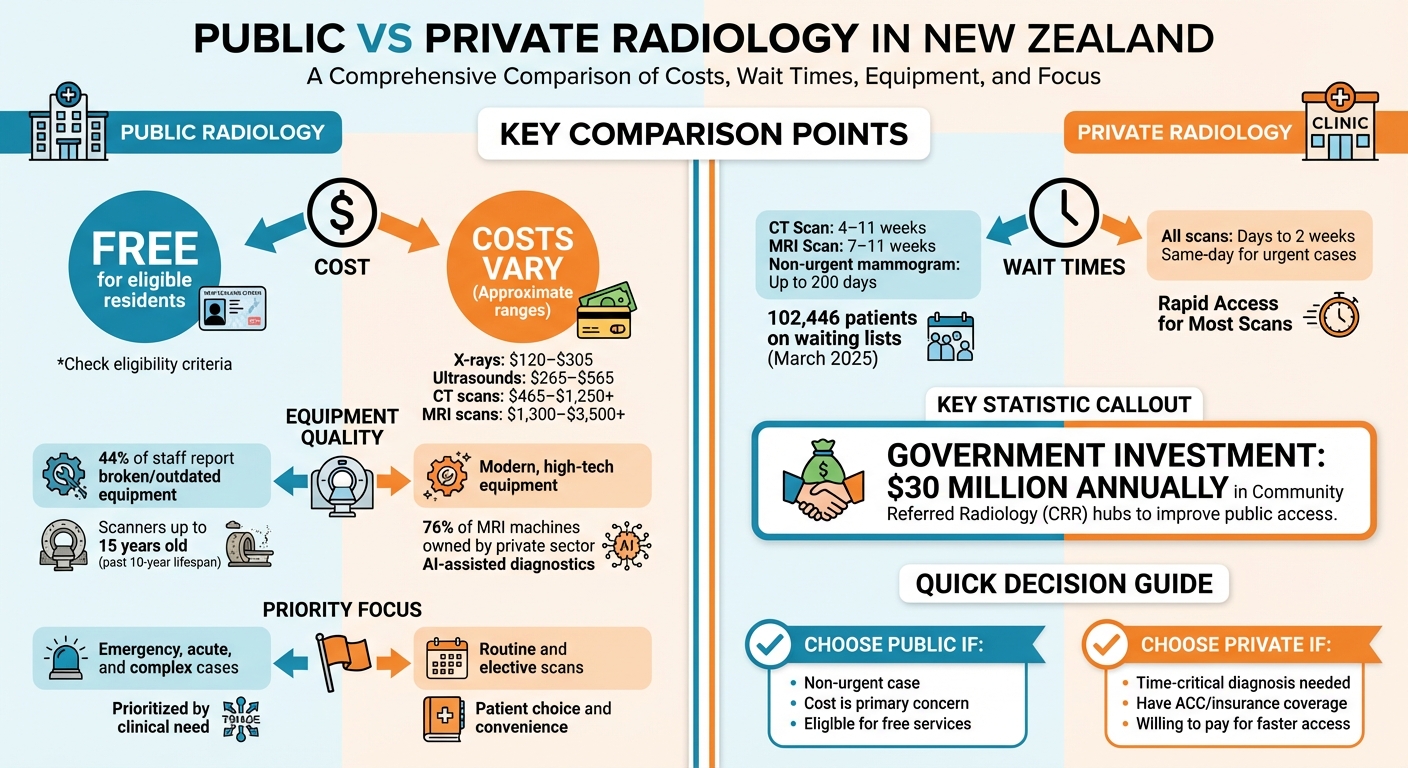
The financial gap between public and private radiology services in New Zealand is substantial. Public radiology services are completely free for New Zealand citizens, permanent residents, and some work visa holders – provided the referral comes from a doctor. On the other hand, private radiology requires patients to pay out of pocket unless they have health insurance or ACC coverage.
Private radiology costs can vary widely depending on the type of scan and the body part being examined. Here’s a general breakdown:
- X-rays: $120–$305
- Ultrasounds: $265–$565
- CT scans: $465 to over $1,250
- MRI scans: Around $1,300 to more than $3,500
Adding a contrast agent for certain scans can increase the cost by over $1,000. This price disparity highlights the financial burden of private care and the public health system’s reliance on private providers to meet demand.
In fact, the public health system spends a significant amount on outsourcing radiology to private providers. Nationwide, more than $100 million was spent in a single year on outsourcing. In the Lakes region alone, $232,396 was paid to private radiology providers between March 2024 and February 2025. Dr Deborah Powell, National Secretary of Apex, commented on this issue:
"An overreliance on expensive private outsourcing is not cost-effective or sustainable long term."
ACC and Insurance Coverage
ACC (Accident Compensation Corporation) provides full coverage for scans related to accidents, as long as the injury meets ACC’s criteria. However, some private clinics may charge a small additional fee – typically between $40 and $80 – for ACC-funded ultrasounds or interventional procedures.
Private health insurance can also help reduce costs significantly. Providers like Southern Cross, AIA, and nib may cover 80% to 100% of the scan costs, depending on the policy. However, many standard insurance plans only cover scans associated with hospital admission or surgery, leaving standalone diagnostic imaging uncovered.
Cost Comparison Table
| Service Type | Public (Eligible Residents) | Private (Out-of-Pocket) | ACC (Approved Injury) |
|---|---|---|---|
| X‑Ray | $0 | $120–$305 | $0–$40 |
| Ultrasound | $0 | $265–$565 | $0–$80 |
| CT Scan | $0 | $465–$1,250+ | $0 |
| MRI Scan | $0 | $1,300–$3,500+ | $0 |
Accessibility and Waiting Times
When comparing public and private radiology services in New Zealand, accessibility and waiting times are key factors that set them apart. Public radiology services are grappling with serious delays, even for urgent cases. For instance, as of March 2025, there were 102,446 patients on radiology waiting lists nationwide. By June 2025, over 18,000 patients had been waiting longer than 42 days for their scans.
Public hospitals rely on a triage system that prioritises emergency department cases and inpatients. This often leaves non-urgent outpatients facing significant delays. Internal memos from 2019 revealed that routine CT scans were frequently delayed by 2–3 months. Some patients have experienced even longer waits, such as up to 200 days for non-urgent mammograms or 94 days for paediatric MRI scans at Starship Hospital.
"Understaffed and exhausted teams, working with broken equipment are finding it impossible to provide safe and timely services as demand for medical imaging surges"
This quote from Dr Deborah Powell, APEX National Secretary, highlights the challenges faced by public radiology services. Staffing shortages and outdated or faulty equipment exacerbate the problem, with 44% of public Medical Imaging Technologist (MIT) staff reporting they work under such conditions.
On the other hand, private radiology providers offer a stark contrast. They can typically schedule scans within days or up to two weeks, bypassing the lengthy triage process of the public system. This faster turnaround is especially beneficial for non-urgent patients, enabling quicker diagnoses and earlier treatments.
Wait Time Comparison Table
| Imaging Service | Public Sector Wait Time | Private Sector Wait Time |
|---|---|---|
| CT Scan | 4–11 weeks | Days to 2 weeks |
| MRI Scan | 7–11 weeks | Days to 2 weeks |
| Non-Urgent Mammogram | Up to 200 days | Significantly shorter |
| Urgent/Acute Scans | Priority (immediate or within days) | Immediate/Same-day |
This table clearly illustrates the stark difference in waiting times, emphasising how private radiology services can provide much-needed relief for patients facing prolonged delays in the public system.
Quality of Care and Technology
After looking at cost and access, it’s time to explore how quality and technology influence radiology services in New Zealand. Both public and private providers aim to deliver top-notch care, but their approaches and challenges differ significantly – especially when it comes to technology and equipment. While the public sector struggles with outdated infrastructure, private providers have ramped up their investment in modern, high-tech solutions. Let’s dive into these contrasting realities.
A survey revealed that 44% of Medical Imaging Technologists are working with outdated or compromised equipment. Some scanners in public hospitals are still in use despite being well past their recommended 10-year lifespan – some even as old as 15 years. This leads to frequent breakdowns and extended downtime, forcing hospitals to rely on private clinics to handle scans when their machines fail. Dr Lyndell Kelly, a radiation oncologist, painted a grim picture of the consequences:
"Patients suffer and die due to the poor access our population has to imaging services".
Private providers, on the other hand, are embracing technological advancements at a rapid pace. Since 2020, they’ve made significant investments in advanced imaging modalities and cutting-edge equipment to keep up with increasing demand. With for-profit companies owning around 76% of MRI machines, private clinics dominate in areas like PET/CT scans. They’ve also adopted artificial intelligence (AI) to improve efficiency – AI tools help prioritise urgent cases and reduce diagnostic errors. For example, AI-assisted breast cancer screening has shown promising results, cutting false positives by 37.3% and reducing unnecessary biopsies by 27.8%.
However, the type of cases handled by public and private providers also sets them apart. Public hospitals are tasked with managing the most complex and acute cases, while private clinics tend to focus on routine scans, which are more profitable. This difference in focus raises concerns about "supplier-induced demand" in the private sector, where financial incentives might influence care decisions and potentially impact overall quality.
While technology plays a crucial role in shaping radiology services, it’s clear that the public and private sectors face unique challenges and priorities. These differences have far-reaching implications for patient care and access.
sbb-itb-16a0ccc
Using Radiology Clinics NZ to Find Services
When you need radiology services, finding the right clinic quickly can make all the difference. Whether you’re looking for public or private options, the Radiology Clinics NZ directory simplifies the process. This resource lists 252 radiology services across New Zealand, including 22 public hospitals, 29 Accident & Emergency (A&E) centres, and 24 specialised ultrasound clinics. You can easily filter by location and facility type to find a service that fits your needs.
Each clinic profile offers essential information, such as the full address, available services (like CT scans or specialised ultrasounds), and star ratings based on patient reviews. Highly rated facilities, like Pacific Radiology – Porirua and Greenlane Clinical Centre, both boast 5.0-star ratings. For instance, Linda Wong shared her experience with Greenlane Clinical Centre, saying:
"Staff at the Greenlane Clinical Centre Radiology Dept delivered excellent customer service in the communication lead up and on the day care."
The directory also features a "Latest Reviews" section, which provides insights into aspects like wait times and staff professionalism. For example, Sharyne Dallas praised Pacific Radiology – Porirua, noting:
"She was efficient and I felt at ease with her. Thanks Linda."
However, not all reviews are glowing. Wayne Moore pointed out a concern:
"Had an appointment today at 1.30pm as usual had to wait 25 minutes I think this is unacceptable especially when my time is just as valuable."
These reviews highlight the importance of patient feedback when choosing a service. The directory also includes a map-based search tool, making it simple to locate services whether you’re in major cities like Auckland and Christchurch or smaller areas like Oamaru and Waiheke Island. This tool allows you to compare public hospitals with private clinics, weighing factors such as convenience, cost, and patient experiences to make an informed decision.
Key Decision Factors: Choosing Between Public and Private Radiology
When deciding between public and private radiology services, it’s essential to weigh factors like urgency, cost, and your specific health requirements.
If your condition is acute or life-threatening, the public system is your go-to. Emergency departments and hospital inpatients are prioritised for immediate care, and there’s no out-of-pocket cost for eligible residents. However, for non-urgent issues, such as chronic pain or unexplained symptoms, wait times can be lengthy. As of March 2025, over 102,000 patients were on radiology waiting lists nationwide.
Cost often plays a big role in this decision. Public hospital radiology is free for eligible residents, while private scans can come with hefty out-of-pocket expenses unless covered by ACC or private insurance. While ACC and insurance can reduce costs, only about one-third of New Zealanders have private health insurance, leaving many to either endure public wait times or pay out of pocket.
Another consideration is equipment quality. Public radiology departments face challenges with older machinery, with staff reporting issues like broken or unsafe equipment. On the other hand, private providers tend to invest in newer, cutting-edge scanners. That said, public facilities are fully equipped to handle complex, high-risk cases and emergencies, but private clinics often offer quicker diagnostics thanks to modern technology.
Pros and Cons Table
| Factor | Public Radiology | Private Radiology |
|---|---|---|
| Cost | Free for eligible residents | High out-of-pocket fees ($750–$1,400 for MRI) unless covered by ACC or insurance |
| Wait Times | Long for non-urgent cases (weeks to months); 102,000+ patient backlog | Generally short (days to a week) |
| Equipment | Often outdated; 44% of staff report broken or unsafe machinery | Modern, high-tech, frequently upgraded |
| Priority | Focuses on emergency, acute, and inpatient cases | Focuses on elective and diagnostic outpatients |
| Complexity | Handles complex, high-risk, and emergency cases | Primarily handles routine and straightforward scans |
| Accessibility | May require significant travel, especially in rural areas | More clinics in urban areas; flexible appointment times |
Practical examples can make these choices clearer. If you’re experiencing severe chest pain, public emergency care is the obvious choice. However, if you’re dealing with persistent knee pain and facing a three-month public wait, a private scan might be worth considering, especially if ACC coverage applies. For those in rural areas, public community programmes can provide urgent scans without the need for long-distance travel.
Your GP is a valuable resource in this process. They can advise on options like the Community Referred Radiology programme, which offers free scans for specific conditions at participating clinics, helping you bypass long specialist waitlists.
Conclusion
Deciding between public and private radiology in New Zealand comes down to factors like urgency, cost, and location. Public radiology offers free services for eligible residents, but non-urgent cases can face long wait times. On the other hand, private radiology provides quicker access and advanced equipment, though private MRI scans can be quite expensive unless a subsidy applies. Each option has its own strengths, whether in affordability, speed, or technology.
New Zealand’s radiology system operates as a mix of public and private services. This means you may need to navigate both systems depending on your circumstances. For emergencies or complex conditions, the public system is well-equipped to provide care. However, if a quick diagnosis is crucial to prevent a condition from worsening, private care may be worth considering. Balancing urgency and cost is key to making the right choice.
The Radiology Clinics NZ directory can help simplify your search by allowing you to find clinics by location, compare services, and read reviews. Whether you’re seeking a private clinic that accepts ACC referrals or looking for facilities with cutting-edge technology, this resource makes the process more manageable.
Talk to your GP to understand your referral options. They can guide you in deciding whether public services or private care align better with your needs and may also help you access free scans for specific conditions at participating clinics.
FAQs
Can my GP refer me directly for a free scan?
Yes, your GP can arrange diagnostic imaging for you directly, including X-rays, ultrasounds, or CT scans, without requiring an assessment by a hospital specialist. This service is part of the phased Community Referred Radiology programme, which began in September 2025.
Will ACC or my insurance cover a private scan?
ACC usually covers scans related to accidental injuries. However, it generally does not fund private scans for conditions unrelated to injuries unless explicitly stated. If you have private health insurance, it might cover part of the costs, depending on your policy. Be sure to review your insurance plan to understand what is included.
How can I get a scan sooner without paying full private fees?
To get a scan sooner without paying full private fees, you might want to look into publicly funded diagnostic imaging services available in certain areas, like Wānaka. These services are free for patients who meet the eligibility criteria and can help cut down on wait times. Another option is to explore subsidies through schemes like ACC, which can cover part of the scan’s cost. Additionally, community-referred radiology services supported by Health New Zealand provide more affordable imaging options when referred by community healthcare practitioners.
Related Blog Posts

Leave a Reply