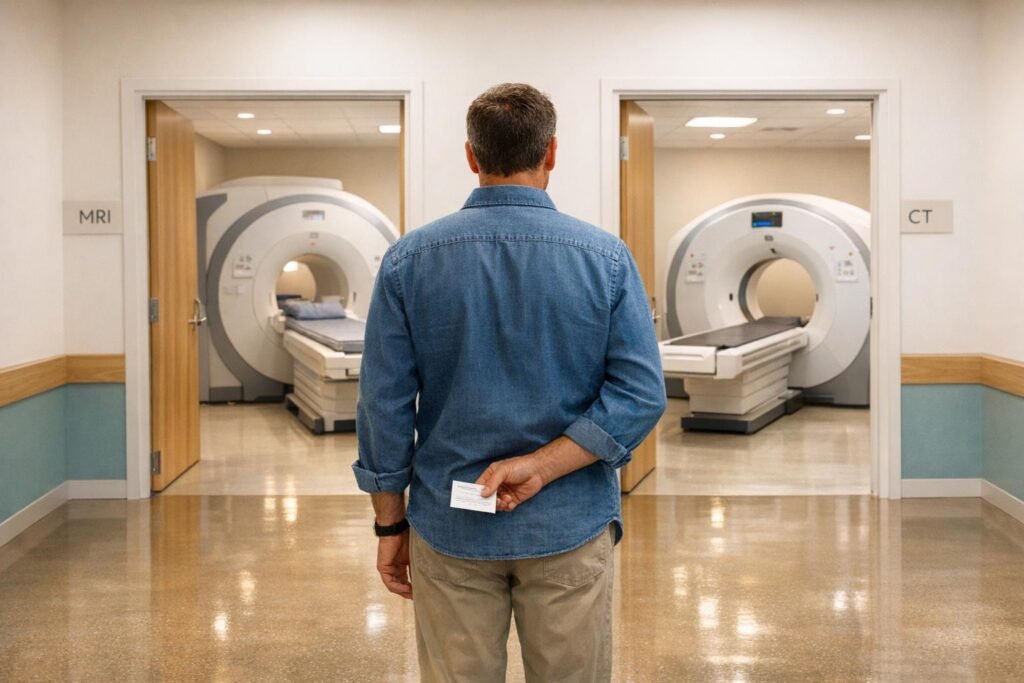
When deciding between an MRI and a CT scan, the choice depends on your specific health needs. Here’s a quick breakdown:
- MRI: Best for detailed images of soft tissues like the brain, spinal cord, and muscles. It uses magnets, not radiation, but takes longer and can be uncomfortable for those with claustrophobia or metal implants. Costs typically range between NZ$1,000–NZ$3,500.
- CT Scan: Ideal for bones, lungs, and emergencies like internal bleeding. It’s faster, uses low-dose X-rays, and is generally less expensive, costing around NZ$1,800–NZ$2,800.
Quick Comparison
| Feature | MRI Scan | CT Scan |
|---|---|---|
| Technology | Magnetic fields, no radiation | X-rays, low-dose radiation |
| Best For | Soft tissues (e.g., brain) | Hard structures (e.g., bones) |
| Duration | 20–60 minutes | 1–5 minutes |
| Cost (NZD) | NZ$1,000–NZ$3,500+ | NZ$1,800–NZ$2,800 |
| Comfort | Enclosed, loud noise | Open, quieter |
Discuss your medical history and needs with your doctor to determine the right option. Always inform the radiology team about implants, pregnancy, or other conditions before booking.
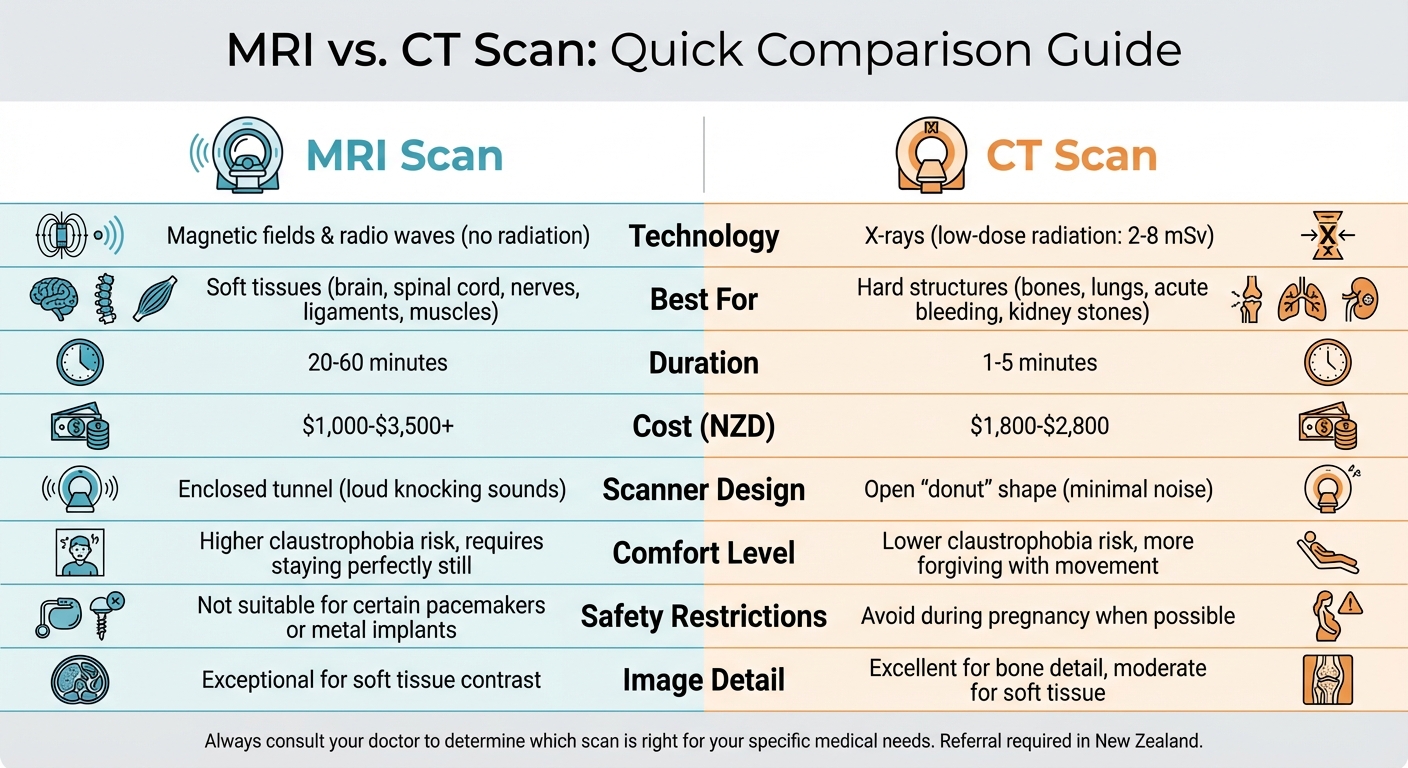
MRI vs CT Scan Comparison: Technology, Cost, Duration and Best Uses
MRI vs CT head-to-head (magnet vs X-rays)
sbb-itb-16a0ccc
What is an MRI Scan?
Magnetic Resonance Imaging (MRI) is a medical imaging technique that provides detailed 3D visuals of internal structures like organs, bones, and soft tissues – all without the use of ionising radiation. Instead, it relies on strong magnetic fields and radio waves to create these images.
MRI is particularly effective for examining soft tissues such as the brain, spinal cord, nerves, muscles, ligaments, and tendons. These structures often don’t appear clearly on X-rays or CT scans, making MRI a preferred choice for detailed imaging.
"MRI scans also take much clearer pictures of your brain, spinal cord, nerves, muscles, ligaments and tendons than regular X-rays and CT scans." – Cleveland Clinic
Most MRI machines are large and tunnel-shaped, but "open" designs are available for patients who feel claustrophobic. The scanner’s magnet is incredibly powerful, capable of attracting metal objects and even affecting magnetic strips.
Let’s take a closer look at how the technology works.
How MRI Technology Works
The process behind MRI imaging explains why it is so effective for soft tissues.
MRI scanners create a temporary magnetic field by running an electric current through coiled wires. Radio waves are then transmitted to interact with water molecules in the body, and a receiver collects the resulting signals. These signals are processed by a computer to produce digital images for doctors to review.
Modern 3T MRI scanners deliver high-resolution images with excellent contrast, making it easier to distinguish between different types of soft tissue.
In some cases, a contrast dye called gadolinium is injected via an IV to enhance the visibility of specific areas, such as tumours, inflammation, or blood vessels. While the risk of an allergic reaction is small, your radiologist will discuss it with you beforehand.
This precise imaging method is why MRI is so widely used in clinical settings.
When is an MRI Typically Used?
MRI is often chosen for diagnosing conditions involving the brain and spine, such as strokes, multiple sclerosis, aneurysms, and spinal cord compression. It can also detect subtle nerve inflammation or compression that might be missed by CT scans.
Thanks to its ability to clearly differentiate soft tissues, MRI is frequently used to diagnose sports injuries. These include ligament tears (like ACL injuries), meniscus damage, rotator cuff tears, and cartilage issues. Dr Laura Fayad, Chief of Musculoskeletal Imaging at Johns Hopkins Medicine, explains:
"Often, problems are too subtle to see on an X-ray. That’s where MRI comes in. An MRI offers excellent contrast resolution for bones and soft tissues."
Beyond musculoskeletal issues, MRI is also used to monitor internal organs. This includes evaluating heart function, liver conditions, and breast tissue. Since it doesn’t use ionising radiation, MRI is a safer option for children, pregnant women, and patients who require frequent imaging.
In New Zealand, an MRI requires a referral from your healthcare provider; self-referral is not an option for either public or private services. Before your appointment, notify the radiology team if you have any metal implants, such as pacemakers or cochlear implants, as these can be affected by the magnetic field. Additionally, avoid wearing makeup or hairspray on the day of your scan, as they may contain tiny metal particles that could interfere with the images.
What is a CT Scan?
A Computed Tomography (CT) scan is a sophisticated X-ray method that creates detailed, cross-sectional images of the body. Imagine slicing a loaf of bread – each thin slice represents a detailed image of your bones, organs, and soft tissues. These slices are then combined to form a comprehensive view.
The process involves a rotating X-ray tube and detectors housed in a large, ring-shaped scanner – often described as a "giant doughnut." While lying on a motorised table that moves through the scanner, the machine captures images in extremely thin slices. Modern CT scanners can produce up to 320 slices, each less than 1 mm thick.
"Computed tomography (CT) uses sophisticated x-ray technology to take images of parts of the body in very fine slices. The fine detail allows accurate diagnosis of a variety of illnesses and injuries." – I-MED Radiology
CT scans are incredibly quick, often completed in minutes, making them ideal for emergencies. While traditional X-rays are effective for examining bones or detecting lung changes, CT scans offer much greater detail for internal organs and complex structures. However, since CT scans use ionising radiation, it’s crucial to inform the radiology team if you’re pregnant or suspect you might be.
How CT Technology Works
During a CT scan, you’ll lie on a table that moves through the scanner as it rotates around you, capturing images from multiple angles. These images are processed by a computer to create detailed cross-sections of your body. When needed, these cross-sections can be combined into 3D reconstructions for a more complete view.
Sometimes, a contrast dye – usually an iodine-based solution – is used to highlight specific structures like blood vessels, organs, or the bowel. This dye may be administered through an IV or taken orally. If contrast is required, you might need to fast for 2 to 4 hours before your appointment to reduce the chance of nausea. Patients with kidney conditions, diabetes, or those on Metformin should notify the clinic beforehand, as extra precautions may be necessary.
While the entire appointment usually takes around 30 minutes, the scan itself is often completed in just 20 seconds to 2 minutes. The scanner operates quietly compared to an MRI and has an open, doughnut-shaped design, which is more comfortable for those who feel claustrophobic.
These features highlight the speed and precision of CT scans, making them especially valuable in urgent medical situations.
When is a CT Scan Typically Used?
CT scans are often the go-to imaging method in emergencies and trauma cases because of their speed. They allow for quick detection of internal bleeding, head injuries, and blood clots. Dr. Oguz Akin, Service Chief in Body Imaging at Memorial Sloan Kettering Cancer Center, explains:
"CT scans are fast and often used when doctors need to make quick decisions, such as in emergency situations."
For bone and joint issues, CT scans provide highly detailed images, making them ideal for diagnosing complex fractures, joint disorders, and bone tumours. As Dr. Albert Parlade, a radiologist at Cleveland Clinic, points out:
"CTs are good at looking at ‘bones and stones’ – like kidney stones and gallstones. Also, surgeons commonly use CTs to plan surgeries."
CT scans are also widely used to examine chest and lung conditions, including detecting lung cancer or infections. They excel in diagnosing abdominal and pelvic issues like kidney stones, bowel blockages, and complications involving organs such as the liver, kidneys, and spleen. In cancer care, CT scans help stage cancer, monitor its spread, and assess blood vessels for blockages or abnormalities.
CT scans deliver rapid, detailed images, making them indispensable in emergencies and a strong complement to MRI scans, which are better suited for soft tissue analysis.
In New Zealand, a referral from your doctor is required to book a CT scan, whether through public or private services. Costs vary depending on the complexity of the scan and the clinic, and ACC co-payments may apply for scans related to injuries.
Key Differences Between MRI and CT Scans
MRI and CT scans both provide detailed images of the body’s interior, but they work in entirely different ways. CT scans rely on X-rays, which use radiation to create cross-sectional images by rotating around the body. On the other hand, MRI scans use magnetic fields and radio waves to produce images without the use of radiation.
These distinct methods suit different purposes. CT scans are excellent for visualising hard structures like bones and lungs. They are particularly effective for identifying acute bleeding and kidney stones. Meanwhile, MRI scans shine when it comes to soft tissues, offering detailed imaging of the brain, spinal cord, ligaments, tendons, and muscles.
Speed is another area where these scans differ. CT scans are quick, often completed in under 10 minutes, making them ideal for urgent situations. In contrast, MRI scans take longer – between 20 and 60 minutes – and are accompanied by loud tapping noises, necessitating ear protection.
Safety is also a major consideration. MRI scans do not involve ionising radiation, making them a safer option for children, pregnant women in certain cases, and individuals requiring frequent imaging. However, MRIs are not suitable for everyone. They can interfere with devices like pacemakers and may be problematic for patients with certain metal implants. CT scans, while involving radiation, are generally less restrictive in this regard.
Here’s a quick comparison of the two:
Comparison Table: MRI vs. CT Scan
| Feature | CT Scan | MRI Scan |
|---|---|---|
| Primary Technology | X-ray (ionising radiation) | Magnetic fields and radio waves |
| Radiation Exposure | Yes (typically 2–8 mSv) | None (zero mSv) |
| Best For | Bone structures, lungs, acute bleeding, kidney stones | Soft tissues: brain, spinal cord, nerves, ligaments, muscles |
| Image Detail | Excellent for bone detail; moderate for soft tissue | Exceptional for soft tissue |
| Procedure Time | Very fast (generally under 10 minutes) | Slower (20–60 minutes) |
| Patient Limitations | Generally safe for most implants | Restricted for certain pacemakers or metal implants |
| Comfort Considerations | Open design, minimal noise | Enclosed tube, loud noise, possible claustrophobia risk |
| Movement Sensitivity | Less affected by patient movement | Requires the patient to remain still |
Duration, Cost, and Patient Comfort
When deciding between an MRI and a CT scan, it’s important to weigh how long the scan takes, its cost, and how comfortable the experience will be. These practical details can often help guide your choice.
Scan Duration: CT scans are quick, typically taking just 1 to 5 minutes. In contrast, MRI scans are more time-consuming, ranging from 15 to 60 minutes depending on the area being scanned and the number of images required [4,27,28,30].
Cost: Pricing varies significantly between the two options in New Zealand. MRI scans usually cost between NZ$1,000 and NZ$3,500 or more. For example, a simple knee MRI might start at NZ$1,300, while more complex areas like the head, abdomen, or spine can begin at around NZ$2,500. Adding a contrast agent can increase the cost by over NZ$1,000.
CT scans, on the other hand, tend to be less expensive. Orthopaedic CT scans are approximately NZ$1,800, while soft tissue scans cost around NZ$2,400. Private or external CT scans can go up to NZ$2,800. For eligible residents, publicly funded scans are free, and ACC covers scans related to accidental injuries [28,29].
Patient Comfort: Comfort levels differ significantly between the two types of scans.
CT scanners are open in design and produce minimal noise, making them a less intimidating option for most people. MRI machines, however, feature an enclosed tunnel and generate loud knocking or vibrating sounds. This can be challenging for patients with claustrophobia. To ease discomfort, many MRI facilities offer earplugs or headphones with music, and in severe cases, a sedative may be prescribed by your GP [27,28,30].
Comparison Table: Duration, Cost, and Comfort
| Factor | CT Scan | MRI Scan |
|---|---|---|
| Scan Duration | 1–5 minutes [4,30] | 15–60 minutes [27,28] |
| Typical Cost (NZD) | NZ$1,800–NZ$2,800 | NZ$1,000–NZ$3,500+ |
| Noise Level | Low (minimal noise) | High (loud knocking sounds) |
| Scanner Design | Open "donut" shape | Enclosed tunnel |
| Claustrophobia Risk | Lower | Higher |
| Movement Tolerance | More forgiving | Requires staying perfectly still [27,28] |
| Comfort Aids | Not typically needed | Earplugs, headphones, or sedation available |
Preparation and Safety Tips Before Booking
Before scheduling your scan, it’s important to address any safety concerns with your doctor or radiology clinic. Share your complete medical history, including details about implants, past surgeries, medications, and whether you’re pregnant. If you have kidney issues or take Metformin, let your doctor know before a CT scan. Similarly, disclose any metallic or electronic implants ahead of an MRI scan.
If you struggle with claustrophobia or feel anxious in confined spaces, mention this when booking an MRI. Your GP might prescribe a sedative to help you relax – just be sure to arrange for someone to drive you home afterward. Discussing these details with your clinic ensures your imaging experience is both safe and personalised.
MRI-Specific Considerations
On the day of your MRI, remove all metal items such as jewellery, watches, hearing aids, hair clips, and underwire bras. Avoid wearing makeup or using hairspray, as these can contain metallic particles that may interfere with the imaging process. If you use transdermal medication patches, check with your clinic to see if they need to be removed. Some patches have metal backings that could cause skin burns during the scan.
While MRI preparation focuses on avoiding metal, CT scans involve different safety precautions.
CT-Specific Considerations
CT scans use ionising radiation (X-rays), which carries a very small theoretical increase in long-term cancer risk. For context, a typical CT scan of the head delivers a dose of about 1–3 mSv, which is comparable to the 2 mSv of background radiation the average New Zealander is exposed to annually. Although the risk from this radiation is minimal, CT scans are usually avoided during pregnancy – especially for abdominal or pelvic imaging – unless absolutely necessary.
Preparation for a CT scan often includes fasting for up to four hours, particularly if contrast dye will be used. For abdominal or pelvic scans, you may be asked to drink a barium or iodine-based contrast liquid to help highlight the bowel. These steps are designed to ensure your scan is both safe and effective.
Finding MRI and CT Scan Services in New Zealand
New Zealand has an extensive network of radiology clinics offering MRI and CT scan services. Leading providers include Pacific Radiology, which operates 47 clinics across regions like Waikato, Wellington, Manawatū, Nelson, Canterbury, Otago, and Southland. Auckland Radiology Group runs 14 locations in Auckland, while Bay Radiology manages 10 clinics in the Bay of Plenty. Beyond Radiology provides services in Auckland, Hamilton, and Christchurch.
To access these services, a referral from a qualified medical professional is necessary. Many clinics make the process easier with online booking systems, allowing patients to select procedures, view available dates, and choose locations. If your scan is related to an accident and referred by a specialist, ACC may cover the cost. For private or insurance-funded scans, you’ll need to contact the clinic directly with your referral to get a cost estimate. Keep reading to learn how to find the most convenient clinic for your needs.
Using Radiology Clinics NZ
To make finding imaging services easier, Radiology Clinics NZ offers a comprehensive online directory of MRI and CT scan providers across the country. The platform (https://radiologyclinics.co.nz) allows you to search for clinics by location, read patient reviews, and access contact information for booking appointments. You can even compare providers based on their services, technology (such as wide-bore MRI scanners, which are great for patients with claustrophobia), and regional availability.
Each clinic profile includes essential details like addresses, phone numbers, and specifics about the imaging services offered. Patient reviews provide helpful insights into the quality of care. For instance, a patient who visited Auckland Radiology shared:
"I had a MRI scan today and found the staff at the Wairau Road clinic were absolutely lovely, very professional and caring".
Similarly, a Pacific Radiology patient noted:
"Lovely staff, great bedside manner. Olivia was fabulous, and an absolute angel in getting the appointment and everything sorted for me!".
Conclusion
The choice between an MRI and a CT scan largely depends on what needs to be diagnosed. CT scans, which typically take less than 10 minutes, are excellent for imaging bones, assessing lung issues, and detecting internal bleeding – making them ideal for emergency situations. On the other hand, MRI scans, which can take anywhere from 20 to 60 minutes, provide highly detailed images of soft tissues like the brain, spinal cord, ligaments, and tendons. One key difference is how they work: CT scans use low-dose X-rays, while MRI scans rely on magnetic fields and radio waves, avoiding ionising radiation.
Personal circumstances also play a role. For example, metal implants may rule out an MRI, and CT scans are often avoided during pregnancy. If claustrophobia is a concern, the open design of CT scanners may feel less confining, though many facilities now offer wide-bore MRI machines to improve comfort.
When it comes to cost and time, CT scans are generally quicker and less expensive, while MRI scans take longer and are typically pricier. Before undergoing either scan, always let your healthcare provider know about any medical conditions, implants, or pregnancy.
To find accredited MRI and CT scan services in New Zealand, check out Radiology Clinics NZ. Their searchable directory includes clinic profiles, patient reviews, contact details, and information about the technology available – making it easier to find a provider that suits your needs.
FAQs
Which scan gives the clearest answer for my symptoms?
The type of scan that suits your symptoms best depends on your specific condition. MRI scans excel at providing detailed images of soft tissues, including the brain, muscles, and internal organs. They’re often used to diagnose problems like tumours or ligament injuries. On the other hand, CT scans are quicker and particularly effective for spotting fractures, internal injuries, or abdominal concerns. It’s always best to consult your healthcare provider to decide which scan is the right choice for your situation.
Can I have an MRI if I have metal in my body?
Yes, the safety of an MRI scan depends on the type and placement of the metal in your body. Many modern implants are crafted from non-ferromagnetic materials, which are labelled as MR-safe or MR-conditional. However, certain implants, such as cochlear implants or specific pacemakers, can present risks. It’s crucial to tell your healthcare provider and the MRI technologist about any metal or implants you have to ensure the procedure is safe for you.
Will I need contrast dye, and is it safe for my kidneys?
You might need a contrast dye for your MRI or CT scan, depending on what the imaging is meant to show. These contrast agents make it easier to see specific structures, like blood vessels or tissues, and are typically safe for most people. For MRIs, gadolinium-based dyes are commonly used, while CT scans often involve iodine-based dyes. Both carry a low risk, but if you have kidney problems, your doctor will carefully weigh the risks before moving forward. It’s important to share your medical history with your healthcare provider beforehand.
Related Blog Posts
- 10 Questions to Ask Before Your First Radiology Scan
- Understanding Radiology Wait Times in NZ: A Guide
- MRI vs CT Scan: Which Imaging Test Do You Need?
- Top Cardiac MRI Clinics in New Zealand

Leave a Reply