Facing long wait times for radiology in New Zealand? You’re not alone. Over 102,000 patients are stuck on waitlists, with demand for CT and MRI scans growing 6.5% annually. Some regions, like Taranaki, report delays of up to two years for semi-urgent ultrasounds. If you’re struggling to secure an appointment, here are five practical solutions:
- Request a Priority Upgrade: If your symptoms worsen, ask your GP to reassess your referral. This could move you up the queue, especially for urgent cases.
- Explore Other Regions: New Zealand’s public health system allows you to access radiology services outside your area, potentially reducing wait times.
- Consider Private Clinics: Private providers often offer faster appointments, though costs range from $106 to $2,500+, depending on the scan.
- Use Telehealth: Virtual GP consultations can assess your need for imaging and provide direct referrals without hospital delays.
- Search Online Directories: Platforms like Radiology Clinics NZ help locate imaging providers, compare options, and book appointments nearby.
These steps can help you navigate New Zealand’s overburdened radiology system, ensuring you get the care you need sooner.
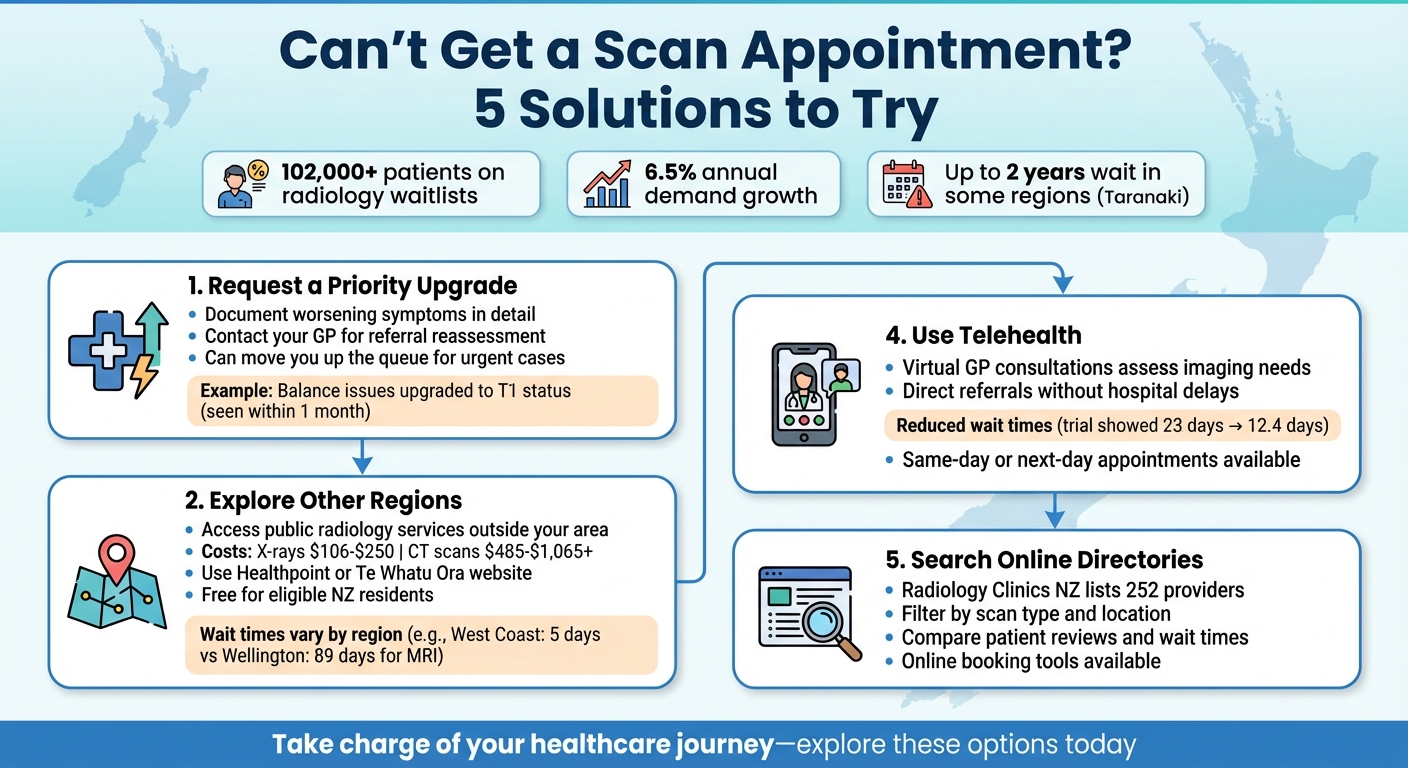
5 Solutions to Get a Scan Appointment Faster in New Zealand
Why Radiology Wait Times Are Long in New Zealand
New Zealand’s radiology system is grappling with a mix of staffing shortages, outdated equipment, and increasing demand. Over half of the radiology departments across the country are critically short-staffed, lacking the imaging technologists, radiographers, and sonographers needed to handle the workload efficiently. Adding to the strain, 44% of technologists are working with equipment that is either faulty or well past its prime – many scanners have exceeded their recommended 10-year lifespan.
Main Reasons for Appointment Delays
Regional hospitals are particularly hard-hit by staffing shortages. For instance, in early 2025, Taranaki Base Hospital had only 2.2 radiologists available, despite needing 8.8 to meet demand – just 25% of the required workforce. This shortfall led to a backlog of over 6,000 unprocessed radiology reports, with urgent ultrasounds delayed anywhere from four weeks to as long as a year. To cope with these challenges, Health NZ has been spending more than $100 million annually on outsourcing scans to private providers.
Dr Deborah Powell of APEX noted that outsourcing has become a cheaper quick-fix than investing in permanent staff and modern equipment.
The public sector is also losing experienced staff to private practices or opportunities in Australia, where salaries are higher. This "brain drain" leaves fewer qualified professionals to train new graduates, exacerbating the workforce shortage.
Wait times vary widely depending on the region. For example, while patients on the West Coast faced an average MRI wait of just five days, those in Wellington endured delays of up to 89 days in mid-2025. Wellington’s situation is particularly dire, with only one functional MRI scanner serving the entire public population. Meanwhile, demand for complex imaging in the region has been growing at an annual rate of 15%. Malcolm Mulholland, Chairman of Patient Voice Aotearoa, summed up the situation by saying:
"The postcode lottery that we’re supposed to be seeing an end to is still alive and kicking in New Zealand".
To address these challenges, the government has introduced targeted funding to upgrade equipment and improve service delivery.
Government Funding to Reduce Wait Times
In October 2025, the government announced a $108 million funding package to modernise radiology infrastructure at 14 hospitals. This includes a $12.7 million upgrade at Palmerston North Hospital, where an ageing CT scanner will be replaced, and a second unit added. These changes are expected to boost capacity by 3,000 scans annually. However, unions have raised concerns that the hospital still lacks enough radiographers to operate the new equipment effectively.
Additionally, a $30 million annual investment in Community Referred Radiology now allows GPs and nurse practitioners to refer patients directly for imaging. This bypasses the need for hospital specialist referrals, which often come with lengthy delays.
While these funding initiatives aim to reduce radiology wait times, many patients are still left waiting for relief. The next section explores alternative solutions for tackling these systemic issues.
sbb-itb-16a0ccc
Solution 1: Ask Your Doctor to Upgrade Your Priority
Extended radiology wait times can be frustrating, but requesting an upgraded referral priority might help you access care faster. If your symptoms have worsened since your initial scan request, talk to your GP about reassessing your case. In New Zealand’s public radiology system, patients are prioritised based on clinical urgency rather than how long they’ve been waiting. This means that if your condition deteriorates, your doctor can notify the radiology department to move you up the priority list [[11]](https://www.pacificorthopaedics.co.nz/referral public.htm). This approach ensures those with urgent needs are seen more quickly.
Steps to Request Priority Status
Start by keeping a detailed record of any new or worsening symptoms. Be specific about how these symptoms affect your daily life. For example, instead of saying, "the pain is worse", describe issues like "difficulty maintaining balance while walking" or "frequent falls". These details provide your GP with the necessary clinical evidence to justify a priority upgrade.
Once you’ve documented your symptoms, contact your GP and request an updated referral. A case in point is a New Zealand patient, "Mrs. A", whose GP upgraded her radiology priority after noting in a referral letter that she was "veering off course when walking" and struggling with balance. Her status was upgraded to "T1" (to be seen within one month), resulting in an urgent MRI that identified a 4cm brain tumour.
If your condition changes significantly, your GP can also call the duty radiologist directly to expedite your scan and the delivery of results, as recommended by Health New Zealand.
When Priority Status Is Appropriate
It’s important to understand when a priority upgrade is justified. These upgrades are typically warranted when new symptoms emerge or existing ones worsen. Symptoms like dizziness, vomiting, or balance issues can signal the need for a higher priority level. For reference, semi-urgent cases should ideally be seen within 30 days, while urgent and emergent cases are expected to be addressed within 7 days and 24 hours, respectively.
Mark J Sherwood, an orthopaedic and spinal surgeon at Pacific Orthopaedics, highlights the importance of staying in touch with your GP:
"It is VERY IMPORTANT THAT YOU KEEP IN CONTACT WITH YOUR FAMILY DOCTOR (G.P.) REGARDING YOUR CONDITION AND THAT YOU REPORT ANY WORSENING OR NEW SYMPTOMS TO YOUR G.P." [[11]](https://www.pacificorthopaedics.co.nz/referral public.htm)
If you haven’t received any updates regarding a referral for a suspected serious condition within 4–8 weeks, reach out to your GP to check its status. You can also ask whether your scan is being monitored through referral tracking software.
While upgrading your priority can help you access care faster, it works best alongside other approaches, such as exploring regional providers or private services, to ensure timely treatment. These additional options can complement government funding initiatives aimed at improving access to radiology services.
Solution 2: Check Public Hospital Radiology Services in Other Regions
If upgrading your referral priority doesn’t speed things up, looking into radiology services in neighbouring regions might be worth considering. Long wait times at your local public hospital don’t have to be the end of the road – New Zealand’s public health system allows you to access care at facilities outside your area, provided you have a GP or authorised referral. This can be a practical way to cut down on delays.
Finding Public Radiology Services
You can find radiology departments through platforms like Healthpoint or the Te Whatu Ora website. These resources list facilities by region, such as Auckland, Canterbury, and Whanganui. Once your GP submits an electronic referral, a Senior Medical Imaging Technologist or Consultant Radiologist will assess your case and prioritise it based on how urgent it is.
Keep in mind that non-urgent scans might still involve a wait of up to 12 weeks. Typically, radiology reports are sent to your referring doctor within 48 hours of your scan. However, in some regions, administrative processes can delay this by up to 4 weeks. If you haven’t heard back about your appointment, it’s a good idea to follow up with either your healthcare provider or the hospital’s radiology department.
Walk-In Services for Urgent Scans
For those needing urgent attention, some hospitals offer walk-in services for specific scans. For example, Waitakere Hospital in West Auckland allows walk-ins for acute chest X-rays during business hours – 8:00 AM to 4:00 PM, Monday to Friday – with a referral. However, scans like ultrasounds, CTs, and MRIs still require appointments.
It’s important to note that public radiology services are under significant pressure, with demand often exceeding capacity across all imaging types. As Te Whatu Ora – Waitematā highlights:
"Waitemata is experiencing significant imaging delays across all modalities with referral demand outstripping capacity." – Health New Zealand | Te Whatu Ora – Waitematā
Even with these challenges, urgent cases are prioritised and usually handled quickly. This often involves direct communication between your referring doctor and the radiology department. Additionally, all imaging services remain free for New Zealand residents who meet the Ministry of Health’s eligibility criteria.
Solution 3: Book with Private Radiology Providers
If public hospital waitlists are slowing things down, private radiology providers can be a solid alternative. These clinics operate independently, meaning they aren’t tied to the crowded schedules of public facilities. Many private providers offer same-day or next-day appointments, and some even allow walk-ins for X-rays and CT scans if you have a referral. Here’s how private providers can make your imaging experience smoother.
Benefits of Private Imaging Services
Private radiology clinics are known for their shorter wait times and flexible scheduling. Some even operate extended hours – like 6:30 AM to 7:00 PM – making it easier to fit your appointment around work or family responsibilities. Plus, you’ll often find newer, more advanced equipment at these facilities. For example, PET/CT scans are much more accessible through private providers compared to public hospitals, where 44% of medical imaging technologists report dealing with "broken, outdated, or unsafe" equipment.
New Zealand’s largest private radiology network, RHCNZ Medical Imaging Group, runs 72 clinics nationwide, supported by over 140 radiologists. Other major players include Pacific Radiology, with 47 clinics, and Auckland Radiology Group, which operates 14 locations across Auckland. These providers often focus on specialised services like sports imaging or breast screening and consistently invest in cutting-edge technology to stay competitive.
Costs and Insurance Coverage
Private imaging services do come with out-of-pocket costs unless covered by ACC or private insurance. Prices typically range from $106 to $250 for X-rays, $485 to $1,065+ for CT scans, and $1,000 to $2,500+ for MRIs. ACC generally covers scans related to accidents, but private clinics may charge a $40 surcharge for ultrasounds.
If you have health insurance, check whether the provider is "Southern Cross Accredited" or works directly with your insurer. This can simplify the process through direct billing. For other insurers like nib, AIA, or Accuro, you might need to handle pre-approval yourself or pay upfront and then apply for reimbursement. To avoid surprises, always ask for a written quote before booking so you can submit it to your insurer for approval. Keep in mind that many standard health insurance policies only cover scans tied to hospital stays or surgery, so double-check whether your policy includes "major diagnostic imaging".
Solution 4: Use Telehealth to Assess Whether You Need a Scan
Telehealth consultations make it easier to determine if you need immediate imaging or if another type of care will do the trick.
How Telehealth Supports Medical Decisions
With a quick video or phone consultation, your GP can evaluate your symptoms and recommend the next steps. For instance, if you’re dealing with a rash or swelling, a video call allows the doctor to visually assess your condition. You can also send high-quality photos or short videos beforehand to give them a clearer understanding of what’s going on. This digital approach fits well with New Zealand’s streamlined imaging referral systems.
Take New Zealand’s Community Referred Radiology programme, for example. It allows GPs, Urgent Care Doctors, and Nurse Practitioners to directly refer patients for scans like CTs, ultrasounds, and X-rays – no need for a hospital specialist assessment. Between 2018 and 2020, ACC trialled a similar process for MRI referrals. Dr. Stephen Kara, Clinical Lead for the GP MRI (GPMRI) service at ProCare, highlighted the benefits:
"You’re almost halving the time because you’re also getting far better quality referrals. Specialists can look at the referral and scan and say, ok, this is someone I do need to see".
This trial slashed average wait times from 23 days to 12.4 days.
In addition to improving diagnostics, virtual consultations come with scheduling and cost perks.
Benefits of Virtual Consultations
Telehealth appointments are often easier to book than in-person visits, with many providers offering same-day or next-day availability. If your local GP is fully booked, telehealth can connect you with providers nationwide, cutting down both wait times and travel expenses. Public hospital telehealth services are generally free, while private GP consultations are usually priced similarly to in-person visits.
To make the most of your telehealth appointment, opt for a video call to show any visible symptoms, prepare a list of your current medications, and confirm if your condition qualifies for a direct radiology referral. However, telehealth isn’t suitable for emergencies like severe chest pain or suspected broken bones – those require immediate, in-person attention. By offering a more streamlined care pathway, telehealth continues to improve healthcare access in New Zealand.
Solution 5: Use Radiology Clinics NZ to Find Local Options
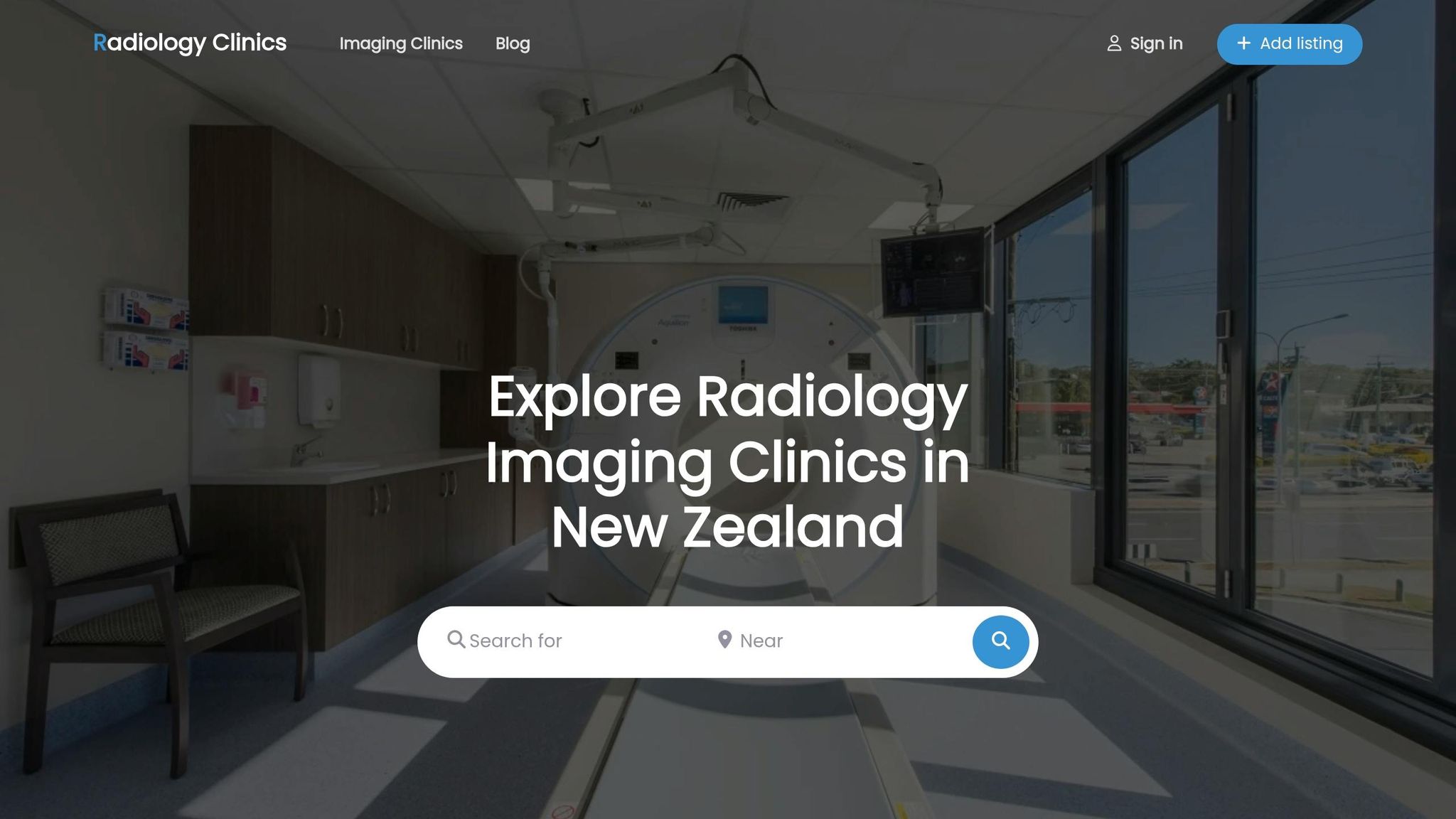
If you’re having a hard time booking a scan, an online directory can be a game-changer. Radiology Clinics NZ lists 252 imaging providers nationwide, including 29 Accident & Emergency centres, 24 ultrasound clinics, and 22 hospital-based services. Whether you’re in Auckland, Hamilton, Wellington, Christchurch, or Dunedin, this directory gives you a clear overview of imaging services nearby. It’s a handy way to find the right clinic for your specific scan needs.
How to Search Radiology Directories
To get started, filter your search by the type of scan you need – MRI, CT, ultrasound, mammography, or bone density testing. Then, narrow it down further by entering a kilometre radius from your location. Once you’ve found potential clinics, check if they offer online booking tools to view available dates and times. For urgent needs, some clinics even allow walk-ins for services like X-rays or non-contrast CT scans.
Why Comparing Providers Helps
After identifying possible clinics, comparing them can make your decision easier. Patient reviews offer valuable insights into what you can expect. For instance, Pacific Radiology in Porirua has a stellar 5.0/5 rating, with patients highlighting the "lovely, funny, and efficient" staff. Similarly, Linda Wong, a patient at Greenlane Clinical Centre, shared:
"Staff at the Greenlane Clinical Centre Radiology Dept delivered excellent customer service in the communication lead up and on the day care".
However, some reviews mention issues like long phone wait times or appointment delays. By weighing feedback, you can choose a provider that matches your preferences – whether that’s friendly service, a convenient location, or shorter wait times. This thoughtful approach could help you secure an appointment faster than relying solely on a referral.
What to Prepare Before Your Appointment
Getting Ready for Your Scan
To ensure your appointment runs smoothly, it’s important to have everything ready ahead of time. Start by gathering all necessary documents. A referral from your healthcare provider is required – self-referrals aren’t accepted for radiology services. For MRI scans, this referral must come from a specialist. If your provider hasn’t sent the referral directly to the clinic, take a photo of it and upload it to the clinic’s portal. If your referral came from a public hospital, the radiology department should already have your details on file, but it’s a good idea to double-check by calling them.
Make sure to bring your appointment letter and, if relevant, your Community Services Card. If you’re using private health insurance, keep your membership number handy when booking. Arrive 10–30 minutes early to allow time for paperwork and safety checks. For MRI scans, you’ll be asked about any metal implants, tattoos, and your medical history. If a contrast agent (dye) is needed for your scan, you’ll also be required to sign a consent form before the procedure.
Preparation can vary depending on the type of scan. For gallbladder or upper abdomen scans, fasting for six hours before the appointment is necessary. If you’re having a renal, bladder, or pelvic scan, drink three to four glasses of water an hour before your appointment so you arrive with a full bladder. Wear loose, comfortable clothing without metal zippers, buttons, or underwires to avoid needing to change into a hospital gown. Let the staff know immediately if you are pregnant, breastfeeding, have kidney issues, or have a history of allergic reactions to contrast agents.
Once your documents are ready and you’re familiar with any specific preparation instructions, it’s also important to know what to do if you need to reschedule.
How to Reschedule If Needed
If you’re feeling unwell with Covid‑19 or flu‑like symptoms, stay home and call the clinic to reschedule. The same applies if you are pregnant, recently tattooed (within six weeks), or develop any condition that makes it difficult to lie flat. Canopy Imaging advises:
"For safety reasons we may not be able to perform your procedure on the day if we have not already referenced your referral form".
Additionally, if your scan involves sedation or a steroid injection, you’ll need to arrange for someone to drive you home, as driving may not be safe for up to 24 hours after the procedure.
Conclusion
Getting a scan appointment doesn’t have to mean waiting for months. The solutions outlined here – asking your GP to upgrade your priority, exploring public hospital radiology services in other regions, booking with private providers, using telehealth for assessments, and searching directories like Radiology Clinics NZ – offer practical ways to take charge of your healthcare journey.
These approaches are particularly relevant in a system facing heavy demand. With 102,446 patients on radiology waitlists nationwide as of March 2025 and an annual demand growth of 6.5%, being proactive is crucial. If your symptoms worsen during the wait, it’s essential to contact your GP immediately. Wendy Langlands, Group Director of Operations at Taranaki Base Hospital, highlights the importance of acting quickly:
"If you experience a change in symptoms while waiting for a result, [we] urge them to contact their GP, who can directly call a duty radiologist to speed up the reporting process."
The healthcare system is adapting, with ongoing government investments aimed at improving access to radiology services and easing financial constraints. New national clinical criteria now enable GPs to directly refer patients for CT, ultrasound, and X-ray scans without requiring specialist approval. A pilot programme run between 2018 and 2020 by ACC, ProCare, and Mercy Radiology demonstrated promising results, cutting MRI wait times from 23 days to 12.4 days.
By staying informed and taking proactive steps – whether that means asking your GP for a priority upgrade, exploring private providers, or even travelling to a nearby region with shorter wait times – you can navigate the challenges of the radiology system more effectively. Options like subsidised telehealth consultations, available for $25.00 with a Community Services Card, can also help make healthcare more accessible. As Health New Zealand underscores:
"Improved access to timely and effective radiology is critical to providing high quality care, reducing waiting times for treatment and improving outcomes".
Take the time to review your options and make informed decisions to ensure you’re getting the care you need, when you need it.
FAQs
How do I know if my scan referral should be urgent?
Your scan referral might be marked as urgent if it aligns with certain clinical factors, such as suspected severe conditions, intense pain, or the possibility of a condition worsening. For example, urgent obstetric ultrasounds are typically required in situations like advanced pregnancy complications or suspected miscarriage, especially if accompanied by symptoms like bleeding and pain.
It’s essential to talk openly with your healthcare provider about your symptoms. They’ll evaluate the urgency of your situation using national guidelines and your specific health condition.
Can I use my public referral in a different region?
Yes, you can use your public referral in other regions of New Zealand. Although the country is divided into several regions, the national criteria for radiology referrals are in place to ensure consistent access to services across all areas. This approach helps maintain uniform healthcare standards no matter where you are.
Will ACC or insurance cover a private scan?
Yes, ACC might cover the cost of private scans if they are directly related to an injury, including diagnostic tools like MRI or CT scans for accident-related issues. However, scans for conditions unrelated to injuries, such as chronic illnesses or diseases, are usually not included. Be sure to review your insurance policy for detailed terms, as coverage specifics can differ.
Related Blog Posts
- Understanding Radiology Wait Times in NZ: A Guide
- Public vs Private Radiology: Comparing Your Options
- Guide to Patient-Centred Radiology in NZ

Leave a Reply